Friday, 8 March 2019

Solo Female Travel in Colombia — Is It Safe?

Is it safe for a woman to travel alone in Colombia? I wanted to find out for myself. One of the main reasons why I traveled to Colombia alone was to report for you, dear readers, on what it was like to experience the country as a solo female traveler.

I visited Colombia for just under three weeks and explored Cartagena, Medellín, Guatapé, El Peñol, Salento, the Valle de Cocora, Bogotá, and Zipaquirá. In a single trip I hit up most of the major tourist destinations in the country.

Tell your family that you’re going to Colombia, though, and they’ll probably freak out. “It’s not safe!” is usually the first thing out of people’s mouths. And it’s understandable why they would say that — for many people, drugs, kidnappings, and Pablo Escobar are the first things that come to mind when you mention Colombia.

But it’s not like that anymore. Colombia is exponentially safer today than it was in the 1990s.

I have a lot of friends who are hardcore travelers, and almost everyone I know who has been to Colombia considers it one of their favorite countries. That’s huge. I can’t think of any other country that earns such universal praise. Maybe Japan.

So I went to Colombia on my own — and I had a blast. Most importantly, I stayed safe. I don’t quite consider Colombia one of my favorite countries, but I had a wonderful time there and I encourage travelers to check it out.
First of all: it’s not the 1990s anymore.

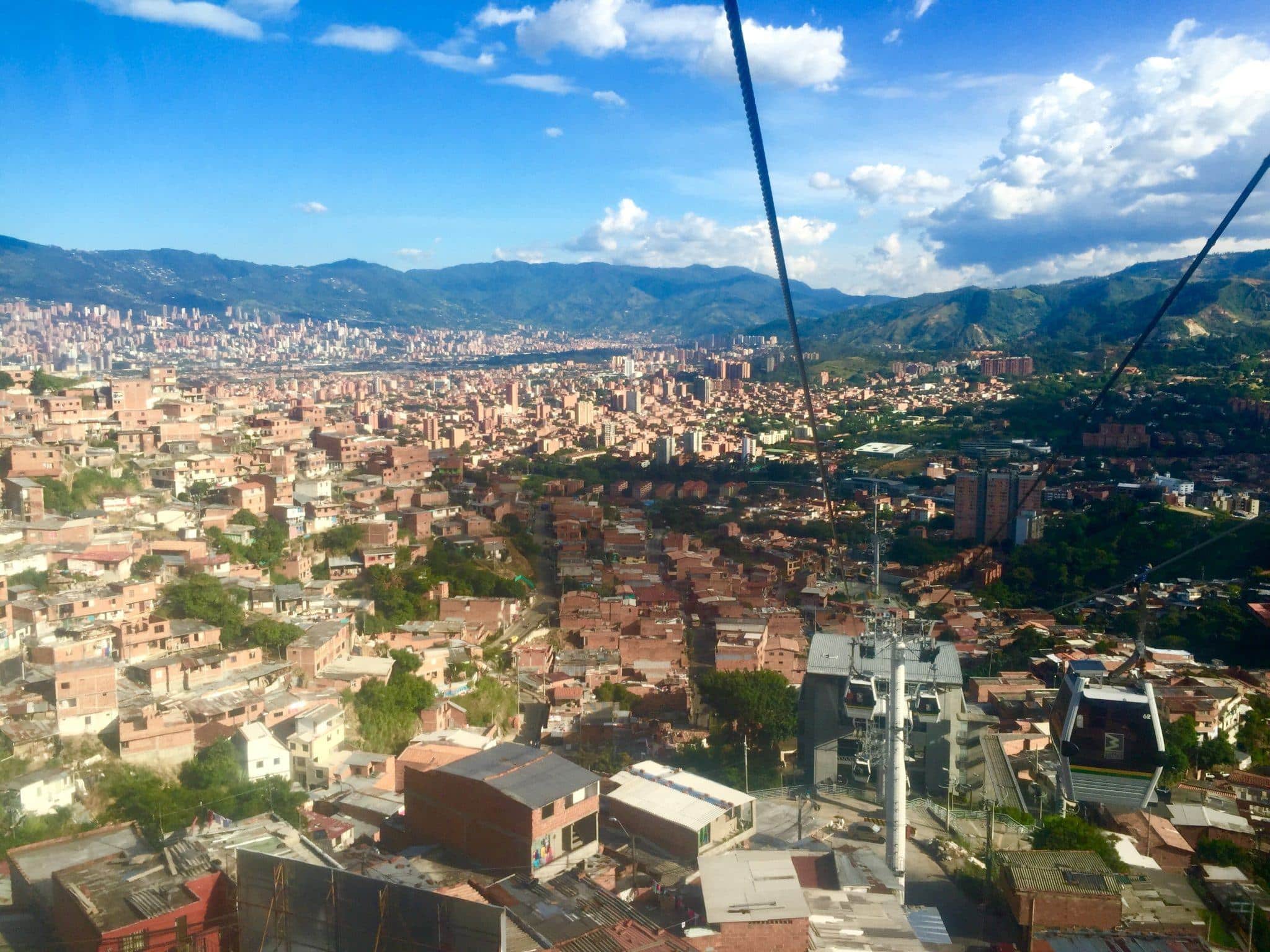
In the mid-90s, Pablo Escobar was king and Medellín had one of the highest murder rates on the planet. Today, digital nomads from around the world flock to Medellín to enjoy its year-round spring-like weather and lively nightlife.

Conflict casts a long shadow. I’ve found that 90s conflicts in particular tend to be brought up today. Many people I’ve talked with about my travels were worried that the Khmer Rouge is still fighting in Cambodia, that bombs are falling in Bosnia, or that South Africa is still in chaos post-apartheid. These were all major conflicts that happened during the 90s, but are nonissues today.

Cable news doesn’t report anything when things are good. And for that reason, many people today still associate Colombia most strongly with drugs, cartels, murders, and kidnappings.

Today, things are different. Year after year, Colombia has become more peaceful. Kidnappings decreased by 90%. Now Peru produces more drugs than Colombia. Gun violence in Colombian cities is much lower than many American cities. And in 2016, Colombia’s government ratified a peace deal with the FARC, the country’s largest rebel group and the group behind many kidnappings. This was a major step in establishing long-lasting peace.

Something to keep in mind is that the 1990s were 20 years ago. Where were you 20 years ago? The world has changed a lot since then, and so has Colombia.
Is Colombia Safe for Solo Female Travelers Today?

That’s where things get a bit more complicated. I had a perfectly safe solo trip to Colombia — nothing remotely bad happened to me. I was also intensely cautious, and perhaps a bit lucky.

When you’re a woman traveling alone in Colombia, you will hear lots of anecdotes from other travelers. There are women who had a safe time and will say, “Don’t worry, Colombia’s fine, nothing happened to me!” And then you’ll hear from other women who will say, “I know so many people who got robbed there.”

Think about Colombia like Yelp reviews. People who had a bad experience will assume that everyone else’s experience was awful. And people are going to rave and think that everyone who had a less-than-perfect experience was an idiot. The job is sifting through the reviews and trying to find a common narrative.

Here’s the narrative — even experienced travelers can fall victim to crime in Colombia, and they often do. And for that reason, I’m not going to say that Colombia is perfectly safe because I happened to have a perfectly safe trip there. It’s more nuanced than that. Colombia requires extra precautions, and this post will go into detail on which precautions to take.

Most of the guides I’ve read for women traveling alone in Colombia shockingly underplay the dangers. I think that’s wrong.

My job is to teach women how to stay safe while traveling the world. I take that responsibility seriously. I understand the temptation to tell women that Colombia is much safer than people think it is — and it is — but it shouldn’t be done at the expense of failing to mention the realities of traveling here.
 

Traveling Solo in Colombia Requires Extra Precautions

I’m going to quote a few lines from Travel.State.gov, the US government’s guide for traveler:

Terrorism: The National Liberation Army (ELN) and dissident groups from the Revolutionary Armed Forces of Colombia (FARC) continue plotting and executing attacks in Colombia.

Crime: Crimes and scams against unsuspecting tourists are common in urban areas. Firearms are prevalent in Colombia and muggings or robberies can quickly turn violent…Robberies by people riding motorcycles are common in all major cities. U.S. citizens have been robbed by individuals posing as police officers. U.S. citizens reported sexual assaults in several different cities throughout Colombia.

ATMs: People are sometimes robbed after using automated teller machines (ATMs) on the street. Use ATMs inside shopping malls or other protected locations.

Taxis: U.S. citizens have been killed during robberies while using taxis, most recently in September 2015 in Medellin. Use telephone or internet-based dispatch services whenever possible.

Disabling Drugs: Criminals may use drugs to temporarily incapacitate unsuspecting victims and then rob or assault them.

While the majority of travelers to Colombia visit without incident, there is still quite a bit of crime that happens. Even so, the majority of crimes that happen against tourists are petty crimes (like pickpocketing and robberies), which you can guard against.

One thing that is scary is the use of disabling drunks like scopolamine. Scopolamine, also known as Devil’s Breath, is a powdered drug that disorients you when you breathe it in. (Yes, it’s the same name as the motion sickness patch.) Criminals distract you, blow the drug on you or put it in your drink, and then they rob you, convince you to empty your bank accounts, and you’ll have no memory of it the next day. Vice did a documentary about scopolamine here.

Kidnapping today is far rarer than it used to be in the 90s, but it does still happen. Most of the time, it happens in areas where tourists are told not to go — like the Darién Gap. You can reduce your risk by sticking to the beaten path in Colombia and flying Viva Colombia for longer overland journeys (see more on that in the Travel and Safety Tips for Colombia section.)
Is Colombia Good for First-Time Solo Female Travelers?

I do not recommend Colombia for first-time solo female travelers. This is a destination that requires a lot of expertise and it’s not the kind of place where you want to try solo travel for the first time. The only exception would be for someone who has already traveled extensively and/or lived in Latin America and speaks decent Spanish.

Instead, I encourage first-time solo travelers to book a group tour to Colombia.

G Adventures offers more than a dozen tours to Colombia. I have traveled with G before and recommend them, as they employ local guides, focus on sustainability, and keep their tour sizes small. They’re a lot of fun, too! Here are some of their Colombia tours:

If you’re looking to plan your first solo trip ever in Latin America, I recommend choosing Mexico or Central America rather than Colombia. Costa Rica and Belize tend to be the easiest for first-timers, followed by Mexico and Guatemala.


READ MORE:

Solo Female Travel in Mexico: Is it Safe?
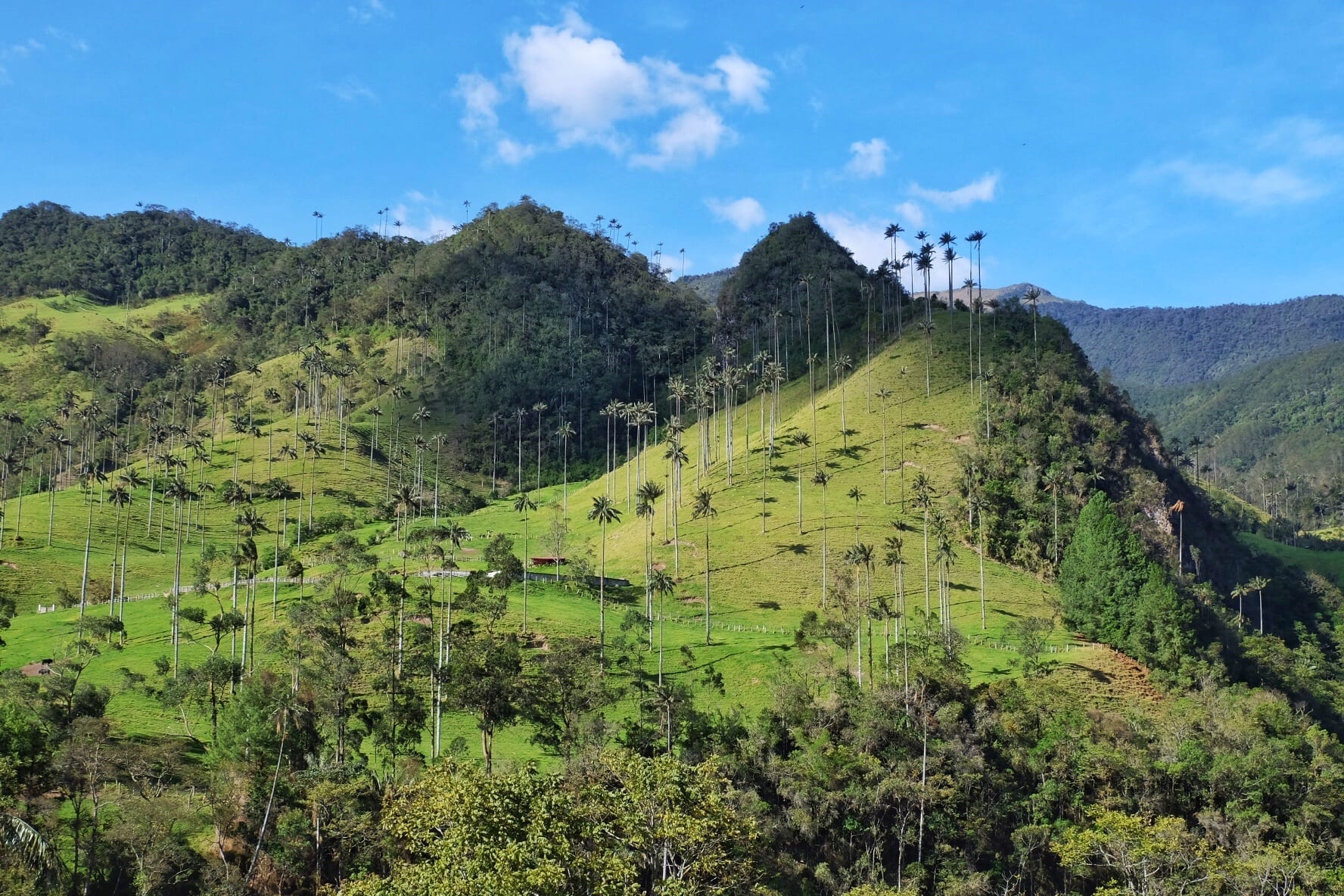

Is Colombia Good for Experienced Solo Female Travelers?

Yes, I definitely recommend Colombia for experienced solo female travelers. I visited as an experienced solo traveler and it was a good level of challenge for me, especially with the language barrier.

I do recommend you to take a lot more precautions than you would ordinarily. While in Thailand or Italy or even Guatemala, you might be comfortable wandering around solo at night, or taking a long walk by yourself in a deserted area, or taking the metro to a random stop and getting off, just to see what’s there.

Those are all things I wouldn’t recommend in most of Colombia. Instead, I recommend that you team up with other travelers as often as you can.

Arriving on a flight with some foreigners? Ask them if they want to share a taxi to town. Hear people at the hostel wanting to visit a coffee plantation? Ask if you can join.

As an introvert, I agree that walking up to a group and introducing yourself is the stuff of nightmares, but it’s much easier once you actually do it. Most people are very nice and I’m always glad I joined a group. I made more friends than usual in Colombia.
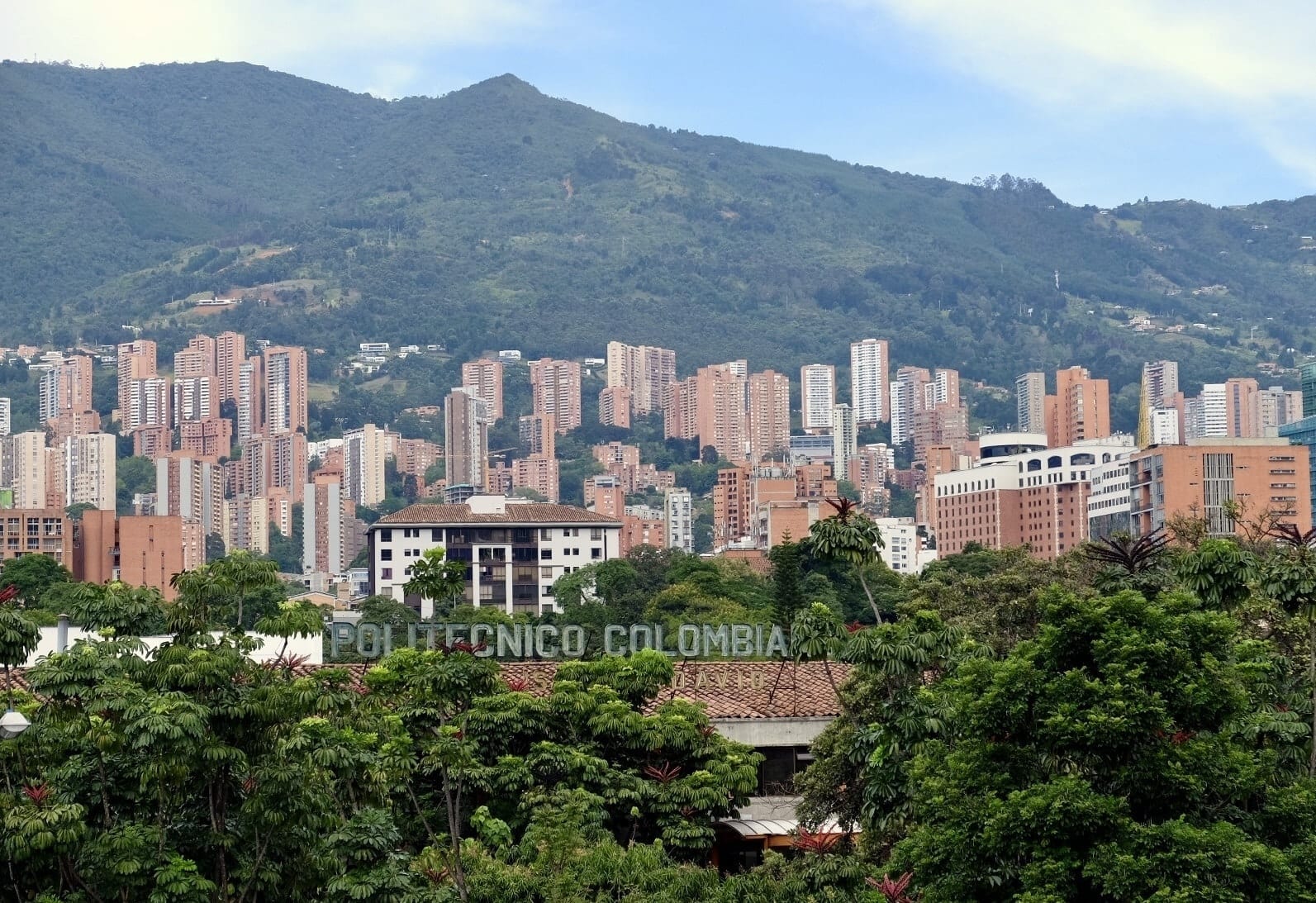
Is Colombia Good for Female Digital Nomads?

There are lots of digital nomads and remote workers living in Colombia — in Medellín in particular. Many of my friends have lived in Medellín on a short- or long-term basis, and all but one of them are male. That’s curious, considering that the travel blogging industry is dominated by women (I’d estimate it’s around 70% women).

On the surface, Medellín looks great for digital nomads. There’s a big expat scene, the internet is pretty good, there are lots of cafes for working, it’s affordable, and you’ve got that year-round springtime climate.

But in addition to that…there’s a reason why *cough* STRAIGHT! *cough* men love living here.

The local women in Medellín are gorgeous, it’s common for them to have breast and/or butt implants, and they love to date foreign men. Basically, if you’re a mediocre guy from the States, you can immediately have a smoking hot girl on your arm, short-term or long-term.

And it’s just not the same situation for foreign women. Not that foreign women don’t like Colombian men, but it’s not like dynamics are the same between local men and expat women.

Like the rest of Colombia, Medellín is a place where you need to constantly think about safety. As a woman, you’re constantly weighing whether it’s too dark to walk a few blocks home safely. Living in that environment, day in and day out, is exhausting. (It’s the same reason why I love South Africa but would never want to live there.)

And when you compare safety between Medellín and other digital nomad cities like Berlin or Chiang Mai or Mérida or Lisbon, there’s just no comparison. Medellín is the only place where women need to constantly be on their guard, where walking at night for even short distances can be questionable.

So yes. Medellín does have some positive attributes for people who work remotely, but if you’re not interested in dating the local women, I think its “digital nomad heaven” reputation is overblown.
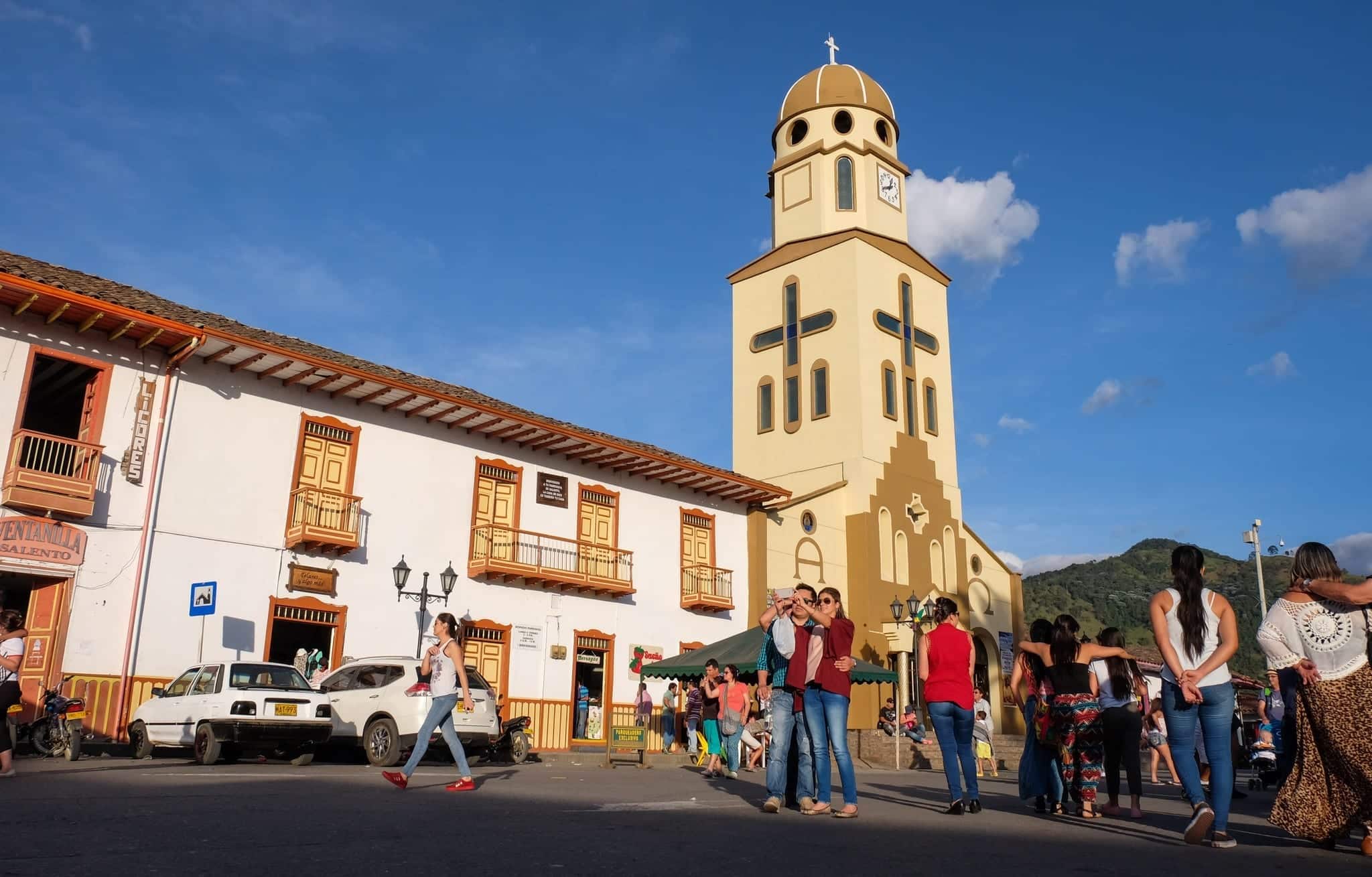
Travel and Safety Tips for Colombia

Most of staying safe in Colombia comes down to using common sense. Don’t get blackout drunk, keep an eye on your belongings, be careful who you trust. And it is very important to know some Spanish before you visit Colombia (see more on that in the next section).

Get a SIM card from Claro. Having a SIM card gives you the option to hail Ubers, and Claro has good coverage throughout Colombia. I got my SIM card from a shopping center in the Gethsemane neighborhood of Cartagena. Bring your passport and it helps to know some Spanish, even if it’s something simple like, “Estoy aquí en Colombia por diez días y quiero cuatro gig de internet.”

Uber exists in many Colombian cities — use it. Colombians will tell you to take Ubers instead of hailing random cabs. Plus you can stay inside until your ride arrives. Uber operates in Bogotá, Cartagena, Medellín, Calí, and Baranquilla. UberBLACK will get you a black car, but I honestly saw no difference in quality between regular Uber and UberBLACK.

Look into the budget airline Viva Colombia. I was shocked that some of the prices weren’t much more than the cost of a bus, even when booking a few days out! It’s a good way to travel across routes that aren’t safe to do overland.

Some journeys are not safe to do overland. And this can change on a dime. Why? Because sometimes buses are robbed — especially public buses. My advice is to ask the person at your guesthouse, or another local, whether it’s safe to travel by land to your next destination. Some more cautious people decide to omit overland journeys overland altogether and fly Viva Colombia whenever possible.

Don’t take the bus at night. Keep your long journeys restricted to daytime hours.

Don’t put yourself in isolating situations. One example of this was when I wanted to visit a coffee plantation in Colombia. I was told that it would be a short, 30-minute walk from Salento down a road, but I ended up teaming up with people from the hostel and hiring a jeep. It turns out that the journey would have taken far longer than 30 minutes and I would have spent a long time as a woman alone with nobody else around, leaving me susceptible to sexual assault.

Don’t flash your valuables or wear expensive jewelry. If you’re out taking photos with an expensive-looking camera, be extra cautious. Only take out your camera and phone when you need them — don’t walk around absentmindedly with them in your hand.

Pickpocketing happens in Colombian cities, especially on public transportation. Keep an eye on your belongings at all times.

If you carry a purse, hold it close to you. I recommend a crossbody purse, made out of a tough material like leather or fake leather, that zips shut. I recommend many purses in this post. Never let it hang behind you — always keep it in a place where you can see it, and keep your hand on it if you’re in a crowd.

If you carry a wallet without a purse, don’t keep it in your back pocket. This is obvious to thieves and they will grab it and run.

If you use a small backpack, lock it. I use a Pacsafe backpack where you can lock the compartments shut.

Keep your valuables locked up in your accommodation and only take with you what you need that day. I do this with my Pacsafe Travelsafe and I consider it the most important thing I pack. Keep an extra debit card and at least $100 hidden in obscure parts of your luggage.

Never leave your bags anywhere unattended. Even if you’re used to asking someone to watch your things while you use the bathroom in a coffeeshop at home, don’t do that in Colombia. Take your belongings with you. If you’re keeping your bag under the table or otherwise out of sight, keep it between your feet or hook the strap around one of the chair legs.

Don’t carry tons of cash around with you. You can use credit cards at many places in Colombia, especially in the cities, and carrying lots of cash leaves you vulnerable to theft. Don’t be the traveler who loses her wallet and the $500 in it.

Only use ATMs at banks during the day, indoors. Don’t use standalone ATMs in convenience stores. Not only do they leave you susceptible to robbery, if your card gets eaten, it’s a lot easier to retrieve it from a real bank’s ATM. If you can’t find a bank, use an ATM in a shopping mall.

The water is safe to drink in Colombia’s major cities. Smaller towns are more of a gamble — ask the locals whether they drink the water or use bottle water. While most travelers in Colombia rely on bottled water, it creates a major waste issue. For this reason, I recommend you bring a reusable bottle and invest in a SteriPen water purifier (much better and faster than tablets). Alternatively, you can bring a LifeStraw, a bottle that purifies water as you drink it through its straw.

Be prepared for street harassment. Street harassment happens all over the world, but especially in Latin American countries where machismo reigns. Honestly, I didn’t find Colombia to be the worst — it’s far worse in Argentina and Nicaragua —  but it will happen with regularity when you’re alone. The comments, the catcalls, the hisses.

The single best thing you can do is ignore it. These men are looking for a reaction. And 98% of the time, it doesn’t escalate into anything worse. If you feel nervous, go into a shop or restaurant and call an Uber or wait for them to leave.


If someone robs you, GIVE THEM WHAT THEY WANT. Nothing is worth your life.

Parts of Colombia are at high altitude and it takes some getting used to. Bogotá is especially high at 8,660 feet. When you’re at a higher altitude, you’ll exhaust yourself doing normal things like climbing stairs, and — THIS IS IMPORTANT — you’ll get drunk much faster. If you’re going from a low elevation to a high elevation in a day, take it easy on the first day. If you go from Cartagena to Medellín to Bogotá, you’ll slowly progress in elevation.

Malaria is present in most of Colombia, excluding high altitude areas like Bogotá. This is the Colombia malaria map from the Center for Disease Control in the US. Some travelers choose to take malaria pills and some choose not to. I’m not going to tell you what to do because that’s a conversation you and a medical professional should have. I recommend seeing a travel doctor.

The zika virus is also present in Colombia. Here is a map. Zika should be a concern of pregnant women, partners of pregnant women, and women who intend to become pregnant soon, but if you’re none of those things, you don’t need to worry. Bogotá is at a high enough altitude that mosquitos are not present and zika is not a factor. Again, this is a conversation to have with your doctor.

Bring motion sickness medication. You will probably be driving through some mountainous areas. I felt nauseous as hell on my four drives into and out of Medellín, which is surrounded by mountains. I recommend meclizine (the generic version of non-drowsy Dramamine).

Be careful about your drinking. Drink less than you ordinarily would at home — two drinks is a good limit. Only take drinks from bartenders, never take a drink from a stranger, and always keep it with you and keep an eye on it. Keep in mind that you get drunk faster when at a high elevation.

Spend extra money on staying safe. If it costs you money to take an Uber rather than the metro, or to stay in a hotel in a nicer neighborhood, do it. It’s worth the peace of mind. Don’t pinch pennies on your safety.

Don’t go on cocaine tours. There are some backpacker tours in Colombia that will take you to cocaine processing facilities (!!) — surely created to capitalize on Colombia’s dangerous reputation. Honestly, why would you even do this?!

Get a digital guidebook and keep it on your phone. Even today, I always keep a guidebook PDF on my phone — it’s great for calculating approximate time of journeys, knowing what days places are closed, and it lists medical centers you should go to in case of emergency. I’m a big fan of Lonely Planet guidebooks — get the digital version of Lonely Planet Colombia, or if you want to save money, just buy the Colombia chapter of Lonely Planet South America on a Shoestring.

Most importantly, you have no obligation to be nice to anyone. Women often feel the need to be nice and please people at all costs. You don’t have to anywhere — especially so in Colombia. If anyone is making you feel uncomfortable, just leave. Trust me — you won’t be the rudest person they meet that day. And so what if you were? You’re never going to see them again.


READ MORE:

Top 10 Travel Safety Tips for Women
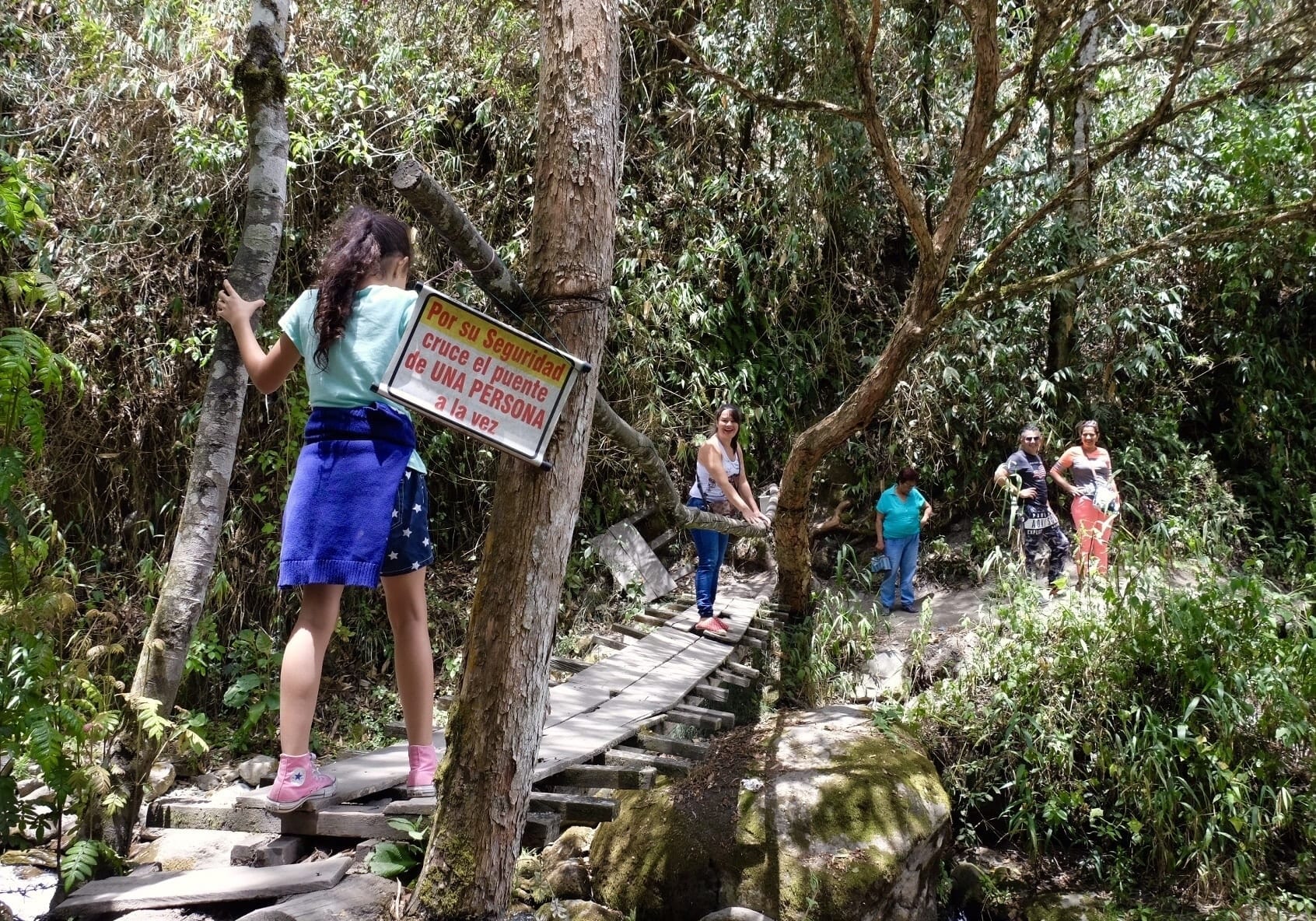

You’ll Need Spanish to Survive Colombia

It’s good to learn a bit of the local language wherever you go, but you should especially make an effort to learn Spanish before visiting Colombia. The language barrier here is significant. Even in Cartagena, the most touristy city in the country, I had to struggle through my kindergarten-level Spanish everywhere outside the walls of the old town.

I’ve traveled a lot in Mexico and Central America, where it’s easier to get by mostly in English. One example: most small guesthouses in Central America have at least one family member who can speak English well enough to communicate with guests. But in Colombia, it’s common for nobody to speak a word of English in small guesthouses.

Spend time learning Spanish before you go — at least the basics. It will make your trip so much easier. If you don’t know where to start, DuoLingo is a fun free app for language learning. You may want to get a Latin American Spanish phrasebook, too.
The Best Experiences in Colombia

There are so many wonderful things to do in Colombia. Here are a few of my favorites:

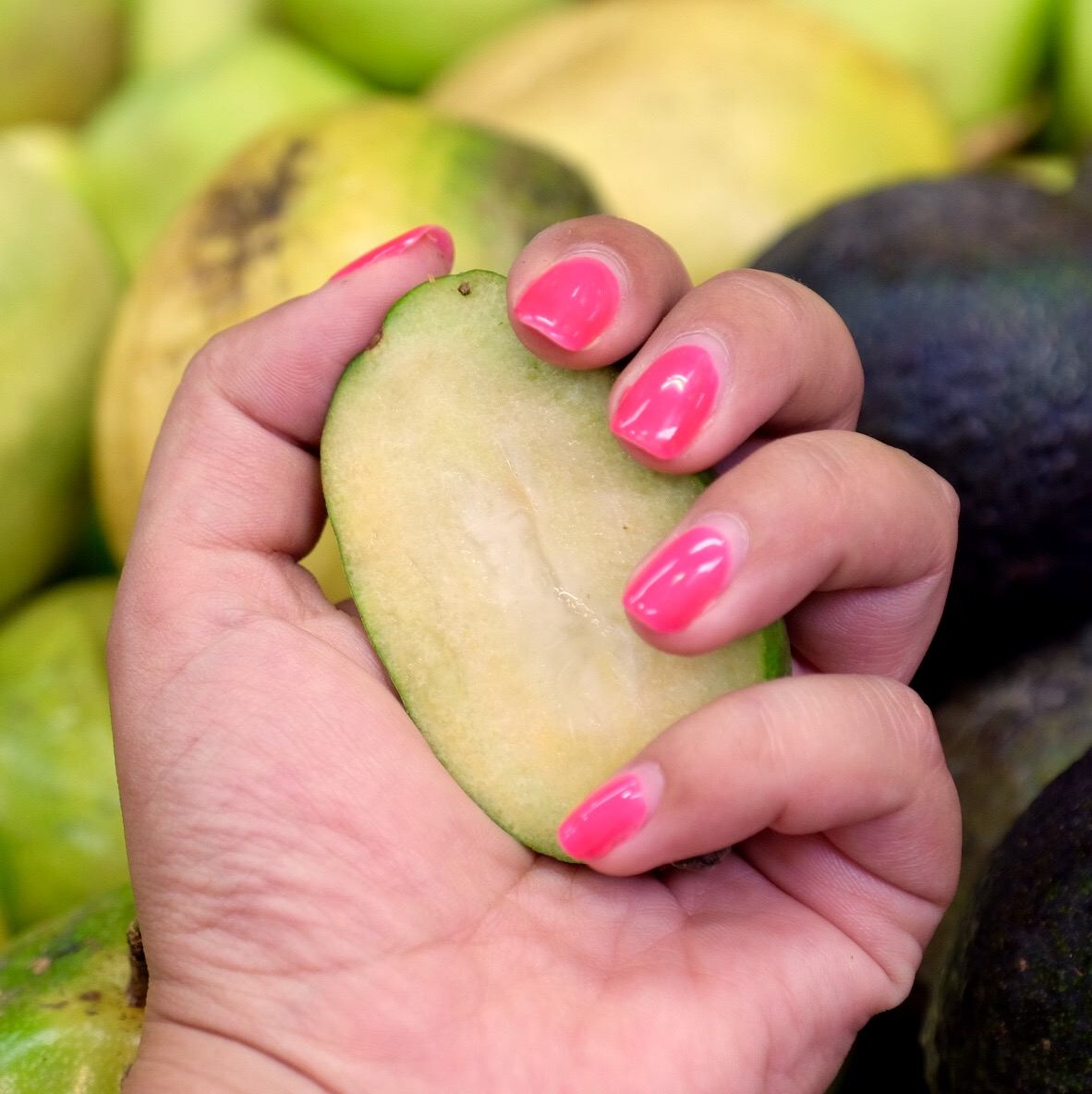
Try dozens of different fruits! Did you know that Colombia has the greatest fruit biodiversity in the world? Seriously! Take this as an opportunity to try all kinds of fruits and discover your favorites. Granadilla, lulo, and feijoa were my favorites. The single best activity I did in Colombia was the Real City Exotic Fruits Tour in Medellín. Once you do that tour, you’ll know what to ask for at fruit and juice stands.

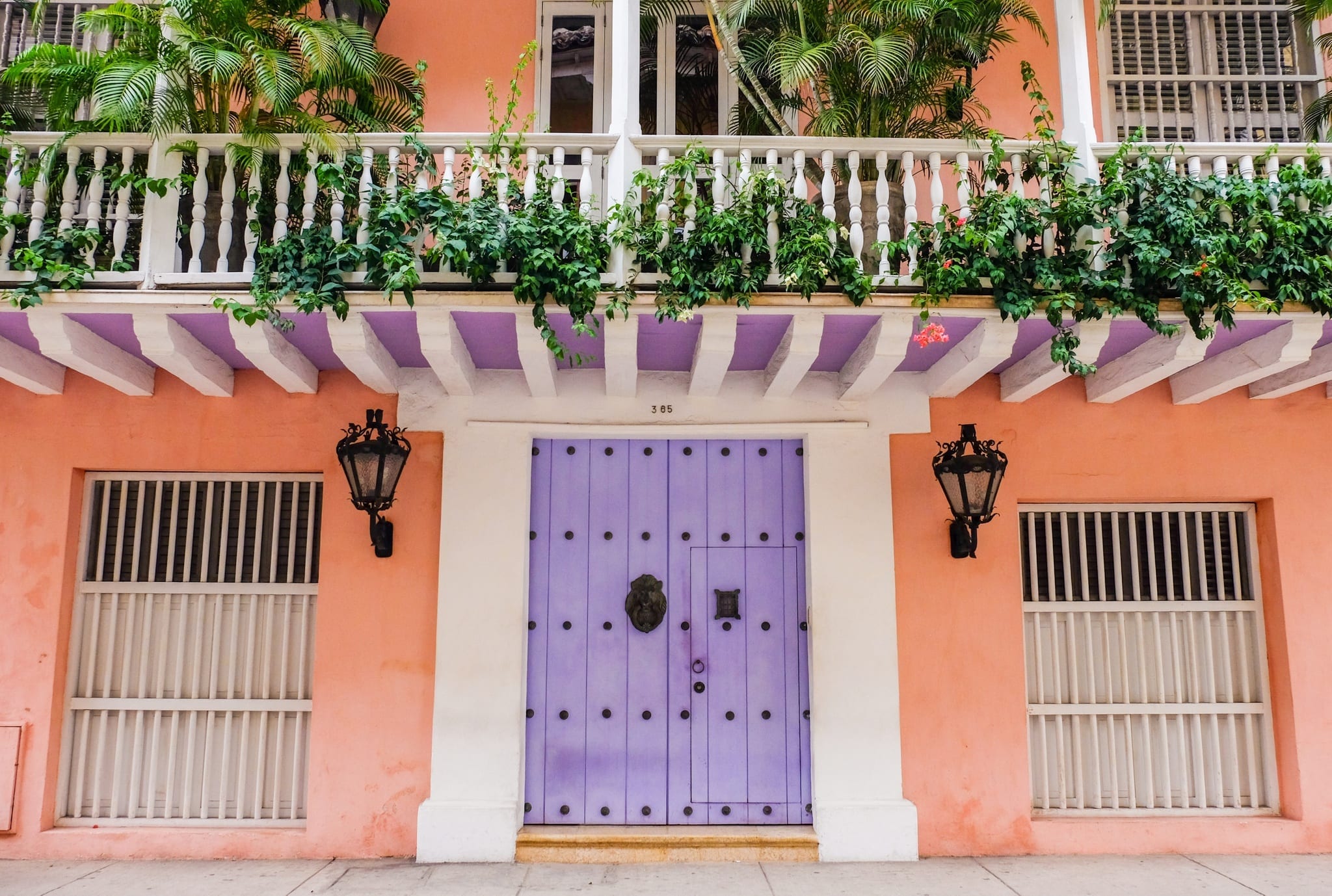
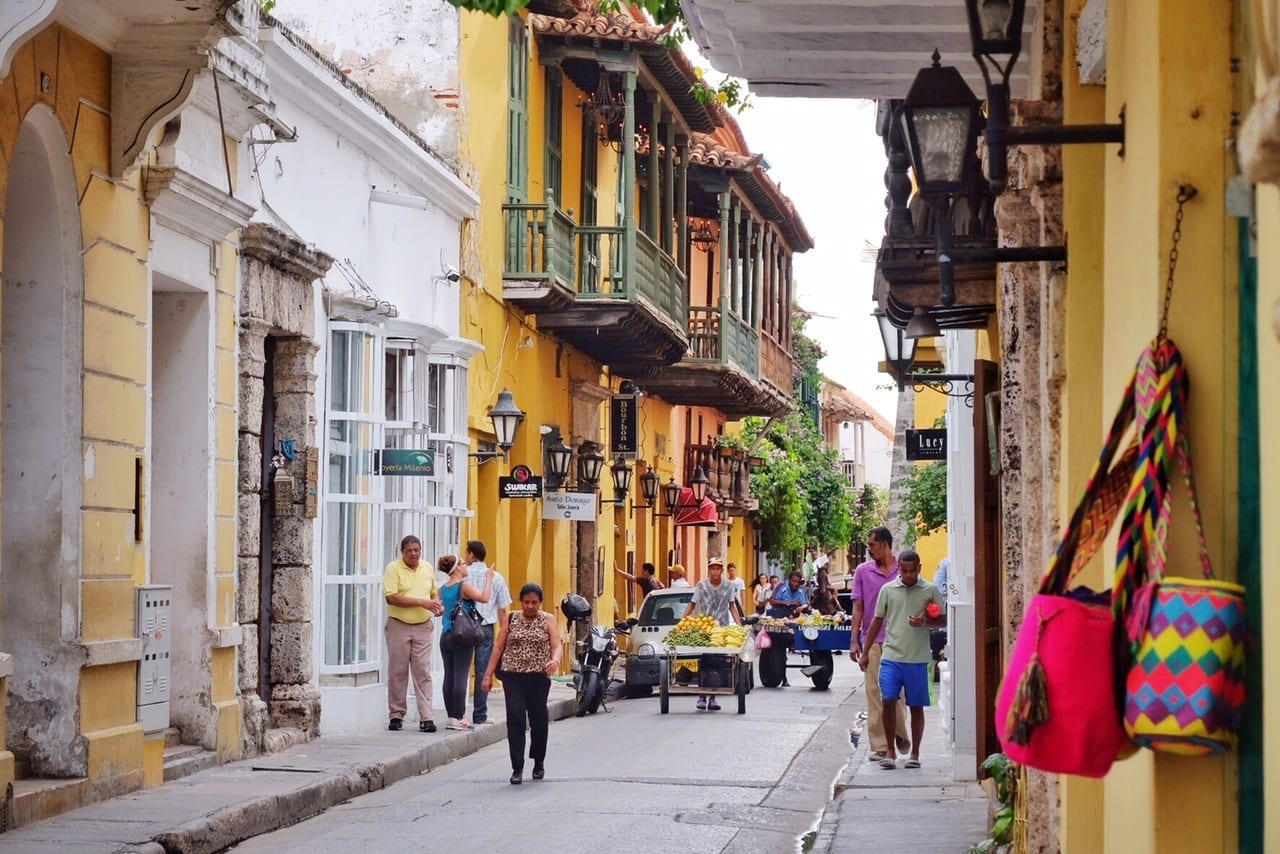
Take Instagram shots in the streets of Cartagena. Cartagena is one of the most beautiful cities in South America — and it’s made for Instagram! Spend your days walking through the streets and admiring the giant doors. And since you’re traveling solo, hire a photographer from a company like Flytographer to get great Instagram shots for you.

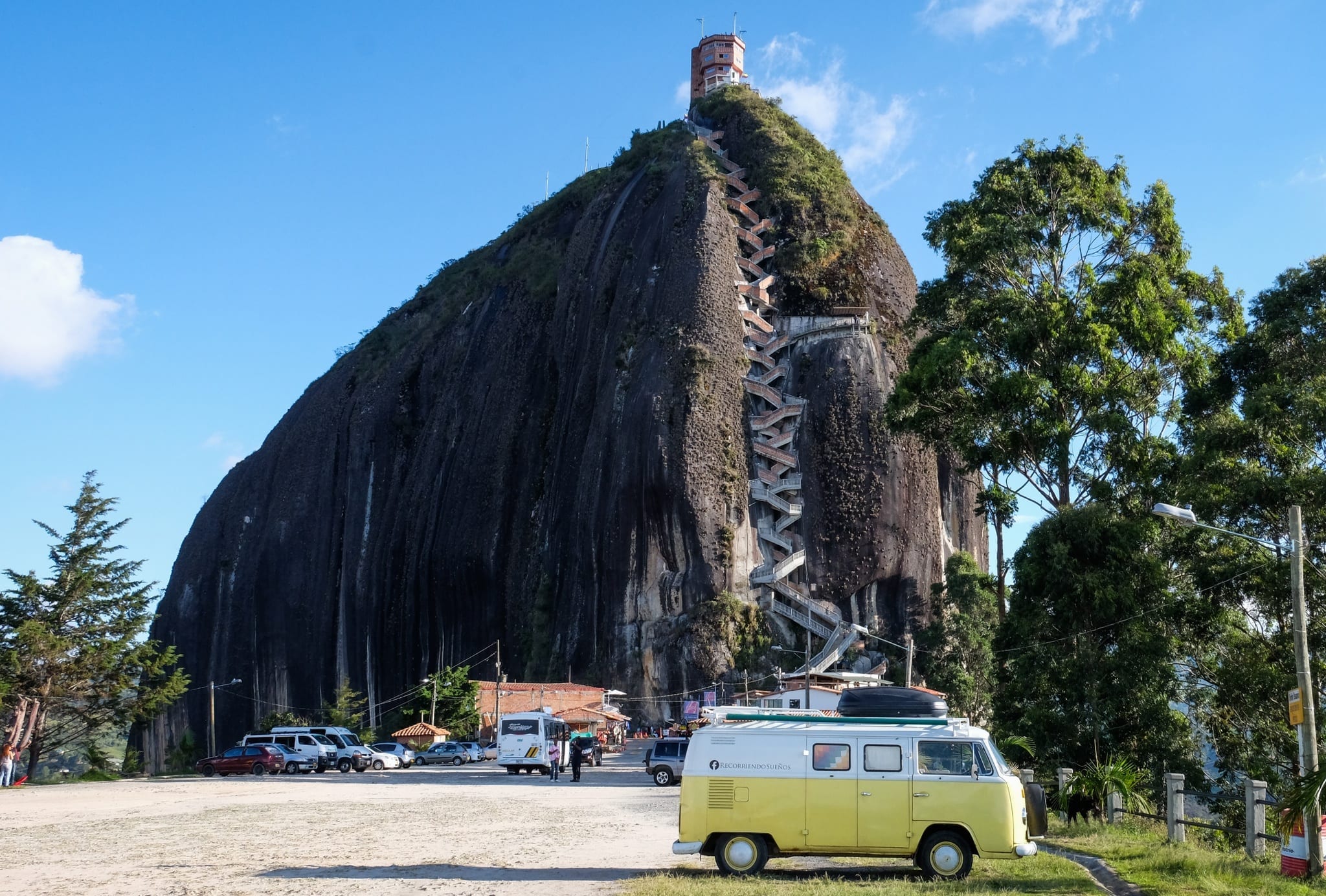
Climb the giant rock in Guatapé. El Peñon is an enormous rock in the middle of nowhere. So what are you supposed to do with it? You climb it! There’s a staircase along one of the sides. While it looks easy, you’ll soon be out of breath if you’re not used to living at this altitude — but the views at the top, of jagged lakes and islands, are so gorgeous. Book a half-day tour from Medellín here.

Climb steps and feel some Catholic guilt. Being such a mountainous country, Colombia has staircases everywhere — and quite a few of them choose to evoke the Stations of the Cross. As you’re climbing the stairs, out of breath because you’re not used to the altitude, you’ll see a sign reading Jesús cae la primera vez (Jesus falls the first time). And you’ll roll your eyes and think, “I get it, Jesus, you had it much worse.”

Explore the salt cathedral of Zipaquirá. Just outside Bogotá is a massive underground salt cathedral. The sheer size of it will blow you away — it just keeps going further and further back! I loved making the half-day trip from Bogotá. Transportation here is a bit of a hassle so I recommend booking a transfer from Bogotá to the cathedral and back. The town of Zipaquirá is lovely, too.

Finding the perfect handmade souvenir. There are lots of crafts for sale throughout Colombia, but my favorite is a wooden model of a Cartagena door that I bought in Salento. It’s white and ornate — most of the doors are colorful but I wanted to match my white-and-gray bedroom — and it’s sitting on my desk as I type this.

Dance to salsa and drink mojitos in Cartagena. One of Cartagena’s best spots for a night out is Cafe Havana. The salsa band is outstanding, the mojitos are delicious, and it’s a beautiful way to get swept up in the magic of this beautiful colonial city,

Try some coffee at the source. The Zona Cafetera is the source of much of the world’s Colombian coffee. There are lots of beautiful villages around here, but I fell madly in love with Salento. One day I made a pilgrimage to a coffee producer just outside town and I got to see coffee at every stage before it gets bagged. And of course I had to have a cup at the end — rich, dark, and right at the source.

Try a hot chocolate with some cheese in it. One of my favorite specialties in Colombia was its hot chocolate, made from rich melted dark chocolate bars — but the best part is that they give you a big lump of cheese to put in it! It sounds crazy, but the sweet-and-salty combination is just perfect.
Where to Go in Colombia

Colombia is a very diverse country and can appeal to a variety of travelers. Whether you want to dance all night in big cities or spend days trekking through the jungle far from civilization, Colombia has plenty of destinations for you.

Cartagena — This UNESCO World Heritage-listed town on the Caribbean Sea is the most touristed spot in Colombia, which makes it an ideal spot for the beginning of your trip. This beautiful town is filled with Colombia’s most beautiful architecture, including its signature giant doors. Be sure to try the Caribbean-influenced cuisine here, like ceviche and coconut rice.

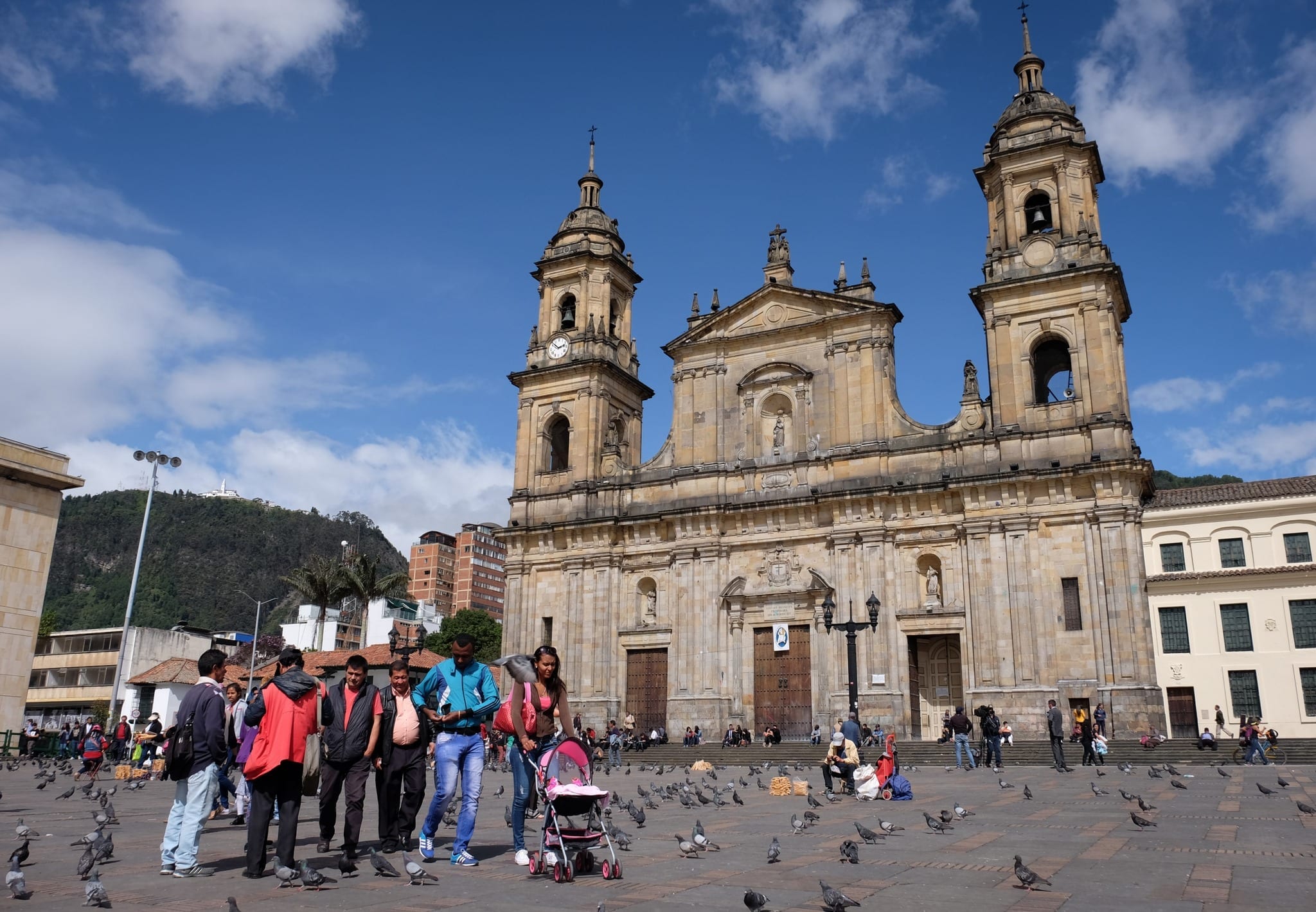
Bogotá — Colombia’s capital is a major cultural hub with tons of museums, beautiful neighborhoods, and lots of art. Don’t expect good weather, and the elevation will leave you breathless at times, but Bogotá is a fascinating city with lots to do.

Tayrona National Park — If you’ve seen an idyllic photo from a beach in Colombia, it was likely from here. Tayrona National Park is home to beaches, jungles, and hostels where you can fall asleep in a hammock to the sound of the waves.

Ciudad Perdida (Lost City) — This is Colombia’s most popular trek. Departing near Santa Marta, you’ll spend 4-6 days trekking through the jungle. It’s not as popular as the Inca Trail in Peru, but it’s getting there quickly.

Medellín — The formerly dangerous drug town of Medellín is now known as the city of eternal spring and a digital nomad hotspot. Ride the cable cars to get views around the city, go on a fruit tour to enjoy Colombia’s unique fruit biodiversity, or visit one of the many excellent museums.

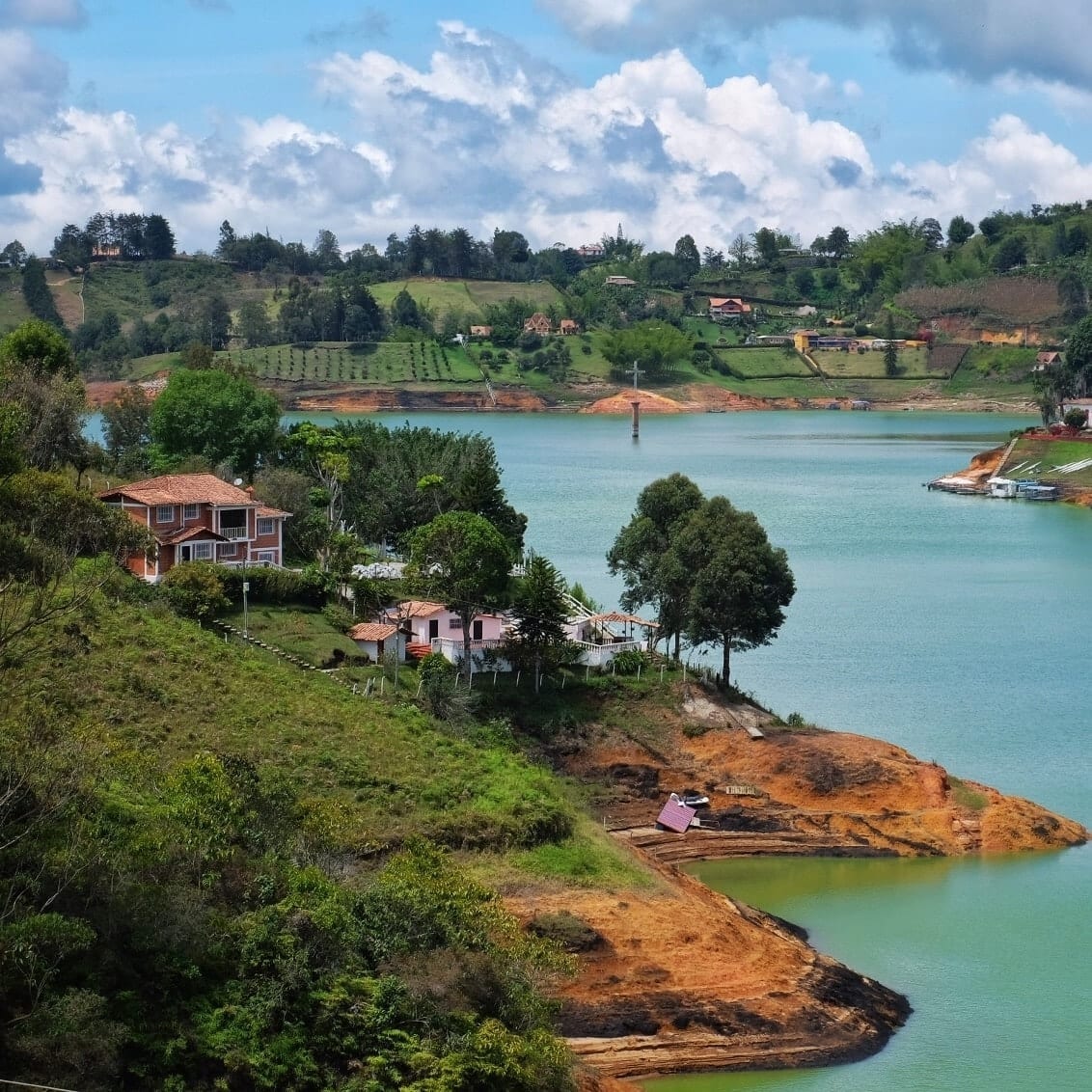
Guatapé — A colorful small town not too far outside Medellín, Guatapé is best known for El Peñon — a giant rock rising out of the ground. You can climb stairs to the top for the best view in Colombia: jagged lakes and tiny islands as far as the eye can see. Be cautious, the altitude makes this tougher than you’d think!

Salento — This is my personal favorite spot in Colombia: a small town in the heart of the Zona Cafetera, or coffee-producing region. This is a good spot to relax and enjoy the calm atmosphere. Other towns in the Zone Cafetera are worth visiting as well.

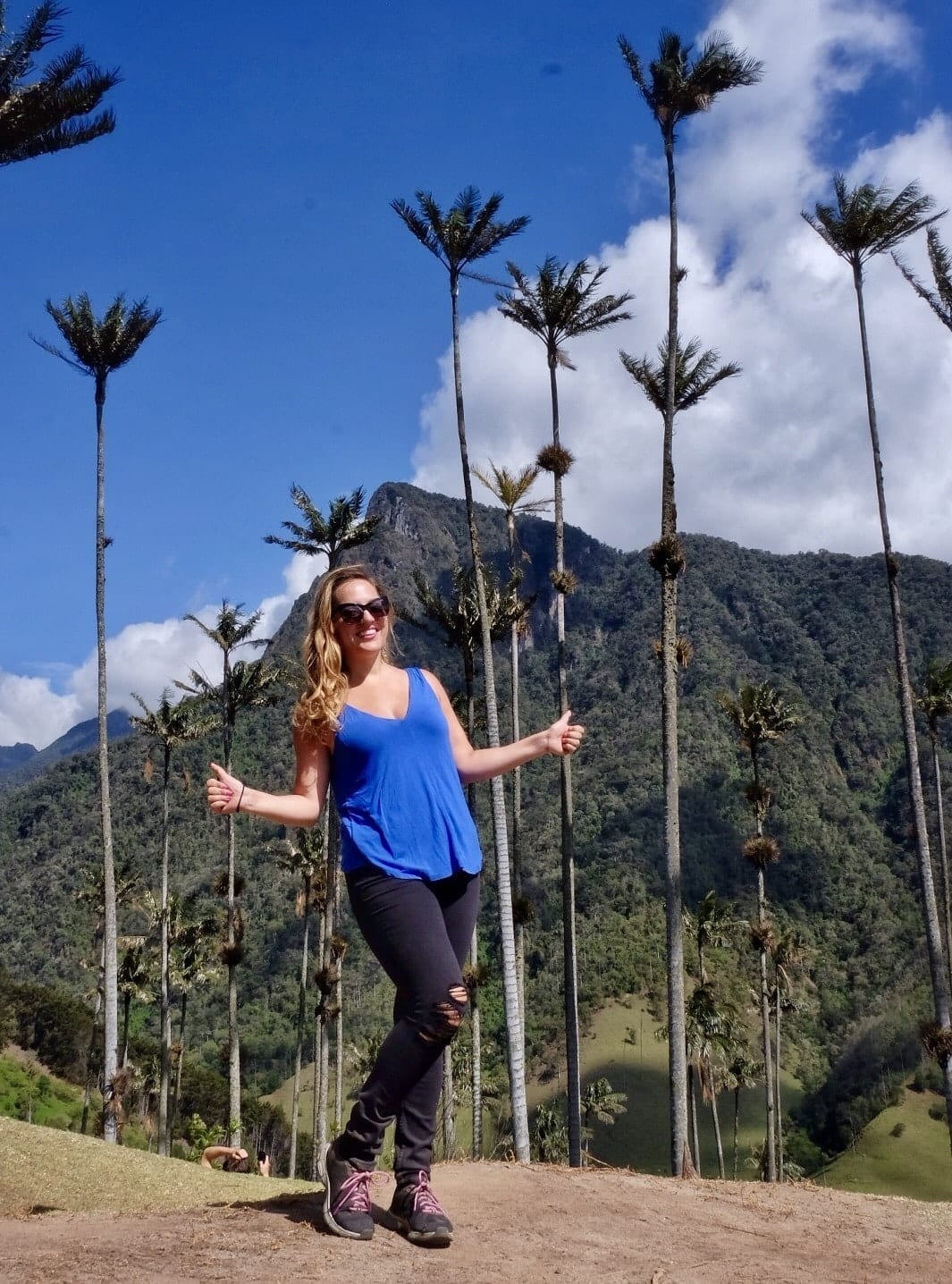
Valle de Cocora — Just outside Salento, this valley is home to hiking trails and the tallest palm trees in the world. You can go horseback riding or hiking on public or private trails (the private trails cost about $1), and you’ll get some of your best scenery photos from this region.

San Gil — A popular adventure travel destination in Colombia, people come here to hike, raft, or throw themselves off cliffs. It’s all in the name of adrenaline.

Calí — If you’re into salsa dancing in the least, this is where to go. Calí can be a bit rough, but the salsa style here is unique and unforgettable. You don’t come here to be a typical tourist — you come here to dance all night with locals. The nightlife here is legendary.

Colombian Amazon — Yes, you can explore the Amazon in Colombia! Leticia is the hub to fly into. Use this as a base to explore the beach on foot or by boat and witness wildlife the likes of which you’ve never seen.

Baranquilla — This seaside city (home of Sofia Vergara!) isn’t on most travelers’ itineraries, but you can find a lot of direct flights here from the States, and it’s home to Colombia’s biggest Carnival celebration.

San Andres and Providencia — These two Caribbean islands are closer to Nicaragua but are part of Colombia. Colombians go for the weekend for sunbathing and tax-free shopping, but once you get out a little bit, you can have white sand beaches to yourself.
How to Meet People in Colombia

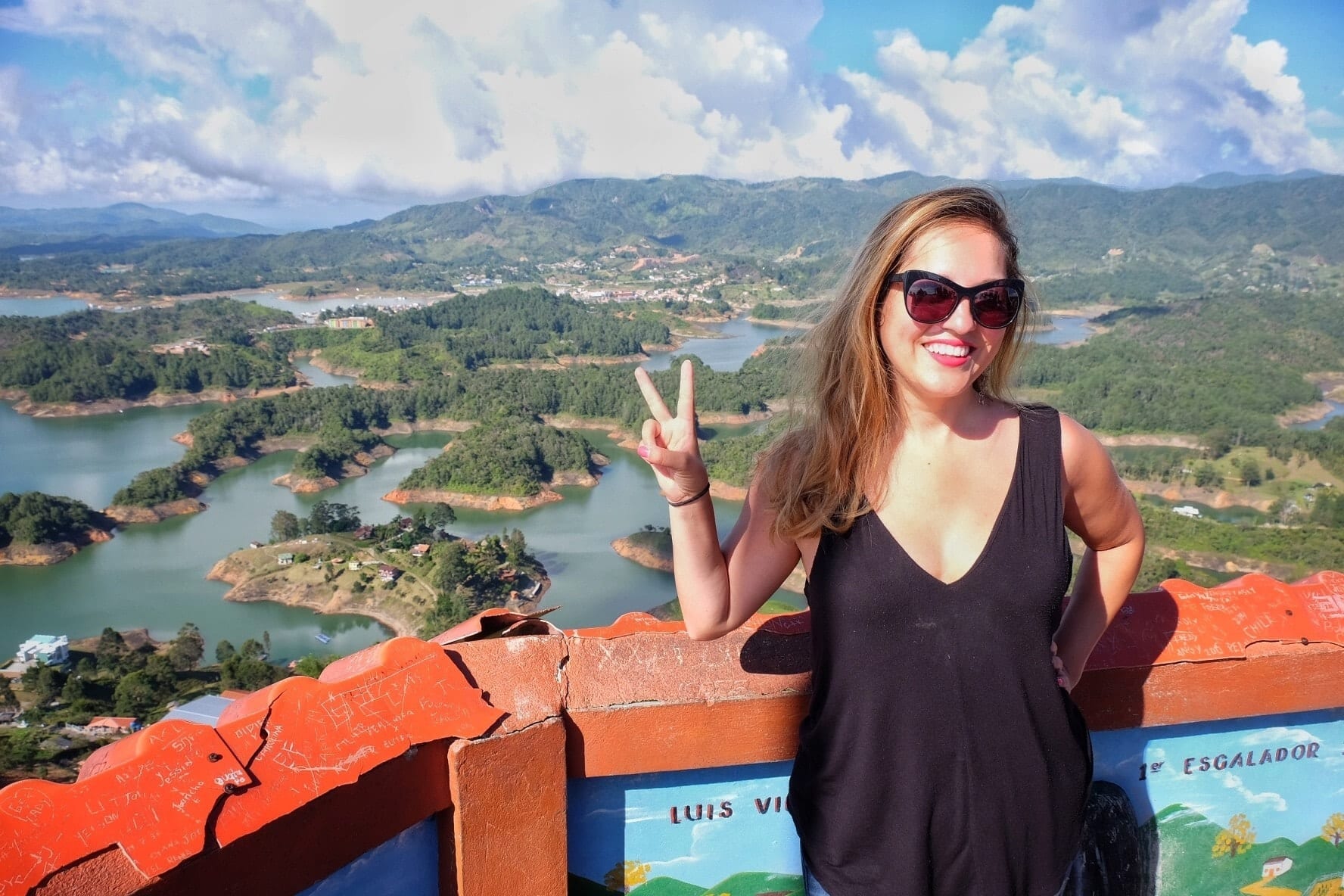
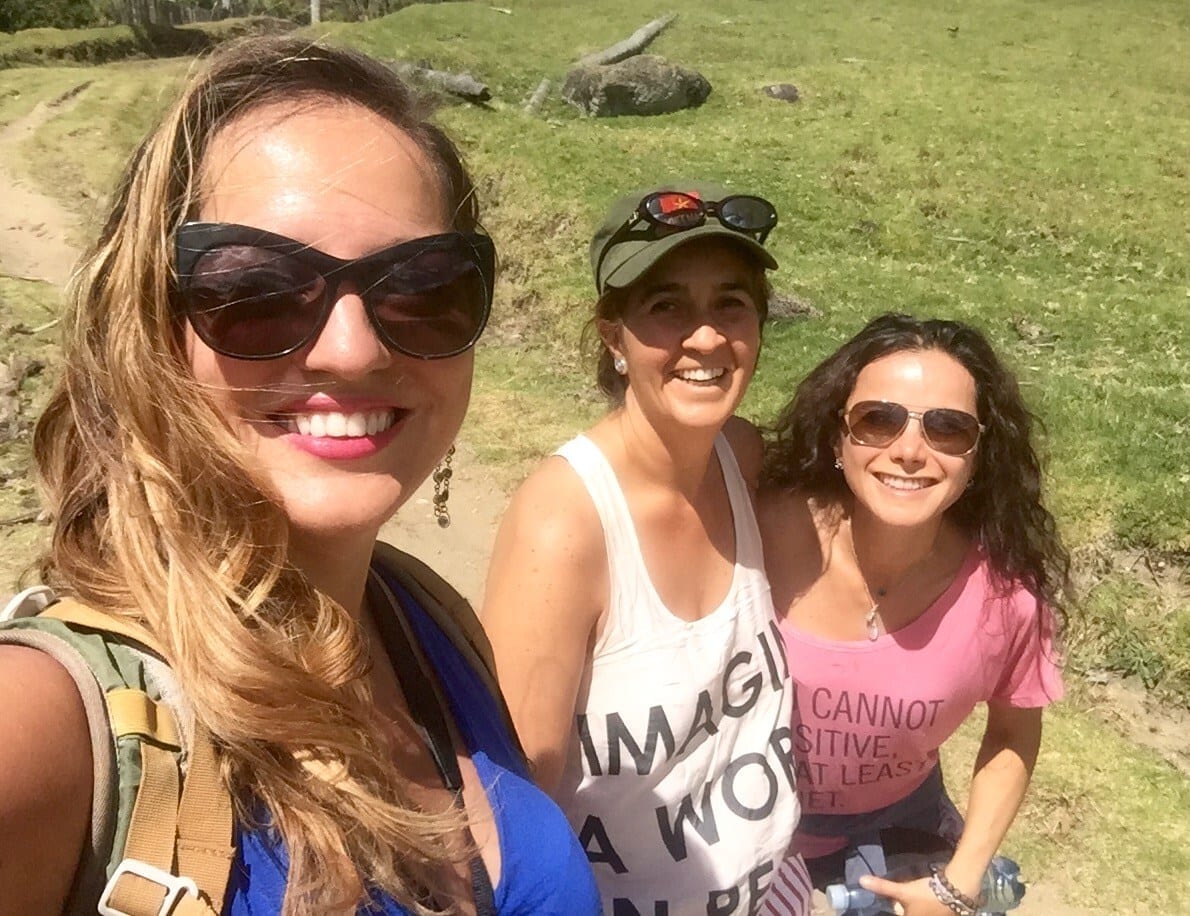
If you want to meet people, you’re in luck — Colombians are gregarious and friendly. I met these two women while hiking in the Valle de Cocora. Amusingly, I was huffing and puffing through the altitude — but as Bogota residents, it was actually easier for them oxygen-wise! We chatted for a bit — they offered to switch to English, a godsend — and we spent some time hiking and chatting.

Beyond the serendipitous instances, here are some ways to meet people:

Consider staying at a social hostel. You don’t have to stay in a dorm — I stayed in a private ensuite room at The Black Sheep in Medellín, an excellent, well-located hostel that runs tours and has all kinds of activities.

Join tours. I made a friend on my Cartagena food tour and we went out to a salsa bar later that night. I made a few other friends on tours in Medellín.

Look for Couchsurfing meetup events in Colombia. Couchsurfing isn’t just for free accommodation — they also put on meetup events where everyone is welcome. I think South America has the best Couchsurfing scene in the world.

Join a meetup on Meetup.com. Whether you’re into travel, running, movies, board games, or just want to meet a group of nice people, there’s a Meetup for that.

Put out feelers on social media. Often a friend of yours will have a cousin or friend who will offer to meet you for coffee, just so you know someone in the city. My friend’s husband is Colombian and she connected me with his cousin in Bogotá. We ended up going out dancing!

Tinder. If you’re looking to date or hook up, have fun! Colombia is full of beautiful people.
What to Wear in Colombia

When you’re traveling solo as a woman, you should dress similarly to the locals. This helps you blend in and often gets you more respect. The goal isn’t to pass as a local, it’s to pass as a longtime resident who knows the area well.

Colombia’s destinations have wildly varying climates. Bogotá is often chilly, overcast and rainy, not unlike Edinburgh. Cartagena is hot year-round and one of the most brutally humid places I’ve ever been. And Medellín is famous for its clear skies and mild, springlike weather. If you’re planning to see a lot of Colombia, you’ll need to pack for these different climates.

So what should women wear in Colombia? Jeans. Almost always. Colombian women love their denim and almost always wear jeans unless they’re dressed up for a special occasion. In general, Latin American women tend to cover their legs but are more liberal with their tops. I would wear jeans everywhere I went and add whatever worked for the climate.

In Cartagena, I wore the local uniform of jeans, flip-flops, and a cotton tank top. (Fun fact: when I wear this outfit in my Dominican neighborhood in New York I often get spoken to in Spanish first.) Yes, this was borderline torturous on the humid August days — but I did not regret this decision. Most tourist women in Cartagena were wearing rompers, short dresses, or short-shorts, which instantly marked them as outsiders.

In the milder areas of Medellín and Salento, I wore jeans and a t-shirt with either flip-flops or flats. I would top it with a cardigan or fake leather moto jacket when I needed an extra layer.

Bogotá was the chilliest, and I would layer up with jeans, socks, flats or boots, a long-sleeved top, my fake leather moto jacket, and a Speakeasy Travel Supply scarf.

Here’s what I recommend packing:

Slim or skinny jeans. A lot of people say not to travel with jeans, but I couldn’t disagree more. I live in jeans; Colombians live in jeans; jeans are the best way to fit in. I wore skinny jeans, and this seemed to be the most popular cut of jeans among Colombian women.

Comfortable shoes. I have bad arches so almost everything I own is from The Walking Company. Depending on where you go in Colombia, I highly recommend their orthotic flip-flops (yes, orthotic flip-flops exist and they are a GAME-CHANGER!), black ABEO flats (this brand is outstanding and they have excellent arch support) or a pair of boots. If you plan on hiking, you’ll want to bring hiking boots or sneakers. (I did light hiking and survived with just sneakers.)

Speakeasy Travel Supply scarf. These beautiful scarves are designed and sewn by my friend and have a hidden passport pocket in them that no thief will know exists. I love these scarves (I even designed my own!) and they are so good at keeping your valuables hidden.

Crossbody purse. I recommend using a crossbody purse, made out of a tough material like leather or fake leather, that zips shut. This is the kind of purse that is much harder for thieves to snatch. I recommend many purses in this post.

Light jacket. I found my little fake leather jacket to be ideal for Colombia — warm enough when paired with a scarf in Bogotá, but also a good option for when the evenings turned chilly in Medellín and Salento.

Travel Insurance for Colombia

Travel insurance is vital for trips to Colombia — or any other country. If you get appendicitis while in Medellín or fall while hiking in the Valle de Cocora, travel insurance will help you in your time of need and protect you from financial ruin. If you need to be flown home, it could save you well over $100,000.

And it’s not just about injury. If you get robbed, travel insurance can refund you for what was stolen from you. If your flights are cancelled due to weather, travel insurance can refund you. And if you have a death in the family and need to get home immediately, travel insurance will help you get home fast. I use and recommend World Nomads travel insurance for trips to Colombia.
How NOT to Travel in Colombia

When on a fruit tour in Medellín, I met a sweet 20-year-old Israeli girl. And while she was a very nice person, my God, she was the single most clueless traveler I’ve ever met — the living embodiment of Karen from Mean Girls. Here is just a handful of the things she did wrong in a two-hour period:

She was a space cadet. She walked around with a dazed smile on her face rather than keeping her head down and staying focused.

She wore the shortest shorts I’ve ever seen. Her butt hung out of the bottom; her whale tail of a thong poked out the top. This market was in a part of Medellín where no tourists go. Literally nobody was dressed like that in the market.

The men stared at all the women in our group, and yelled things out at me when I was exploring on my own. But every man in the market gawked at this girl’s lack of clothing, and had she not been in a tour group, I’m certain she would have been grabbed.

She walked around with her purse hanging open. It was like an invitation to pickpockets.

She didn’t speak a word of Spanish. She didn’t even say hola or gracias to the locals she met.

She didn’t carry a map on her, nor did she have a data plan on her phone. I helped her figure out how to get to her next destinations, and I honestly have no idea how she would have found her way if I hadn’t been there to direct her.

Honestly, I have no idea how this girl survived. She told me she had already been robbed at gunpoint in Peru, which is awful — nobody deserves that. I hope she made it home to Israel safely.

But let this be a lesson to you — this girl demonstrated the absolute worst way to travel as a solo woman in Colombia. Hell, this would be a bad way to travel anywhere.
Colombia is waiting for you!

Don’t worry — if you’ve read this much, you’re going to be nothing like that clueless girl I met in Medellín. You are going to love Colombia.

Go have the time of your life. Then come back and tell me all about it.


READ NEXT:

Traveling in Colombia: The Best Moments

Have you been to Colombia? What tips would you add? Share away!

The post Solo Female Travel in Colombia — Is It Safe? appeared first on Adventurous Kate.


from Adventurous Kate https://www.adventurouskate.com/solo-female-travel-colombia-safe/

Thursday, 7 March 2019

How to Live and Travel Full-Time by RV

marc and julie from RV Love
Posted: 3/7/2019 | March 7th, 2019

Over the past few years, there has been an explosion of people giving up the daily grind to live and travel in vans, RVs, and other nontraditional abodes. While traveling in an RV has been something people have been doing for decades, new sharing economy websites, better resources online, more modern vans, and a growing community that can provide support have made it easier for anyone to travel full-time in an RV.

What used to be traditionally and predominantly an activity for older, retired, or family travelers is now something people of all ages are trying to do.

One just has to look up #vanlife on social media to see!

(An aside: I hate the #vanlife movement. The faux Instagram movement does nothing for me. Just a bunch of millennials searching out that perfect sponsored photo and talking about how woke they are (for the most part)).

But #vanlife aside, RV travel is a wonderful way to see the world.

“How do you travel in an RV?” is one of the questions I’m most asked.

So today, we’re going to the experts and talking full-time RV with nomads Marc and Julie from RV Love. This couple joined my blogging program a few years ago, hoping to find a way to spread the gospel of living and traveling in an RV to the wider world. (Spoiler: they did. And they just published a book with Simon & Schuster about it too!)

They’ve been driving around in their RV for nearly five years and, today, they share their wisdom about how to travel by RV:

Nomadic Matt: Tell us about yourselves! How did you get into this?
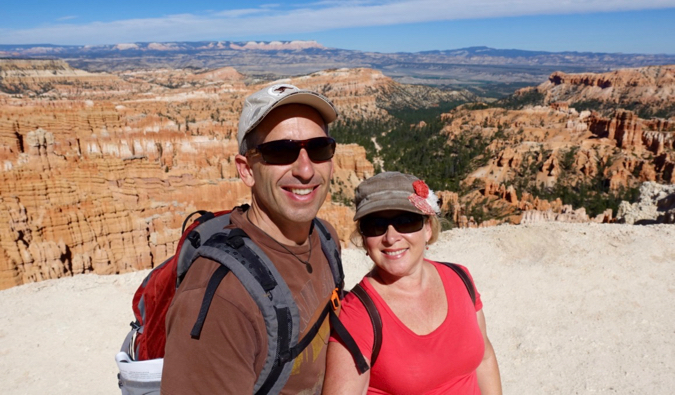
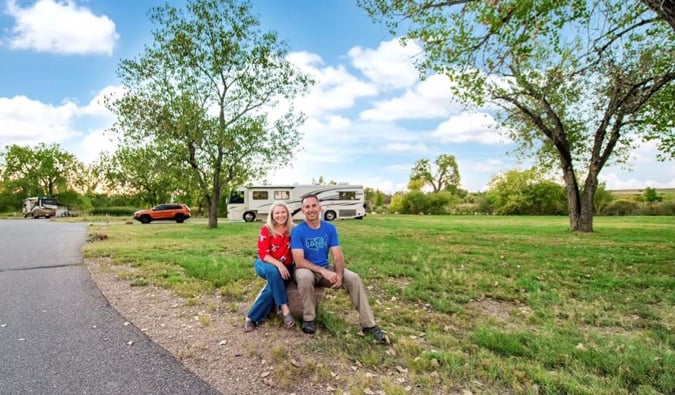
Marc and Julie: We’re Marc and Julie Bennett, full-time RVers since 2014, living, working, and traveling in our motorhome as we explore North America and the world! We met on the dating website eHarmony while both living in Colorado in 2010, married in 2011, and hit the road three years later!

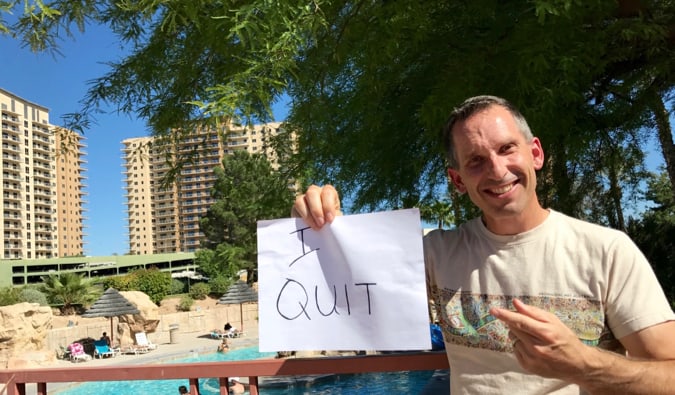
marc from RV Love quitting his job

Why did you pick traveling in an RV as your way to get around?
We knew we wanted to do a lot more extended travel while we were still working. We get such little vacation time here in the USA, and we didn’t want that to limit our lives. So we started exploring different ways to bring more travel and adventure into our everyday life without Marc having to give up his job as project manager of operations, which he was able to do from home.

We considered international travel, but there were two main reasons why wasn’t a fit: the challenge of time zones, and more specifically, we wanted to travel with our dog Coda. Plus, we love to drive, so RVing was really the ideal solution for us. We love that wherever we go, we’re always home, and we’re not living out of suitcases.

We’re both passionate about driving, so it makes sense that we would choose to live and travel by RV, although we usually prefer more sporty rides when it comes to entertainment, as we both have a love for sports cars and convertibles.

What’s life like living and traveling around in an RV?
We just entered our fifth year on the road full-time as RVers, and we recently changed from a 2012 36’ gas Class A motorhome to a 1999 40’ diesel motorhome! We bucked the trend and went bigger (and older and cheaper, but much higher quality), and we’re actually doing a complete remodel of our RV this summer.

Traditionally, we spend about 80% of our time in campgrounds and about 20% dry camping, but we recently installed a big lithium battery bank and solar system on our RV, so we plan on spending a lot more time camping off the grid out in nature in the coming years. We try to spend 2-3 weeks in each location, but that varies on where we are, the weather, and what projects we have on our plates. We moved pretty fast in our first 3+ years, having visited all 50 states while still working full-time.

This year, we have so many big and exciting projects on our plates, we’re really feeling the need to slow down, catch our breath, and get caught up on our content! We tend to wing our plans a lot more than we used to, as we’re more comfortable and confident RVers now.

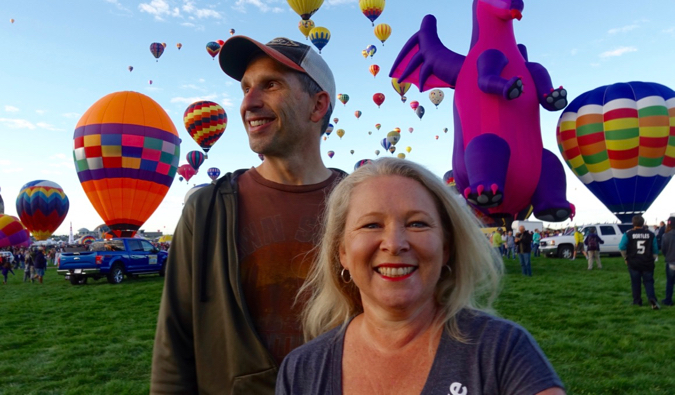
marc and julie from RV Love looking at balloons

An average day depends on whether you have to work or not. We love that we no longer have a commute and that the views outside our windows change every week or so. Nature is a big part of our everyday life, so it can be easier to get in more walking, hiking, biking, or kayaking. We definitely get to see more sunsets — that’s a big thing for a lot of RVers.

RV life is still life. You need to go grocery shopping, make meals, do laundry, pay bills, and do housework. Then there’s RV maintenance and repairs! There’s almost always something to do on an RV — tighten screws, replace parts, troubleshoot issues, check your tire pressure, fix whatever’s broken.

Upon arrival at a destination, it usually takes less than 30 minutes to set up. It may sound like a hassle, but if you’re staying a week or more, it becomes a small percentage of your time. And RV life can be as social as you like. We tend to mostly stay in campgrounds, so it’s not too difficult to meet new people. And we also go to RV rallies to meet up with our RVing friends, who we stay in touch with online. It can take a little time to build your RV community, but if you put yourself out there, it can happen pretty quickly!

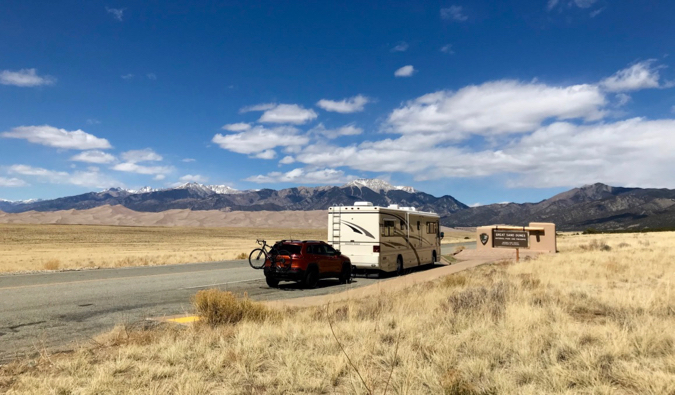
an RV for long-term travel parked on the side of the road

Do you need a lot of mechanical skills to do this?
When you’re traveling around in an RV, if you aren’t already handy, you’ll learn to be! It’s definitely an advantage to become somewhat mechanical and familiar with simple tools. The RVing community is very helpful and supportive when it comes to finding answers for issues you may have — whether online (in social media groups) or in person. At RV parks and campgrounds, you will usually find someone reasonably experienced and mechanically oriented nearby. If you are not skilled or it’s a complex job, you can usually find a local or mobile repair person to perform needed maintenance or repairs.

We recommend sticking with a less complex RV when starting out. The more simple the RV, the more reliable and easy to fix they are likely to be, and you can tackle many repairs yourself. As full-time RVers driving a Class A motorhome, we only need to take our RV into repair facilities 2-3 times per year on average.

Many RV repairs are fairly simple, and that’s when YouTube and Google are your friends! One of our favorite YouTube channels is the RV Geeks, who make DIY how-to videos to help you make simple repairs and upgrades. It’s often more convenient (and definitely cheaper) to do many RV repairs yourself. And you may even want to consider an extended service contract to cover your RV for repairs outside of the manufacturer’s warranty period and help limit repair costs.

Are there any personality traits you think are necessary for living in an RV?
Flexibility, adaptability, resourcefulness, and a sense of humor! Just like any other kind of travel, things don’t always go the way you want, RVs break (or break down), and travel plans go awry when you least expect it, so you need to be able to find a creative solution, often on the fly. It really helps to be handy or at least be willing to have a go at DIY fixes. RVers learn to become much more self-sufficient pretty quickly.

Anyone can RV if they really want to. It doesn’t matter about your age, life stage, relationship status, or financial situation. In our book, we share the inspiring story of 69-year-old Frieda who hit the road solo after her husband passed away and drove to Alaska to celebrate her 70th birthday. She’s been on the road for two years now and is still going strong.

Another great case study from the book is Nik and Allison (31 and 30). They share why they decided to RV and explore the country before they started a family. They follow the FIRE philosophy (Financial Independence, Retire Early) and save more than 50% of their income so Nik can be a stay-at-home dad. RVing for a year and a half while still working allowed them to do a lot of travel affordably while keeping them on track with their financial and life goals. 

marc and julie from RV Love

There really is no “one way” to RV, just the right way for you. That’s why, when writing our book Living the RV Life: Your Ultimate Guide to Life on the Road, we wanted to create a roadmap for people that would help them hit the road and thrive, keeping them on track with their personal goals while they’re doing it. That’s been a big part of our own success. We’re almost five years in now and still living and loving the RV Life. Now we’re showing others how they can do it too.

A lot of people are embracing RV/van life these days. Why do you think that is?
We think it’s a perfect storm of several things colliding simultaneously:

  1. A lot of people are questioning the traditional American Dream as a path to success or happiness — the idea of postponing your life, travels, and experiences until retirement just doesn’t really make sense, and of course, the future is promised to no one. Why not travel while you have youth and health on your side?
  2. Technology is enabling us to live and work from pretty much anywhere, and more companies are allowing people to work remotely, and more people are starting their own businesses.
  3. Then there’s social media and FOMO! With the increased awareness that RV or van life is possible through watching people’s YouTube channels, Facebook pages, and Instagram feeds, other people are beginning to realize you can travel and see cool places, and live or work in forests or by lakes — and they want to do it too. America has long been famous for iconic road trips — and RVs and van life offer the ultimate freedom: exploring the country on wheels.

julie from RV Love surrounded by beautiful nature

How much money will people need before they dive into RV life?
It’s a good idea to pay off as much unsecured debt as possible before hitting the road. Less debt lightens your load and allows you to really enjoy the freedoms of RV life.

It all depends on how you want to RV, and your budget. Generally, we recommend people try to save up a few months of living expenses to get started, and as a backup for unforeseen challenges and expenses. Life happens, and you just never know when you may be hit with an unexpected expense or expensive RV repair.

As a guide, as long as you plan and budget carefully, and make a good RV purchasing decision, it’s possible to RV full-time for about $2,000–$3,000 per month. Some do it for less, and others do it for way more. But across the board, we find most RVers end up spending about the same in their RV life as they did in their regular life.

Just like in traditional life, you just have to plan to live and travel within your means. Plus, your ability to earn an income while you travel is a huge factor. If you can work from the road while you RV — as was the case for us — it can be a pretty simple trade.

For example, we sold our townhome and traded our mortgage payment, HOA, utility bills, and two car payments for:

  • A used RV, which we financed
  • A less-expensive car that we paid cash for
  • Campground and fuel expenses

What we previously spent on home repairs and maintenance for our home is now redirected to our RV. Same goes for RV insurance and roadside assistance. We tend to spend a bit more on eating out and entertainment, as we’re always on the move and experiencing new places. But it’s easy to save money by making meals in your RV, and there’s no shortage of things you can do for free, like hiking, biking, and kayaking.

Many people (like us) are able to work remotely with just an internet connection. Some work seasonally, then take a few months off to travel and explore. Other careers, like nursing, hospitality, agriculture, and construction are highly transferable to new locations, especially for seasonal work. For some lines of work, it can actually be easier to find jobs by having the ability to follow the work around the country.

We have met people who live full-time in vans or RVs frugally, for less than $20,000 per year. And we have seen others who spend well over $60,000 per year. Like all other forms of travel (and life!), expenses are variable, depending on how you do it.

julie from RV Love working on her laptop

What tips do you have for people who aren’t sure what RV, van, or trailer they should get?
Buying an RV can be expensive, and buying the wrong RV can be even more expensive! Like anything with wheels, RVs depreciate (hard), and so doing your research in advance pays off. Before you even set foot on an RV dealer’s lot or go check out the RV you found on Craigslist, ask yourself:

  • Who is traveling with you? 
  • How much do you plan to travel? (weekends, part-time, full-time)
  • Where do you want to go? (campgrounds and RV parks or off-grid camping in national forests?)

Generally speaking, you’ll want to choose the smallest RV that you feel that you can comfortably live in. Smaller RVs offer more flexibility to access more places. Larger RVs are more comfortable for extended travel but will be more limiting in terms of where you can take them, especially if you want to stay in national parks and do off-grid camping.

Don’t overinvest in your first RV — it’s the one that will teach you what is most important to you and your travel style. Start out by buying used. You will avoid the steepest part of the depreciation curve. Plus, you’ll have a much better idea of what’s important to you when it comes time to buy your second RV. It’s possible to nail it with your first RV purchase, but not without a lot of research and clarity around your priorities.

What are some common pitfalls to avoid when starting out?
Full-time RVing is not a vacation, it’s a lifestyle. It’s exciting when you start. You want to go everywhere and see and do everything. Try to create a sustainable travel pace from the beginning. Stay longer in an area. It’s cheaper – in terms of fuel and campground fees – and you’ll really be able to immerse yourself, explore, and even feel like a local for a while.

Second, it’s easy for people to think they need a big RV to be comfortable, especially when coming from a bigger home. In the RV lifestyle, your environment and views are constantly changing, so your world feels a lot bigger, even if your living space isn’t. It’s easier to live in a smaller space than you might expect, especially with way less “stuff.” Remember our advice above when it comes to choosing the right RV, so you can avoid that expensive mistake.

And finally, it can be hard to resist buying gadgets and gear before you even buy your RV! Every RV has cupboards and storage of different sizes and shapes, and you won’t know what fits where until you have your RV. Save money by hitting the road with the essentials, then spend some time traveling before investing in too many upgrades or gear. You’ll want to make sure they are going to be a fit for your preferred travel style. You can always buy what you need as you go. Don’t take too much stuff! You need less than you think and can get what you need as you travel.

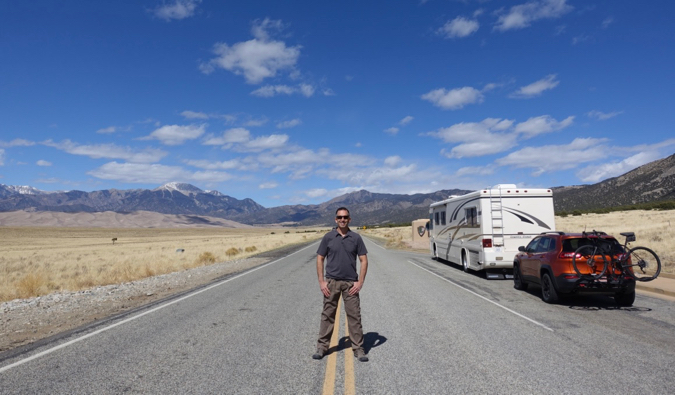
marc from RV Love standing in the road on a road trip

Do you have any recommended companies for vans/RVs? What about resources for finding where to camp/park?
It’s a good idea to consider renting an RV or van first, to see if you even like the lifestyle. You can rent RVs from rental companies and even from private individuals, which gives you more variety in the types of RVs you can choose from. This is really useful for helping you decide what kind of RV is right for you, before buying one. It may seem expensive, but making the wrong decision isn’t cheap either! Many large RV dealerships rent RVs, there are large rental chains like cruiseamerica.com or www.roadbearrv.com, but if you want to rent an RV from individuals for more variety, consider doing so via rvshare.com.

It is difficult to make specific recommendations about buying RVs, as there are hundreds of manufacturers, models, and types, and RVs are not like cars. The options, features, and price range of RVs vary widely. That said, we generally recommend buying a preowned RV, as they are usually more affordable, and, contrary to cars, you will generally experience fewer issues with a well-maintained preowned RV than with a brand-new unit. That’s because every RV — much like building a new house or condo — will have a “punch list” of items that need to be fixed for the first few months (or more) after you drive it off the dealer’s lot.

You can find RVs at RV dealers, on websites like RVTrader.com, as well as on Craigslist or Facebook Marketplace, and from friends and family. Local RV parks often have a community notice board of RVs for sale, too.

If you want to camp for free on public lands, there are websites like Campendium.com and Frugal Shunpiker’s Guides to find free camping areas. And there are thousands of RV parks and campgrounds around the country, which you can you find online, through apps, and in camping directories.

You can also look into camping memberships that offer discounts on your stays. For example, we spend a lot of time in a campground membership network that literally saves us thousands of dollars per year. Other websites and apps we recommend include CampgroundViews.com, Campendium, and AllStays. There are a ton out there, and you can find many more resources in our book and at our website, RV Love of course! 🙂

***

If you want more information, Marc and Julie Bennett are RVers who live, work, and travel from the road full-time, and since hitting the road in 2014, have visited all 50 USA states, plus Canada and Mexico. They are co-authors of Living the RV Life: Your Ultimate Guide to Life on the Road, and you can follow along on their journey via their website RV Love as well as their social media channels!

If you’d like to dive deep and get hands-on help on starting your own RV life, they also run online courses at RVSuccessSchool.com. As a Nomadic Matt reader, you can get 10% off their course with the code NOMADICMATT. Just input the code when you sign up!

Book Your Trip: Logistical Tips and Tricks

Book Your Flight
Find a cheap flight by using Skyscanner or Momondo. They are my two favorite search engines because they search websites and airlines around the globe, so you always know no stone is being left unturned.

Book Your Accommodation
You can book your hostel with Hostelworld, as it has the largest inventory. If you want to stay somewhere other than a hostel, use Booking.com, as it consistently returns the cheapest rates for guesthouses and cheap hotels. I use them both all the time.

Don’t Forget Travel Insurance
Travel insurance will protect you against illness, injury, theft, and cancellations. It’s comprehensive protection in case anything goes wrong. I never go on a trip without it, as I’ve had to use it many times in the past. I’ve been using World Nomads for ten years. My favorite companies that offer the best service and value are:

Looking for the best companies to save money with?
Check out my resource page for the best companies to use when you travel! I list all the ones I use when I travel — and they will save you time and money too!

The post How to Live and Travel Full-Time by RV appeared first on Nomadic Matt's Travel Site.


from Nomadic Matt's Travel Site https://www.nomadicmatt.com/travel-blogs/rv-travel-tips/

Wednesday, 6 March 2019

QNAP TS-453BT3 Review

QNAP TS-453BT3 with Remote

In this in-depth review of the QNAP TS-453BT3, we will go through the pros and cons of this 4-bay storage array and see how well it works for photography and videography needs. While there are many large and advanced storage arrays out there (some of which we reviewed in the past here at PL), most photographers simply don’t need that much storage, as well as the complexity and expenses that come with them. The TS-453BT3 is specifically designed to address the storage needs of enthusiast photographers who want to be able to consolidate their media to a single location without much effort or investment. Let’s take a look at what this little storage array has to offer in more detail.


from Photography Life https://photographylife.com/reviews/qnap-ts-453bt3

Venus Optics Laowa 12mm f/2.8 Zero-D Review

Venus Optics Laowa 12mm f2.8 Zero-D Lens

One of the widest lenses on the market today is the Laowa 12mm f/2.8 Zero-D, made by Venus Optics. Not only is this lens rectilinear (not a fisheye), but Venus Optics claims it has almost no distortion whatsoever. With so few 12mm lenses available today, anyone who needs an ultra-ultra wide has likely considered this one with some interest. Our review below covers everything you need to know about the 12mm f/2.8, both good and bad.


from Photography Life https://photographylife.com/reviews/laowa-12mm-f2-8

Tuesday, 5 March 2019

Venice in Black and White

Venice in Black and White #7

I saw an earlier article on Photography Life about photographing the city of Venice (Venice – The Most Beautiful City in the World by Alan Mosley) and felt inspired to write one of my own. I, too, find the city to be inspirational for photography, especially architectural work. Moreover, I enjoy photographing Venice in black and white, which I find captures certain elements of the city with more emotion – the atmosphere, the light, the texture, and the patterns. That is my purpose with the photo essay below.


from Photography Life https://photographylife.com/venice-in-black-and-white

Solo Female Travel in Paris — Is it Safe?

Is it safe for a woman to travel alone to Paris? Absolutely. Under most circumstances, with the right preparation and precautions, visiting Paris can be as safe as staying in your hometown.

Paris is a place where I’ve been traveling alone for years! I first fell in love with Paris when I was 16 years old and on a school trip, and I’ve returned more than a dozen times since, often solo. It’s a city that I love dearly, a city where I frequently play tour guide for my friends and family.

However, Paris is very different from people’s idea of it. It’s a beautiful city, yes, but it’s also a city where tourists are targeted. You need to look out for that. And so here’s a guide that I’ve put together to make sure you have the best trip to Paris ever — but also a trip where you stay safe.

Why Travel to Paris Alone?

I love traveling alone in Paris — it’s one of my favorite cities to explore on my own. I think it’s one of the cities best suited for solo travel. Why is that?

First, Paris is an introvert’s dream. French people and Parisians in particular tend to be pulled a bit inward in comparison to Americans, which means that you don’t have to face constant draining interactions with strangers. Beyond that, Paris is chock full of activities that are wonderful to do on your own: like museums, long walks, photography, shopping, and sitting in cafes.

Second, it’s easy to eat alone in Paris. While servers in other cities may give you a cocked head and an, “Only one?” (God, I hate that), it’s very common for women to eat alone in Paris. Being alone at a restaurant won’t raise any eyebrows. Paris is also covered with cafes, where you can eat at any time of day without raising any eyebrows.

Third, Paris is a dreamy destination. You’ve probably been dreaming about visiting Paris since you were a child. While it won’t be quite the idealized destination you have in your mind (see below for more on that), Paris still has a lot of magic. There’s something about sitting at a street cafe and drinking red wine as an accordionist plays across the street. It’s just PARIS and it will make your heart swell.

And finally, Paris is a great place to just be. Simply walking down the street in Paris can be an entertaining experience. Not a lot of cities have that. For that reason, you don’t need to fill your trip with nonstop activities — simply just hanging out can be enough. It took me so long to find the right words to describe this and I finally wrote a piece called The Art of the Chilled Out Trip to Paris.

However — Paris Is Rougher Than It Seems

Most people have an image of a perfect, beautiful Paris in their minds. Even before Instagram existed, people idealized Paris in their heads. It’s all white buildings and wrought-iron balconies and baguettes and artists with berets and poodles on leashes.

Not exactly, though. Paris is rough — rougher than a lot of European cities. There’s a significant amount of crime. There’s street harassment. There’s occasional terrorism. Tourists are targeted to a level perhaps greater than any other city. It’s dirty and polluted and dog poop is everywhere (though believe me, the poop used to be much worse). There’s a lot of homelessness.

Beyond that, Parisians often have the reputation for being rude, especially to tourists — and while I think this is a bit unfair, I understand why. French people tend to be very formal in their actions, and when they don’t receive the same level of formality in return, they often respond with coldness. Couple that with French culture, which is quieter and more pulled in, especially compared to the American South or Midwest, and it can be jarring. People don’t chat you up in Paris the way they do in America.

Don’t expect friendly service, either. America’s tip-based restaurant culture ensures that you’ll get attentive service in most restaurants — but in France and especially Paris, don’t be shocked if a waiter sighs and rolls his eyes when you ask for a beverage.

And while French people are well aware of these Parisian proclivities (there’s a joke that the French hate Parisians but nobody hates Parisians as much as they hate themselves), but this isn’t common knowledge among non-Europeans. Paris remains ever idealized in the mind of foreigners, so when they arrive, they are often shocked and disappointed.

Is Paris Good for First-Time Solo Female Travelers?

I want to say yes, but this is actually a tricky question. I think a lot of women would do well with their first-ever solo trip being to Paris. If you have traveled with others a good amount on your own, especially in Europe; if you’ve studied abroad; if you’ve lived in a big city or are used to city life; or if you speak French — those qualities make you a great candidate for traveling to Paris as a first-time solo traveler.

If you haven’t done much travel anywhere or have never been out of the country before; if you’ve grown up fairly sheltered and you haven’t been outside your region much, Paris is a much bigger leap. You can absolutely go if you want to — but you may prefer to start with an easier European destination where more English is spoken and where tourists aren’t as much of a target. Somewhere like Ireland, Scotland, Iceland, the Netherlands, or Norway.


READ MORE:

Solo Female Travel in Europe: A Complete Guide


Another option: you can get your feet wet in an easier city, like London or Edinburgh, and then go to Paris after. On your first solo trip, you’re going to make the most mistakes in your first days! Spend a few days getting your solo travel bearings, then finish your trip in Paris.

Is Paris Good for Experienced Solo Female Travelers?

Of course! If you’ve already traveled quite a bit, you’ll enjoy Paris. There’s nowhere else like it, as much as other cities like to claim that they’re “the Paris of the East” or “the Paris of the South” or “the Paris of Asia.”

Traveling to Paris is going to be different for you, though. You’re not going to be as easily hypnotized by the Eiffel Tower and Notre-Dame; you’re probably going to be a lot more annoyed by the crowds. For this reason, I encourage you to get off the beaten path in Paris. I mention many offbeat sites in this article. Definitely see Paris’s major sites, sure, but make an effort to seek out less-visited spots too.

And if you’ve never visited Paris before, chances are high that you’ve never visited France before. In that case, I’d recommend pairing Paris with another French destination. See below for where to go after Paris.

Is Paris Safe?

Yes and no. Paris can be very safe, but there are precautions that you need to take that you wouldn’t think about ordinarily. On some levels, Paris is as safe as your hometown. On other levels, Paris can be quite rough.

Like all big cities, Paris has its share of crime, mostly petty crime. But as the most visited city in the world, Paris attracts many inexperienced travelers. For this reason, a lot of thieves and scam artists set up shop in Paris, looking to make money off these inexperienced travelers.

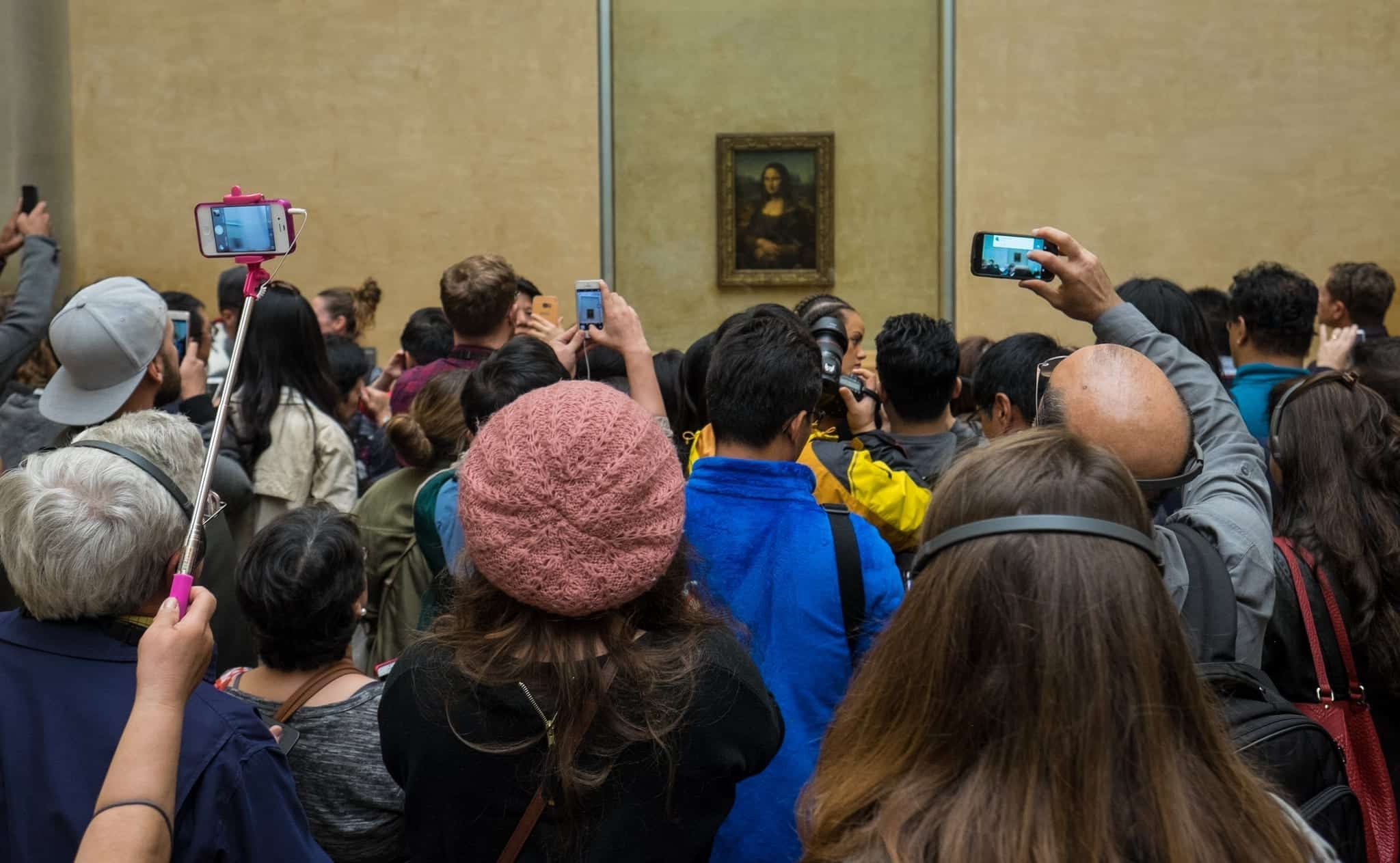
Pickpocketing is common in Paris. In fact, I’d name Paris and Barcelona the two worst cities for pickpocketing in Europe, if not the world. Bag snatching is commonplace as well. And it doesn’t just happen on public transportation or in outdoor crowds — some thieves even pickpocket tourists at the Louvre.

See below for detailed advice on how to avoid pickpocketing and bag snatching.

Street harassment is another major concern. While it happens almost everywhere in the world, it happens with great frequency in Paris, especially when you travel solo, and especially at night. The best thing you can do is ignore it, and duck into a shop or restaurant if it escalates.

My advice is to blend in as well as you can. This doesn’t mean you try to pass for French. It means you try to look like a longtime resident. Dress similarly to French women, don’t bring obvious travel gear when you’re out and about, keep a hand on your purse at all times, walk quickly and with purpose, and keep yourself emotionally subdued rather than gaping wide-eyed at everything around you.

Travel and Safety Tips for Solo Travelers in Paris

Say, “Bonjour, madame!” or “Bonjour, monsieur!” when walking into a store or business. French people consider this basic manners and if you don’t do this, they think YOU are the rude one. One reason why foreigners think French people are rude is because they are treated rudely after not greeting a shopkeeper. This is something that will make a big difference in your travels and will lead to French people looking out for you.

Bring a guidebook PDF and keep it on your phone. Even in this day and age, I always buy guidebook PDFs because they are good for planning and have information on hospitals and what to do in case of emergency. I recommend Lonely Planet Paris or Lonely Planet France, where you can buy the whole book or just the individual chapter for Paris for much less.

Consider getting a SIM card. Having a SIM card helps you navigate your way around the city, as well as summon an Uber when you need one. Get a card at a Vodafone shop at the airport or one of the many Vodafone shops around the city.

Keep your valuables locked up in your accommodation and only take with you what you need that day. I do this with my Pacsafe Travelsafe and I consider it the most important thing I pack. Keep an extra debit card and at least $100 hidden in obscure parts of your luggage.

Pickpocketing is insidious in Paris. Be extremely aware of your belongings. Pickpockets are especially prevalent in touristy areas, like the Louvre and the Eiffel Tower, and during the most touristy times of year, like August.

If you carry a purse, hold it close to you. I recommend a crossbody purse, made out of a tough material like leather or fake leather, that zips shut. I recommend many purses in this post. Never let it hang behind you — always keep it in a place where you can see it, and keep your hand on it if you’re in a crowd.

If you carry a wallet without a purse, don’t keep it in your back pocket. This is obvious to thieves and they will grab it and run.

If you use a small backpack, lock it. I use a Pacsafe backpack where you can lock the compartments shut.

Never leave your bags anywhere unattended. Even if you’re used to asking someone to watch your things while you use the bathroom in a coffeeshop at home, don’t do that in Paris. Take your belongings with you. If you’re keeping your bag under the table or otherwise out of sight, keep it between your feet or hook the strap around one of the chair legs.

Don’t carry tons of cash around with you. You can use credit cards at most places in Paris, and carrying lots of cash leaves you vulnerable to theft. You occasionally hear the story of a traveler to Paris losing her wallet and the 500 euros in it. Don’t let that be you.

Be aware of the men trying to trick you into buying something. This is especially common in Montmartre. Men will come up to you and start drawing you, or weaving a bracelet for you, or cutting out your silhouette into paper — then they’ll tell you that you owe them money. Turn away and leave them, or say NO forcefully and turn and leave. Do this immediately — this is not a time to be “nice.” If the person demands money, turn and leave. (If you want to be drawn in Montmartre, head to Place Tertre and pay one of the sitting artists, not one of the roving artists, to draw you. It costs more money, but they’re much better artists and they won’t cheat you.)

Be aware of other Paris travel scams. If someone offers you a ring or piece of jewelry and says they found it on the ground, ignore them and leave the area — it’s a fake and if you take it, someone will come after you demanding money. If you see the game of someone hiding a ball under one of three cups, DO NOT put money down for it, even if it looks easy enough to win. Don’t buy tickets to museums from random people on the street.

If someone asks to take your photo and they’re not an obvious tourist — and I mean an obvious tourist, like a baby-wearing mom with a Louisiana accent — say no thank you. Some people use this as a reason to steal phones or cameras.

Don’t give to beggars. While some of these people are genuinely hurting and in need of money, so many of them are scamming the public. This is especially so for beggars holding a sleeping baby or next to a sleeping dog — the babies and animals are often sedated with narcotics. If you want to give, donate online to a legitimate charity helping in the homeless in Paris like Depaul France.

Use the metro to get around Paris. It’s easy, cheap, and the network is extensive. If you take a taxi, verify that the driver is using the meter and keep an eye on it. There is no reason to drive in Paris; at best, it will be a complicated and miserable experience for you.

Be careful about your drinking. Drink less than you ordinarily would at home — two drinks is a good limit. Only take drinks from bartenders, never take a drink from a stranger, and always keep it with you and keep an eye on it.

Most importantly, you have no obligation to be nice to anyone. Women often feel the need to be nice and please people at all costs. You don’t have to anywhere — especially so in Paris. If anyone is making you feel uncomfortable, just leave. Trust me — you won’t be the rudest person they meet that day. And so what if you were? You’re never going to see them again.


READ MORE:

Top 10 Travel Safety Tips for Women


The Best Things to Do in Paris

Paris has something for every kind of traveler. Here are some of my favorite things for solo female travelers to do in Paris:

Have the best Bretagne-style crepes at Breizh Cafe. Start with a savory buckwheat galette (I love the egg, ham and artichoke) and have a sweet crepe with salted caramel for dessert. This place is very popular; get a reservation or go here early (before noon).

Lose yourself in the best museums in the world. Of course, you’ve got the Louvre and the Musée d’Orsay, but there are so many more — the Musée Rodin with its outdoor sculpture park, the Centre Pompidou for modern art, and don’t forget excellent but less famous ones like the Musée Picasso and the Orangerie. If you’re planning to visit several, check out the Paris Pass — it may save you a lot of money. There’s also the Paris Museum Pass.

Enjoy the almost country vibe of Ile Saint-Louis. Just down the road from Notre-Dame and its hundreds of tourists, Ile Saint-Louis feels like a world away in the heart of the city. Be sure to stop at Berthillon for some ice cream. Get a flavor you’ve never tried before!

See a show at the Moulin Rouge. I was a bit skeptical when I went, thinking it would be a bit cheesy — but this show is outstanding. It’s not just dancing girls (and boys) — they have some insane variety acts in between the dancing. I got to see the world’s fastest juggler, among others.

Cruise along the Seine at sunset. This is one thing that you must do at least once in Paris! Take a basic Seine river cruise or book a dinner cruise with a three-course meal.

Check out the flea markets in Paris. The best one is Marché de Puces de Saint-Ouen at Porte de la Clignancourt; some others are Les Puces de Montreuil and Les Puces de Vanves.

Head to Du Pain et Des Idées for some breads or pastries. With boulangeries on every corner, you don’t have to go far for something fresh and delicious — but this bakery is special. While most places excel at either savory or sweet dishes, Du Pain et Des Idées does both wonderfully, and it’s a nice, offbeat neighborhood to explore.

If you’re visiting in the winter, go ice skating. There are rinks all over the city and it’s cheap to rent a pair of skates.


READ MORE: 100 Travel Tips for Paris


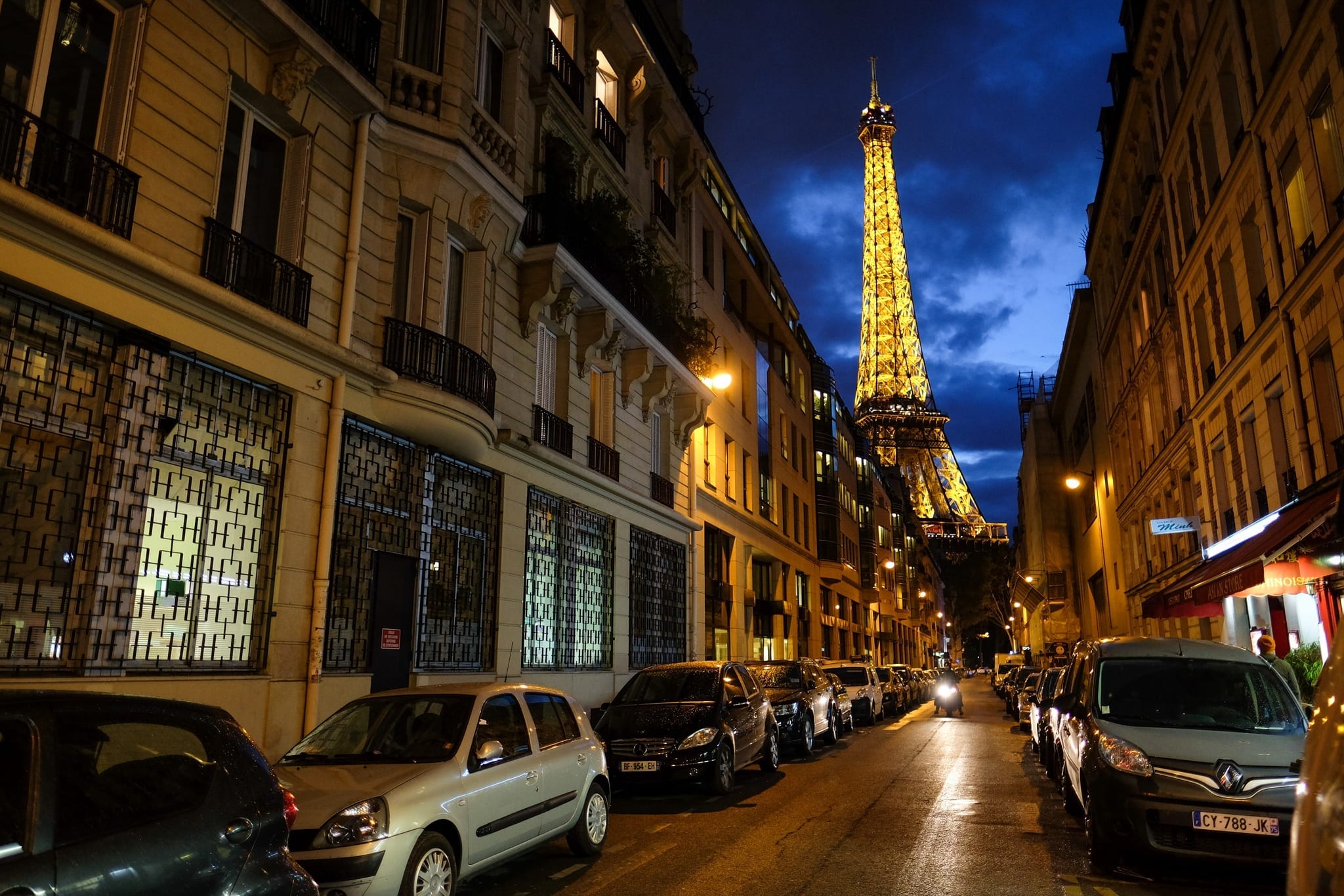
Enjoy the best views of Paris — especially at sunset. Some of my favorite spots are the top of Galeries-Lafayette department store in the 9th, the top of the Arc de Triomphe, the top of the Montparnasse Tower, and the top of the Sacre-Coeur in Montmartre. Keep in mind that when you’re on top of the Eiffel Tower, you don’t actually see the Eiffel Tower — and isn’t seeing the Eiffel Tower the point?

Go to a hammam for a scrub. Paris is home to several hammams, or Turkish baths, and they’ll get you cleaner than you’ve ever been in your life. Some are O’Kari, Les Bains du Marais, and the hammam at the Grand Mosquée de Paris. For a guide on how to hammam in Paris, read this post.

Climb to the top of Notre-Dame. This cathedral is a very popular spot for tourists, but the real attraction is climbing to the top of the towers, where you can see the famous gargoyles overlooking the Paris landscape.

Go to my favorite, cheap, super Parisian restaurant. It’s called Chartier and it’s in the 9th. Few places give you a great experience for such a cheap price. Prepare to wait in line here, as it’s very popular.

Dress up and go to a designer shop to buy something special. I decided to purchase my first pair of Chanel sunglasses in Paris, and it was nice to buy something super-fancy and super-French in Paris. You’ll get better service if you dress nicely.

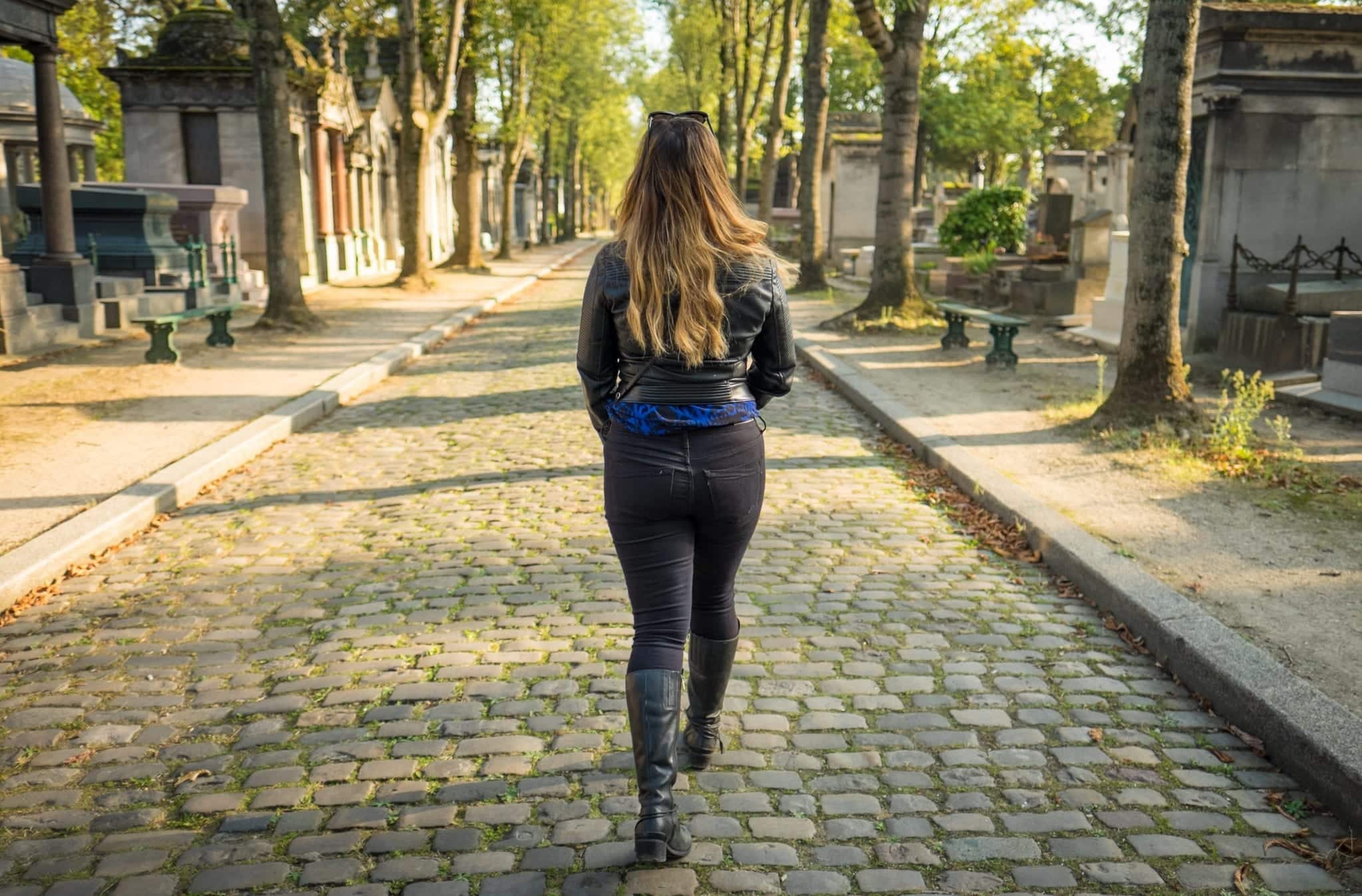
Go for a quiet walk in Père Lachaise Cemetery. Lots of tourists come to see Jim Morrison’s grave — the most photographed grave in the world. But lots of other famous people are buried here, from Chopin to Gertrude Stein to Oscar Wilde, and the grounds are a peaceful place for a stroll, especially if all the tourist crowds are getting to you.

Put together a French picnic. Pick up some baguettes, some cheeses, some fruits, and a bottle of wine and head to the nearest park. Any park is great, but the Champs de Mars, in front of the Eiffel Tower, is perhaps the most Instagrammable. Alternatively, grab some world-famous falafel at L’As du Falafel on Rue des Rosiers and go eat it in the Place des Vosges.

Get gorgeous Instagram photos of yourself. Hire a photographer through Flytographer to get some professional photos that will make all of your friends jealous!

The Best Day Trips from Paris

There is so much to see within a daylong journey from Paris. Here are some of my favorites:

Versailles is the classic day trip — it’s located just outside Paris. The town of Versailles is home to the Palace of Versailles in all its decadent glory. Visit independently (though I recommend buying a skip-the-line pass) or book a group tour that includes the gardens.

Versailles pairs well with Chartres, as they’re on the same train line. Chartres is home to a UNESCO World Heritage-listed gothic cathedral and the town is small and picturesque, a nice break from Paris.

Giverny is a must for Monet fans — depending on the time of year. Monet’s home and gardens will look familiar to you — because you’ve seen them in so many of his paintings! Book a tour from Paris here.

Take the train to the Champagne region for a glass of bubbly. The town of Reims is home to tasting centers like Taittinger, G.H. Mumm, and Pommery; if you have time, visit the town of Epernay, too. Tours from Paris can be pricey; I recommend traveling to Reims by train then booking a cheaper tour from Reims, or just visit places independently.

If you want to go international, you can do a day trip by train to London or Brussels. Of course, it would be ideal to visit either of these destinations for more than a day, but if all you have is a day, it’s still worth it.

How to Meet People in Paris

If you’re looking to meet people in Paris, you’re in luck! There are so many different ways to network and make new friends.

Join a meetup on Meetup.com. Whether you’re into travel, running, movies, board games, or just want to meet a group of nice people, there’s a Meetup for that. Visitors are always welcome.

Couchsurfing. The Couchsurfing community in Paris isn’t just for free accommodation, it’s also for socializing. The local Couchsurfers often put on events and meetups.

Put out feelers on social media. Often a friend of yours will have a cousin or friend who will offer to meet you for coffee, just so you know someone in the city.

Tinder. If you’re looking to date or hook up, congratulations! Paris is full of beautiful people.

What to Wear in Paris

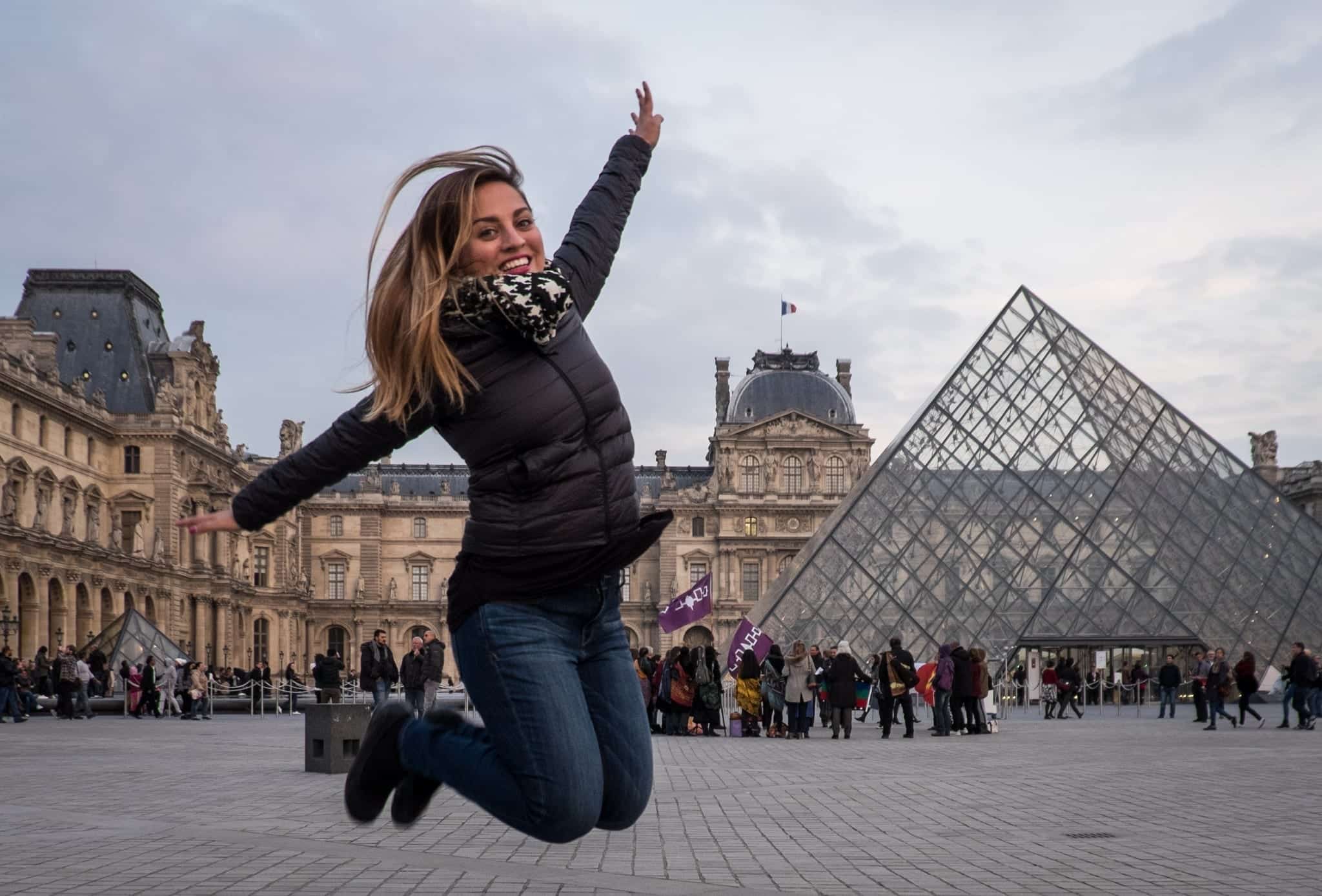
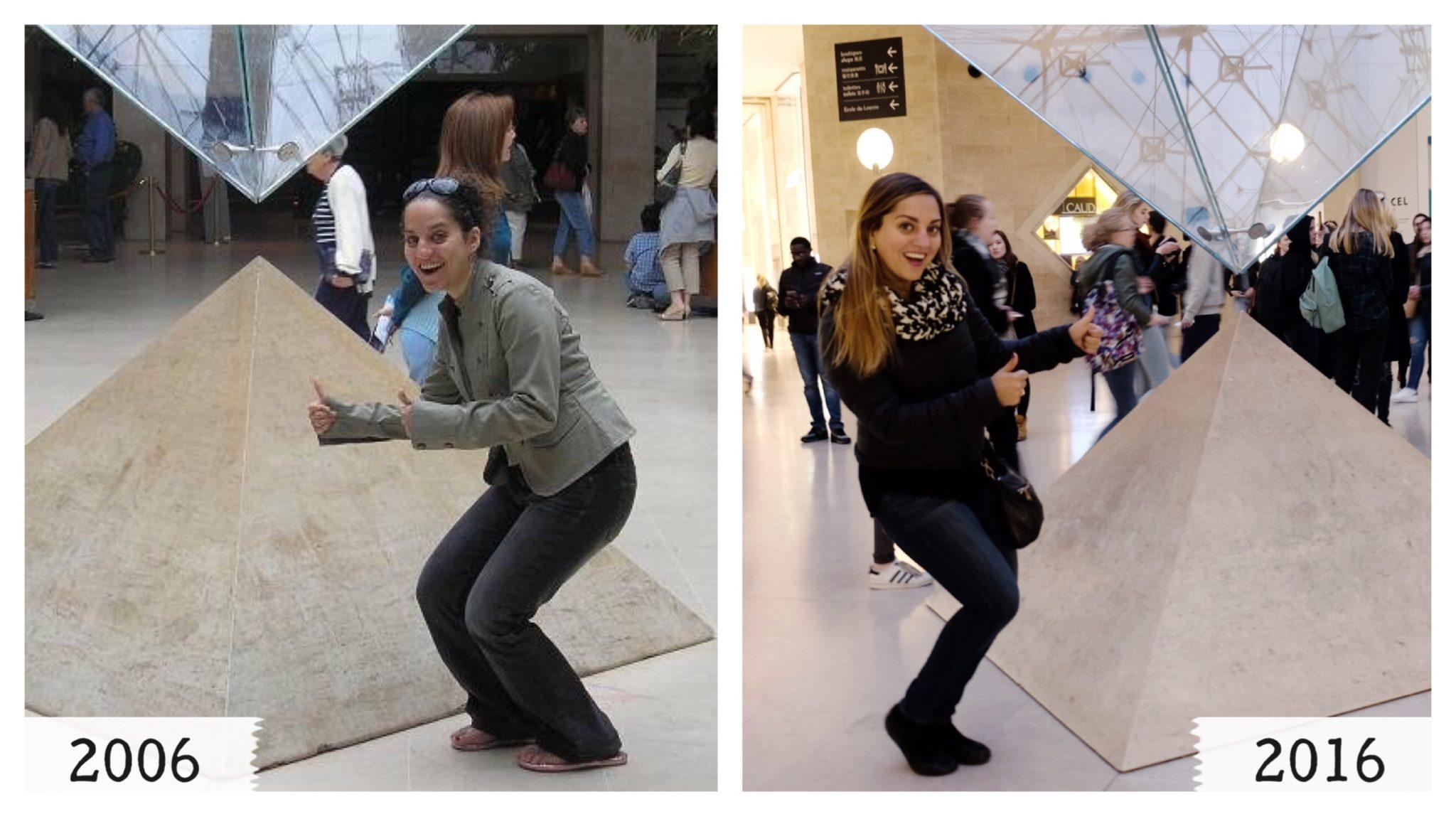
I LOVE THIS PHOTO ABOVE because there’s such a difference between what I wore in Paris as a 21-year-old and a 32-year-old. What the hell were you wearing in 2006, Kate?! Are those pink foil-covered flip-flops and an olive green military jacket? Together? At the LOUVRE?!

Paris is one destination where it’s important to dress up. Parisian women tend to have excellent, subtle style. Dressing neatly will help you blend in and it will make you less of a target to scam artists. And it will get you better, more polite service in Parisian establishments.

Clothing for Paris: In warmer weather, I’m a fan of wearing tailored dresses in Paris. In colder weather, I usually wear slim jeans with tall boots, a nice top, and a black jacket and scarf on top.

Also, I have a Rent the Runway Update subscription — I rent four designer items at a time and keep them for a whole month. This plan is ideal for travel! Even if you’re not interested in a yearlong subscription, just try it for the month of your trip. For less than $100, you can bring four designer dresses to Paris with you!

Avoid wearing shorts (even “nice” shorts), yoga pants, athletic wear, ripped jeans, and t-shirts or sweatshirts with the name of a destination or school on them. There is no need to buy any specific “travel clothing” — you don’t need zip-off pants for Paris.

Accessories for Paris: I highly recommend a Speakeasy Travel Supply scarf. These beautiful scarves are designed and sewed by my friend and have a hidden passport pocket in them that no thief will know exists. I love these scarves (I even designed my own!) and they are so good at keeping your valuables hidden. They’re also chic enough to wear in Paris!

Beyond that, I recommend simple, tasteful accessories. I’m a fan of Kate Spade earrings. It’s a New York brand that looks right at home in Paris. For handbags, I recommend a crossbody purse, made out of a tough material like leather or fake leather, that zips shut. I recommend many purses in this post.

Avoid wearing baseball caps — they will immediately brand you as a tourist.

Footwear for Paris: You want shoes that you can walk in — but that doesn’t mean you should wear ugly shoes! I have bad arches and live in comfy but cute shoes from The Walking Company. I strongly recommend black ABEO flats, which have fantastic arch support. You might also like a pair of black boots. I own and love these tasteful, comfortable black sandals.

Avoid wearing athletic sneakers or flip-flops. If you want to wear sneakers, wear something more fashionable — I own these white sneakers from Cole Haan and they are perfect for Paris.

Where to Go After Paris

Paris is one of the most conveniently located cities in Europe for onward travel. You’ve got so many options — if you can bear to tear yourself away from the city!

France has so much to offer — and there are big differences from Paris. You could hop around several different cities or focus on one region in depth. Some popular destinations are Alsace (the Alsatian city of Colmar is pictured above), the Côte d’Azur, and Provence, but there are so many wonderful places! If you’re into city-hopping, you might enjoy Bordeaux, Lyon, Strasbourg, or Nice. Bonus — almost everywhere in France is cheaper than Paris.


READ MORE:

A Taste of Alsace in Strasbourg and Colmar


If you want to head somewhere internationally by train, think about Belgium or the Netherlands. Brussels is a 90-minute train journey from Paris; Amsterdam is a four-hour journey from Paris. From either capital you can fan out and explore more cities (try Bruges or Rotterdam!). Parts of Germany and Switzerland are within reach as well.

Keep in mind that trains from Paris to Spain and Italy are further than they look — Barcelona is six and a half hours away; Milan is seven hours away.

Thanks to being one of the best flight hubs on the continent, Paris has cheap flights all over. You’ve got endless options. Whether you want to go to Marrakesh or Santorini, Stockholm or Tel Aviv, Bologna or Dakar, you can get there with a nonstop flight from Paris.

Travel Insurance for Paris

One last note — it’s absolutely vital to have travel insurance before traveling to Paris. If you get appendicitis while in Paris or break your ankle while climbing up the steps to Montmartre, if you get robbed while on the metro, or even if you need to be flown home for an emergency, travel insurance will protect you from financial ruin. I use and recommend World Nomads for trips to Paris.

And an important note — yes, you need travel insurance even though France has a good healthcare system. When I hit my head in Germany and ended up with a concussion, I had to go to the hospital — and because I wasn’t an EU resident, I was charged 300 euros for my urgent care visit. But I had travel insurance and I was refunded that money by World Nomads.

Paris is waiting for you!

I hope you have a wonderful trip to Paris! Paris is one of my favorite destinations for solo travel, and I only hope it’s as good to you as it has been for me.

Go have the time of your life. Then come back and tell me all about it.


READ NEXT: Where to Stay in Paris


Have you traveled solo in Paris? Share your tips!

The post Solo Female Travel in Paris — Is it Safe? appeared first on Adventurous Kate.


from Adventurous Kate https://www.adventurouskate.com/solo-female-travel-paris-safe/