Friday, 6 April 2018

Solo Female Travel in New York City — Is it Safe?

Is it safe for a woman to travel to New York alone? Absolutely. And I would know: I’m a travel writer specializing in solo female travel who lives in New York City. Since moving here, dozens if not hundreds of women have asked me the same question: I want to visit New York, but is it safe if I go alone?

I believe that with the proper research and preparation, almost anywhere in the world can be safely traveled by a woman on her own. And that goes for New York, too. Millions of women from around the world call New York their home; millions more women visit each year, many of them solo. That wouldn’t be the case if it were too dangerous for women on their own.

New York is fantastic for other reasons, too. It’s a city built for the solitary person. So many people are jammed up against each other in New York that it’s common for residents to seek solitude outside their homes, not inside them. The city reflects this. There are activities for all kinds of people to enjoy on their own, and it’s not considered unusual to do activities alone or go out to eat alone.

Whether you want to spend time on your own or meet cool people, whether you want to browse quirky museums or take the hardest fitness class in the city, whether you’re on a budget or the sky’s the financial limit, New York has something for every solo female traveler.

Welcome. We’re glad to have you.

How to Use This Guide

This 5000+ word guide is a comprehensive resource for solo female travel in New York City. And any woman who has traveled solo knows that safety is only one aspect of your trip. Other important things are knowing what activities are good to do as a solo traveler, picking restaurants and hotels that are welcoming to solo travelers, and learning how you can meet people if you want to.

Here are the categories:


New York Is An Extremely Safe City

New York today is much safer than it used to be in the 90s, the 80s, and beforehand. The New York of today is not the New York of Taxi Driver, or RENT, or Home Alone 2, or even Sex and the City.

The New York of today has far less crime than it used to, is far cleaner than before, and is much more expensive than ever before. It’s a place where some people making six figures are considered middle class. Nearly all of Manhattan and the “cool parts” of Brooklyn are so sanitized, the safety is on par with a theme park.

Over the years I’ve found that people tend to associate destinations with their 90s conflicts. Mention that you’re going to Cambodia, or Bosnia, or South Africa, and people will often react like Pol Pot is still alive, Serbian bombs are falling, and Apartheid ended yesterday. That’s not the case. Each of these countries has changed enormously since the 1990s and, with proper research and preparation, is safe to travel today.

This is true for New York as well. Case in point? In the episode of Friends where Frank Jr. first visits Phoebe in New York, filmed in 1996, Frank says, “Yeah, I was thinking that maybe we could go down to Times Square and pick up some ninja stars. And, oh, um, my friend Larry, he wants me to take a picture of a hooker.”

That makes me laugh. Today Times Square is one of the most touristy places in the city. It’s hard to believe that 20 years ago (yes, the 90s were 20 years ago!) it was where you went for drugs and ambiguously legal weapons. Today it’s where families go to get photos with Elmo.

I’ve been to 74 countries and 7 continents and I consider New York one of the safest cities in America and among the safest cities in the world. New York may not be quite as safe as Reykjavik or Tokyo, where you can leave your purse on a bench and nobody will touch it, but it’s certainly safer than Paris or Barcelona, where you have to constantly be on guard for pickpockets.


Safety Tips for New York

Most of staying safe comes down to common sense. Be aware of your surroundings; keep an eye on your property; don’t get bogged down in your phone screen.

Be vigilant when in crowded areas. This especially goes for busy subways, crowds watching a street performer, and touristy areas like Times Square and the ferry to the Statue of Liberty. Keep your belongings close to you; have your purse in front of you (ideally a cross-body purse that zips).

Don’t carry tons of cash around with you. New York is a card-happy city; you can use cards nearly everywhere, including in taxis. You occasionally hear the story of a traveler to New York losing his wallet and the $500 in it. Don’t let that be you.

Be careful of your drinking. Drinking reduces your reaction time and lowers your inhibitions. Be especially careful at happy hours and bottomless brunches, where there’s pressure to drink quickly to make the most of your money.

Be cautious of strangers who come up to you and start telling a story. If they don’t get to the point in the first sentence or two, they are likely going to ask you for money or try to sell you something. You are not obligated to give them anything. Walk away and say that you have to go, that you’re late.

There are lots of panhandlers in New York, especially on the subway. You are not obligated to give them anything, either. While some of these people are genuinely in need, a great many of them are scamming people. It’s your choice whether or not to give, but if you want to help the homeless, I suggest making a donation to the Coalition for the Homeless, an excellent New York charity that works to create human solutions to end homelessness.

Look for exits. This is something I do everywhere, not just in New York. If there’s an emergency, it’s extremely helpful to know how to get out quickly.


READ MORE: The Biggest Mistakes New York Tourists Make


If a subway car is empty at a busy time, it’s empty for a reason. Usually it means the AC isn’t working on a sweltering day; it could also mean there’s a spill or it smells terrible.

Don’t be afraid to spend more money to feel safer. If you’re wary about staying in a certain neighborhood, spend more for a hotel in a more central neighborhood. If it’s late at night and you’re not comfortable taking the subway at that time, just call an Uber Pool or Lyft Line. Sometimes it’s worth the peace of mind.

The best way to blend in? Walk quickly and with purpose. Respect people’s time. If you need to ask someone a question, do so quickly without telling a story. And definitely don’t stop in the middle of the sidewalk!

Most importantly, you have no obligation to be nice to anyone. Women often feel the need to be nice and please people at all costs. You don’t have to anywhere — especially so in New York. If anyone is making you feel uncomfortable, just leave. Trust me — you won’t be the rudest person they meet that day. And so what if you were? You’re never going to see them again.


25 Great Things for Women to Do Alone in New York

There are so many amazing things to do in New York! No matter how long you’re here or what you’re into, you’ll leave wishing you had more time. Here are 25 offbeat activities in all five boroughs that are fun, memorable, and especially good for a woman traveling alone.

1. Take a walk through the Ramble in Central Park. The Ramble is my favorite part of the park — it’s dark, mysterious, and the closest thing to a forest in the middle of the city. It’s a nice quiet place to read a book, too.

2. Go to Amateur Night at the Apollo in Harlem. Cheer on your favorite performers and boo the others — they say it’s the most fun you can have for under $30! And you never know who might be discovered — D’Angelo won three Amateur Nights in a row when he was just 16 years old. He used his winnings to buy recording equipment and the rest is history.

3. Get lost in the stacks at The Strand. In my opinion this is New York’s finest bookstore, and if you like to read, you can get blissfully lost for hours. This is also a great spot to pick up New York souvenirs.

4. Join a Bushwick bites and street art tour. Bushwick is a strange neighborhood of art and culture, and most of the good stuff is hidden in plain sight, so you’re best off going with a guide. My friend Jessie is a licensed NYC Tour Guide and she’s been perfecting this tour for years — you’ll meet interesting people for sure!

5. Try some alternative health remedies. Curious about reiki? Or infrared saunas? Or sensory deprivation floating? New York has all of those and more. Groupon tends to have good deals.

6. Join a “watch party” at a bar. Lots of New Yorkers don’t have cable, so bars put on some of the most popular shows for people to watch together. You have instant camaraderie with your fellow watchers. RuPaul’s Drag Race and Game of Thrones are particularly popular.

7. Spend a day exploring the biggest Chinatown in Flushing, Queens. Manhattan’s Chinatown is actually on the small side compared to Flushing. Come here for the best Chinese food in New York. Both Serious Eats and Eater have Flushing food crawl guides.

8. Get away from it all at The Cloisters. Tucked into the corner of upper Manhattan is a medieval complex that feels like you’ve been transported to centuries ago. It’s included with your admission to the Met!

9. See a show by yourself. Broadway, off-Broadway, comedy, opera, ballet, whatever you’re into, New York has it all! If you want to see a Broadway show and can’t get Hamilton tickets, I recommend Waitress (funny, sweet, and romantic) or the now off-Broadway Avenue Q (hilarious, puppety and raunchy). You can always get cheap tickets to Phantom and Chicago. Use the TodayTix app for the best prices and get $10 off your first purchase with the code AELAA.

10. Visit two of New York’s island getaways. Governors’ Island is just south of Manhattan with historic buildings, incredible city views, and lots of bikes to rent. City Island, up in the Bronx, may be the opposite of what you expect the Bronx to be — it’s a quiet, retro fishing village best experienced with an ice cream cone. Keep in mind the ferry to Governors’ Island only runs during the summer months and City Island is best experienced in the summer.

11. Enjoy wine, cheese, and groceries, Italian- and French-style. Head to Eataly in Flatiron to gawk at the pasta selection before settling down for a glass of Nero d’Avola with some parmigiano reggiano. (And a tiny cone full of Nutella after!) Alternatively, visit Le District in Battery Park for some Sancerre and brie before perusing their fromagerie.

12. Visit New York’s less famous museums. Everyone knows the Met, the MOMA, and the Museum of Natural History, but you might enjoy the Museum of the City of New York, the Frick Collection, the New York Transit Museum in Brooklyn, or the Museum of the Moving Image in Queens. Visiting museums alone is the BEST — you go so much faster and only see what you want to see!

13. Rent a CitiBike and ride through a park. Don’t worry if you’re scared of city biking — riding through a park is much more low-key! Central Park may be most famous, but Riverside Park shows you a lot more of the city. Prospect Park is a great option in Brooklyn.

14. See a lecture or two. New York’s lecture scene doesn’t get many mentions in travel guides, but authors, artists, leaders, and celebrities are always giving interesting talks here! Thought Gallery has a list of lectures; 92Y puts on some of the best lectures in the city.

15. Dance the day away at a Daybreaker. Daybreakers are sober dance parties taking place early in the morning before work. They’re artsy and weird and the perfect way to start your day. It may feel intimidating to go to a dance party alone, but the Daybreaker crowd is very welcoming!

16. Go on a food tour of Jackson Heights, Queens. Queens is the most diverse borough in New York, and Jackson Heights in particular is home to many different ethnic communities. A food tour could include cuisine from Ecuador, Mexico, Nepal, the Dominican Republic, Bangladesh, the Philippines, and more.

17. Get your hair done and your nails done too. Visit one of the city’s many blowout bars, get a new cut and style, or spend an hour getting a gel manicure and pedicure that won’t budge for weeks. There are always plenty of deals on Groupon.

18. Try some crazy foods at Smorgasburg. This Brooklyn weekend food market features all kinds of crazy local fare. Get there when they open; the coolest stuff (like dragonfruit juice served right out of the fruit) goes quickly.

19. Join a fitness class. Whether you want to keep up your yoga practice or try an activity you can’t find at home, you’ll have fun, be healthy, and get mistaken for a New Yorker. Try aerial yoga at ANYA, underwater cycling at AQUA, or a prison workout taught by ex-cons at ConBody. Want to challenge yourself? Tone House is infamous for being the toughest workout in New York.

20. Spend a day at a Korean spa. Get scrubbed harder than you ever have before. Spa Castle in Queens is the biggest and best (there’s a shuttle from the Flushing stop); Premiere 57 is a smaller spa in Manhattan. Get there early, ideally on a weekday, for the fewest crowds.

21. Get lost in a botanical garden. New York has two: the New York Botanical Garden in the Bronx and the Brooklyn Botanical Garden. Bring a camera and stop to smell the roses. Hit up the Bronx’s Little Italy (far more authentic than Manhattan’s Little Italy) for a meal if you choose the former; an eatery along Flatbush Ave. if you choose the latter.

22. Experience the weirdness at Sleep No More. This immersive production is designed to be seen alone — they make efforts to separate you from your friends. Wear a mask and wander through a hotel as scenes from Macbeth take place around you in a nonlinear fashion.

23. Try the most Instagrammable food in the city. My recommendations? Head to Taiyaki in Chinatown for a fish-shaped ice cream concoction, try some glitter rainbow bagels at The Bagel Store in Williamsburg, and the insane candy-covered milkshakes at Black Tap are well worth a visit (get there EARLY on a weekday). Want to be healthier? Vegetarian restaurant Dirt Candy has a “hot dog” made of broccoli.

24. Ride the Staten Island Ferry, with or without a drink. Buy a beer or canned drink in either terminal — it’s totally legal to drink openly on the ferry, and it’s a free ride too! Enjoy views of the Statue of Liberty and lower Manhattan.

25. Go to an alternative concert, rave, or party somewhere deep in Brooklyn. Looking for the weird, beyond hipster parties? Events vary widely, but Resident Advisor is a good source for finding them. House of Yes is a famous venue worth checking out.


How to Meet People in New York

If you’re looking to meet people in New York, you’re in luck! There are so many different ways to network and make new friends.

NYC Meetups on Reddit or Meetup.com. Whether you’re into travel, running, movies, board games, or just want to meet a group of nice people, there’s a Meetup for that. The Redditors have an ongoing meetup every Tuesday night at the Peculier Pub in Greenwich Village at 7:00 PM. Visitors are always welcome.

Couchsurfing. The Couchsurfing NYC community isn’t just for free accommodation, it’s also for socializing. The local Couchsurfers often put on events and meetups.

Put out feelers on social media. Often a friend of yours will have a cousin or friend who will offer to meet you for coffee, just so you know someone in the city.

Tinder. If you’re looking to date or hook up, congratulations! New York is one of the best cities in the world for that.


Eating Alone in New York

New York is a city where it’s normal to eat alone. Don’t stress about this; nobody will think you’re weird or even unusual for eating by yourself.

If you’re nervous about eating alone in New York, you may feel more comfortable eating at a restaurant with a bar or in a coffeeshop or cafe. Bring a book with you or just your phone. I prefer to avoid loud, scene-y places with a crazy bar scene when eating alone, and my picks below reflect that.

Here are 12 New York restaurants where I enjoy eating alone:

The Meatball Shop (many locations) — This is my go-to post-theater spot (Hell’s Kitchen location) and I often take out-of-towners here. Super fun menu and more ways to customize a meal of meatballs than you thought possible. I usually get the spicy pork meatballs with spicy meat sauce and a side of whatever greens they have that day.

The Spotted Pig (Meatpacking District) — Perennially trendy pub, great food, great neighborhood, dark, and you may see a celeb or two. This is one of the best burgers in the city; the gnudi is terrific too.

Ivan Ramen (Lower East Side) — Ramen that is as delicious as it is trendy in the heart of the Lower East Side. Go for the shio ramen.

Community Food and Juice (Upper West Side) — Just a nice, solid spot with low-key, creative fare where I like to go for lunch and brunch. Their chickpea bowl with artichokes and parmesan is one of my favorite dishes in the city.

Bono (Hamilton Heights) — Italian food, but unexpectedly amazing Italian food. Every item on the menu is exquisite. I don’t know how they do it. Anything with bread is excellent; the foccacias are standouts. I also love their shrimp spinach salad with lemon and avocado.

Saigon Shack (Greenwich Village) — Solid Vietnamese fare at very good prices. Their pho is so good I haven’t been able to psych myself up to try any other entrees!

Roberta’s (Bushwick, Brooklyn) — Hipster pizza. Inventive flavor combinations in the warehouse- and street art-filled neighborhood of Bushwick. The Bee Sting isn’t listed on the menu, but they always have it — it’s a pizza topped with soppressata and honey. Trust me, it works.

The Smith (many locations) — Another solid, all-around option for creative American food. If you’re a bit of a picky eater, you’ll find something you’ll like here. They also have potato chips topped with blue cheese that are fantastic.

Melba’s (Harlem) — Excellent soul food and none of the tourists you see at Sylvia’s or Red Rooster. The salmon is great, as are the fried chicken and chicken with waffles; don’t even think about skipping the mac and cheese.

Sun in Bloom (Park Slope, Brooklyn/TriBeCa) — Delicious vegan fare, complete with collard green-wrapped sandwiches and exotic nut milk lattes. I love their macro bowl filled with lots of delicious beans and vegetables with homemade sauerkraut.

983 (The Living Room) (Bushwick, Brooklyn) — Fantastic comfort food in a cozy, welcoming atmosphere with lower-than-Manhattan prices. I love their chicken under a brick.

Joe’s Pizza (Greenwich Village and other locations) — Best slices in the city, in my opinion. Eating a slice while standing at a table may be the easiest way to eat alone.


Best New York Hotels for Solo Female Travelers

What makes a good hotel for a solo female traveler? It’s a place that feels safe, is in a good location, and provides good value for money. “Value” is a relative term here because New York is an expensive city across the board. That said, when averaging out properties, I found these ones to be some of the best:

The Ace Hotel in NoMad — This is my favorite place I’ve stayed in New York, and it’s especially good for solo female travelers because only people with a key can access the elevator. One of my favorite coffee shops is in the lobby (Stumptown), there’s wine on tap in the bar, and neighborhood-wise it’s scintillatingly close to Eataly.

The Jane Hotel in the Meatpacking District — If you want to stay downtown, this is always a solid option. Quirky vintage Wes Anderson-esque decor, a short walk from the Hudson, and easy access to the West Village.

The Library Hotel in Midtown East — The dream hotel for any bookworm. Each floor is themed around a different category of the Dewey Decimal System. There’s a gorgeous lounge that is perfect for reading by day and drinking literary-themed cocktails by night.

Aloft Brooklyn in Downtown Brooklyn — Sleek style and cool design in the center of downtown Brooklyn with 24-hour food available. Close to lots of subway lines.

Hampton Inn Brooklyn Downtown in Downtown Brooklyn — A three-star gem in the heart of Brooklyn. Not the fanciest or buzziest, but solid and perennially one of the highest rated hotels in the region.

Z New York Hotel in Long Island City, Queens — This hotel has unbelievable panoramic views of the city, especially from the rooftop bar. Here you can enjoy boutique luxury for less than you’d pay in Manhattan.

Check out more New York City hotels here.

What about hostels? If you want to stay in a hostel, I recommend the HI NYC hostel on the Upper West Side. It’s gorgeous, safe, and has easy access to Central Park.

What about Couchsurfing? There are hosts all over the city, but as New York is a very popular destination, be sure to request far in advance. I recommend only staying with people who have been verified and have lots of positive reviews. For single women, I recommend avoiding single male hosts whose history shows them only hosting single women; chances are they’re using the site for hookups.

Do note that Airbnb is illegal in New York City if the lease-holder isn’t staying with you in the rental, unless the stay is for 30+ days. Translation: any rental where you rent the whole apartment for less than 30 days is illegal. But Airbnb doesn’t enforce this — only the NYPD does. It’s up to you to do your homework and not book an illegal rental.

Why is this illegal? Keeping apartments vacant for vacationers creates a housing shortage for locals and drives rents up. This is happening throughout the world, and New York is one city fighting to protect its citizens. If you care about the people in the city you’re visiting, you should obey this law.

For that reason, if you want to book an Airbnb, I urge you to book a room in someone’s apartment instead of a whole apartment. New York is a city where people highly value their own space; hosts will give you plenty of privacy.


Where to Stay in New York as a Solo Female Traveler

The vast majority of New York City is safe for women traveling alone. The important thing is that you stay close to the subway, because that will take you around the city just fine.

Stay within a 10-minute walk of the subway. In Manhattan, you should be covered unless you’re staying far west (think 11th-13th Ave) or far east (think 1st-York Ave). Google Map it to make sure. You may want to double-check that you’re close to a subway line that you’ll actually use.

The subway makes everything so convenient, you don’t need to plan your hotel depending on what you want to do. For example, you can visit Times Square without staying in a hotel close to Times Square. Nearly all the subway lines route through Times Square; it’s the center of the city.

What are some good neighborhoods? In Manhattan the world is your oyster. My top recommendation is the West Village. It’s the perfect combination of a central location, beautiful and clean streets, lots of interesting shops, beautiful brownstones, and easy access to parks and the Hudson. Check out hotels in the West Village here.

Chelsea, Flatiron, and SoHo have a similar ambiance to the West Village. East Village and the Lower East Side are best for exploring nightlife (and can be loud at night).

I recommend the Upper East Side and Upper West Side for something quieter and more residential. Harlem is also more residential and cheaper (I recommend around 110th-120th near Frederick Douglass or 140th-155th between Riverside and St. Nick).

Midtown and downtown are full of hotels, but the neighborhoods are gray and a bit soulless; I was convinced I didn’t like New York until I realized I had spent my visits in midtown.

Brooklyn and Queens are great options, too, and can often be cheaper than Manhattan (Queens especially).

In Brooklyn I recommend Brooklyn Heights and Cobble Hill for beautiful brownstones, excellent views, cool shops, and easy access to Manhattan. Head a bit further in to Boerum Hill, Prospect Heights, and Park Slope for a more residential feel.

Downtown Brooklyn is central and convenient. Williamsburg, the original hipster zone turned expensive yuppie neighborhood, is very popular with visitors. Brooklyn is also the center of lesbian life in New York. Check out hotels in Brooklyn here.

In Queens I recommend Long Island City (amazing Manhattan views along the water) and Astoria (fantastic Mediterranean food). Both neighborhoods have easy access to Manhattan via subway. Check out hotels in Queens here.

Which neighborhoods should solo women avoid? Almost all of Manhattan is perfectly fine; the only Manhattan neighborhood where I would avoid walking at night is East Harlem (north of 96th St and east of 5th Ave) unless you’re very experienced in cities. The rest of Harlem is fine (I live there!), as are Washington Heights and Inwood to the north. Avoid the area around Brownsville and East New York in Brooklyn.

Staten Island and parts of New Jersey (Jersey City, Hoboken) are perfectly safe, as well as cheap, but less than convenient. What you gain in savings you end up spending in transit (traveling to Jersey requires the PATH train in addition to the NYC subway, and Ubers/cabs are expensive) and time (the Staten Island Ferry is free but takes 30 minutes, and that’s if you’re staying right by the ferry). Feel free to stay there, just remember that they’re cheaper for a reason.


Getting Around Safely in New York

Most New Yorkers get around primarily if not exclusively by subway. I recommend you do the same. The subway runs 24 hours a day (albeit less often late at night) and it’s safe to take 24 hours a day. Get a MetroCard at a machine in the subway (cost: $1) and you can put an amount of money on (rides cost $2.75 each) or get a weekly pass for $32 or monthly pass for $120.

On some routes it makes more sense to take a bus, like if you’re going from West Harlem to the Upper East Side. Use Google Maps and it will tell you which method of transportation is fastest. Bus rides also cost $2.75 each.

Despite what you see on TV, only wealthy New Yorkers take cabs all the time, and today Uber, Lyft, and Via are more popular options. Taking a cab or Uber is best if you have heavy luggage or you need to get somewhere random quickly and Google Maps tells you it will be much faster than the subway. You can save around 50% by taking an Uber Pool or Lyft Line, where you share the vehicle with other riders.

My recommendation is to primarily take the subway in New York, take the bus occasionally if it’s a better route than the subway, and take the occasional Uber, Lyft, or cab if you’re carrying heavy luggage or you need to get somewhere fast.

Be sure to check Google Maps beforehand because it will tell you how long each way will take. It may seem faster to take a cab, but often the subway can be much faster, especially during rush hour.

And don’t forget about walking! One of the great pleasures of New York is that you can walk everywhere and be entertained along the way. If your next destination is a 30-minute walk away, why not just walk it?


But What If Something Bad Happens?

Most likely, nothing bad will happen to you on your trip to New York, but bad things can happen even in the safest places. If anything bad happens to you, it will likely be petty theft. Guard your belongings closely, especially when you’re in crowded situations like on the subway or at a touristy place like Times Square or a museum.

Violent crime is rare in New York; shootings and other terrorism are super rare. The only way to guarantee you avoid violent crime is to live underground in the middle of nowhere and never leave. That said, it’s always smart to note the exits wherever you are, just in case.

In the event that you become the victim of a crime, whether theft or worse, go to a police station and report it. At the very least, you need a documented police report to provide to your travel insurance.

Travel insurance is vital for trips to New York. It’s especially vital if you’re visiting from outside the United States due to our overpriced and unfair medical system. If you break your ankle in the US, you could end up paying thousands of dollars for the hospital visit; travel insurance will help you get through that awful situation without going bankrupt.

Beyond that, travel insurance will help you if you get robbed or if there are any problems with your flights or accommodation. I use and recommend World Nomads for travel insurance.

Staying Safe from Men in New York

Being a woman means constantly being on guard against the threat of sexual assault. New York is not home to more sexual assaults than any other place in America; it’s simply a place where you need to acknowledge that it does happen.

The majority of sexual assaults in New York and the world are not of the rapist-jumping-out-of-the-bushes variety; most of the time, it’s perpetrated by someone the victim knows. Even so, it’s smart to be aware of your surroundings at all times, especially at night. Don’t listen to your headphones at night. Be extra vigilant in isolated places where there aren’t other pedestrians.

Do men catcall in New York? Unfortunately, men do catcall women in New York. It’s not as bad as Italy or Latin America; it’s more of an occasional occurrence than an all-the-time thing. The best thing you can do is ignore it. The majority of the time, they stop when you don’t react.

What if I feel uncomfortable? If a man is following you or making you feel uncomfortable, walk into a public place — a bodega (convenience store/sandwich shop), a shop, a restaurant. If you want to leave the neighborhood, call an Uber or Lyft to pick you up.

New Yorkers will always help you if you’re in trouble, whether it’s a cashier, a bartender, or a girl you meet in the bathroom. Ask for help if you need it.

What should I do if I go on a date? Have someone at home know who you’re meeting and where, and check in with them to let them know how it’s going. Even if the guy seems nice, never leave your drink unattended. Minimize your drinking. And never forget that you don’t have to do anything you don’t want to do. You don’t have to sleep with him, you don’t have to go to his place, you don’t have to have another drink. It’s all about your personal comfort level.

What to Pack for New York

Clothing-wise, you’re probably fine sticking with your wardrobe from home unless you live in a hot climate and are coming in winter. It’s not necessary to buy any special “travel clothing.” If you want to blend in with New Yorkers, wear a lot of black.

Here are other items I recommend:

Digital Guidebook — I’m a fan of guidebook PDFs that you keep on your phone. Lonely Planet New York is my favorite.

Comfortable but fashionable shoes — I have bad arches and live in comfy but cute shoes from The Walking Company. I strongly recommend black ABEO flats, which have fantastic arch support. You might also like a pair of black boots.

A crossbody purse that zips. This is the kind of handbag I recommend for keeping your belongings close and safe. Amazon has lots of affordable options. If you want to spend more, Rebecca Minkoff makes some of the best.

Portable safe — Leave your valuables locked in this and lock it to something sturdy in your room. I consider my portable safe the most important item I pack.

Books set in New York — It’s always nice to read a book set in the destination you’re visiting, and it’s the best way to pass time on the subway while alone! Some of my personal favorites are Lillian Boxfish Takes a Walk by Kathleen Rooney, Behold the Dreamers by Imbolo Mbue, The Leavers by Lisa Ko, and everything by AJ Jacobs (The Year of Living Biblically is my fave). Tip: don’t just read books about rich white people in New York; the city is so much more than that.

The Bottom Line

New York is one of the best destinations for solo female travelers. It has so many exciting things to do, it’s tailored to people who spend time alone, and it’s a very safe destination where common sense will keep you even safer. If it weren’t so expensive, New York would be the perfect city!

I hope you have the best time in New York. And I hope this trip is the catalyst that sends you on many more solo adventures!


READ NEXT: TOP TEN TRAVEL SAFETY TIPS FOR WOMEN


Have you traveled solo in New York? What tips would you add to the list?

The post Solo Female Travel in New York City — Is it Safe? appeared first on Adventurous Kate.


from Adventurous Kate http://www.adventurouskate.com/solo-female-travel-new-york-city/

Thursday, 5 April 2018

Flying High in New Zealand’s Fiordland

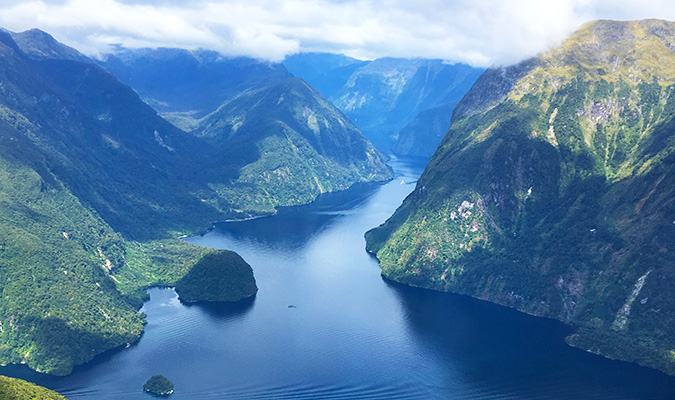
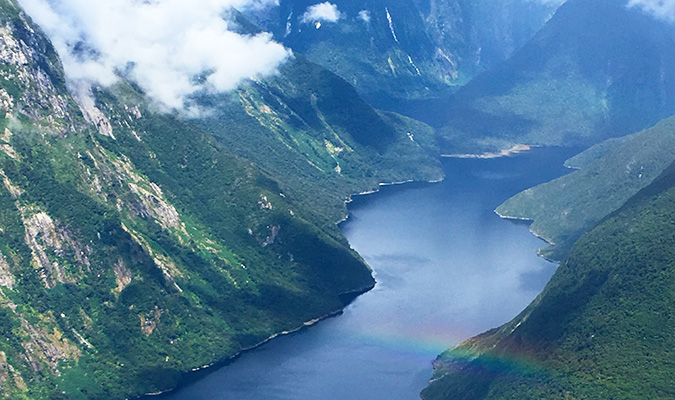
A view of the fjord from the seaplane

“How do you do on boats?”

“I love ’em,” I said gripping the seat of the plane tightly.

“Well, just picture turbulence as waves you can’t see,” the pilot said with a laugh.

“I know turbulence can’t take down a plane, but that doesn’t make this any more comfortable.”

The plane was jolted as we passed some high mountains. None of the other passengers seemed to notice, but I cringed with the look of someone who just got a thousand needles stuck in his arm.

“If something goes wrong here, we just fall and die! That’s just where my mind goes!”

The pilot looked at me, laughed again, and went back to talking to the other passengers.

I was in a tiny, six-seater seaplane three thousand feet above Doubtful Sound. Located in Fiordland in the southwesternmost part of New Zealand and home to numerous Lord of the Rings film locations, the region is considered one of the country’s most scenic and remote areas. Filled with gigantic mountains, deep lakes, swelling rivers, untamed forests, and resplendent fjords, most of it has never been set upon by man. Save a few places where boats and planes can go, the government has made the land off-limits, ensuring that that will be the case for a long time to come.

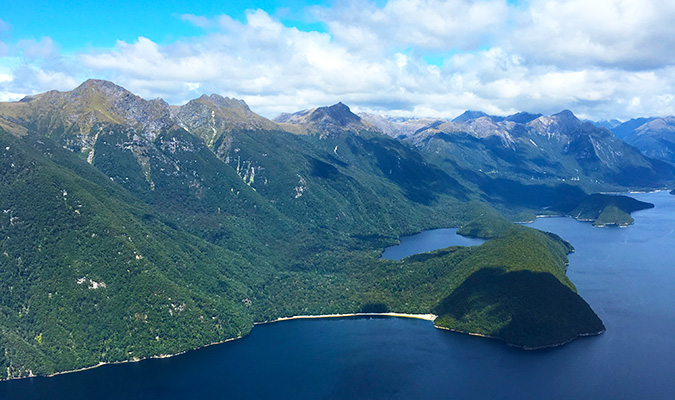
A view of the fjord from the seaplane

The day before, I had had the bright idea of seeing Doubtful Sound on a quick one-hour flight instead of a full-day bus/boat ride. Despite my fear of heights and flying, I had thought it would be cool and save me lots of time.

Yet as the teeny plane bounced around, that no longer seemed so bright.

I had hitched a ride to the area with Karin, a Swedish girl I’d met in Wanaka. After a few days partying in Queenstown, we had driven down to the region’s launching pad, Te Anau, a small town of barely a few hundred people on a lake, with lots of campervan parks for tourists who came to camp, hike the Kepler Track and Milford Sound trail, and visit the area’s two biggest attractions: Milford Sound and Doubtful Sound.

Karin and I drove up to Milford Sound for the day. On the way, we passed giant granite mountains, crystal-clear blue rivers, and roaring waterfalls. Sheer cliffs rose above us as we followed the road to the sound. Tiny lakes dotted the way, and hiking trails — some of the country’s “Great Walks” — crisscrossed the area. This was wild New Zealand, where cellphone service didn’t exist, you had to camp, and, to quote Doc Brown, “you don’t need roads.” You came here for one reason: to escape city life.

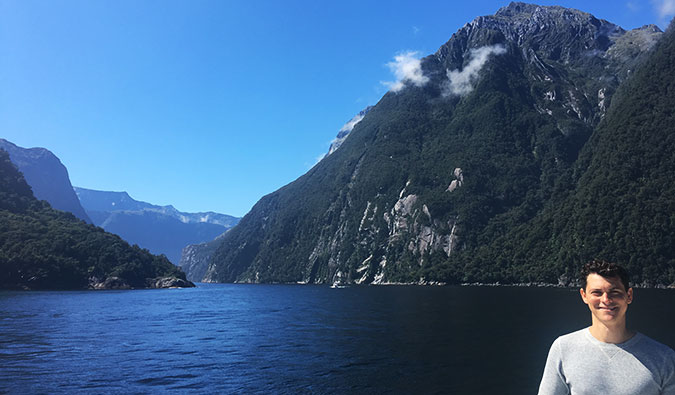
On our two-hour cruise on Milford Sound to the edge of the Tasman Sea and back again, water from the recent rains rushed in a torrent off the sides of the fjord, ice covered the tops of the mountains, and seals frolicked nearby. It was a clear, bright, sunny day, the kind that makes you feel like you got the luckiest card in the traveler’s deck.

Matt on a cruise through Milford Sound

The next day, Karin left but I stayed on. I found an Airbnb run by an older couple, complete with a garden, sun deck, and hot tub. However, they had quirky nature, and it was clear that they weren’t that hospitable or used to young travelers booking via Airbnb. From the odd blackmail (“if you want to use our kitchen, maybe you can book your tours with me”) to the reversal of that offer (“I changed my mind”) to the immediate outpouring of personal information to the shock that someone would cook in their kitchen to the constant checking up, they left a bad vibe that made it seem like I never was wanted there.

So I got out of the Airbnb as often as possible. I headed to Wings and Water, a small seaplane company run by Jim, a hard-nosed pilot who had a lot to say about the state of modern pilot training and airplane safety. He spouted off about the nanny state and government regulation not letting pilots be pilots, companies outsourcing maintenance, the overreliance on computers and technology, and pilots not going with their guts enough.

A view of the fjord from the seaplane

“There’s not enough experience out there. A computer isn’t going to save you.”

He had strong opinions on every subject.

“Matt is afraid of flying, but we’ll make him a man,” he said to the two other couples waiting to board our flight, slapping my back as he went to do another safety check on the plane.

I already regretted having mentioned my fear of flying.

With a sputter of the engine, we coasted on the water and ascended smoothly into the air. Now, below us, the giant Lake Te Anau and mountains were splayed out over the landscape. There were lakes leaking down the sides of mountains, patches of ice dotting inaccessible mountaintops, and sheer, gray cliffs with trees seemingly hanging on by a root, ready to slide off at a moment’s notice. We weaved so closely around the mountains I felt I could touch them.

A view of the fjord from the seaplane

As the clouds rolled in, I became nervous. With clouds came wind and choppier air.

“How do you know when to turn back? Like is there a point when you go, ‘OK, time to go!’?”

“You just know from experience,” Jim replied.

“What happens if the weather worsens?”

Browne Falls, New Zealand“Well, you see those big bodies of water down there?”

“Yeah…”

“Well, we’re in a seaplane. I’d just land the plane on the water and wait it out,” he replied mater of factly, “But don’t worry. That’s never happened.”

“Planes,” he continued, “are stronger than people. You’ll break before this baby does.”

We cut through the clouds and did a loop around the Browne Falls, the world’s tallest waterslide (since the water technically was always touching the ground, it wasn’t a waterfall), through which the cascade poured incessantly from a large pool set in a depression of the mountain.

As we landed back in Te Anau and pulled up the to dock, Jim looked at me. “Not so bad, huh?”

“No, not so bad, but that didn’t change my view of flying.”

The next day I snuck out of my Airbnb to avoid seeing my hosts and caught the early-morning bus.

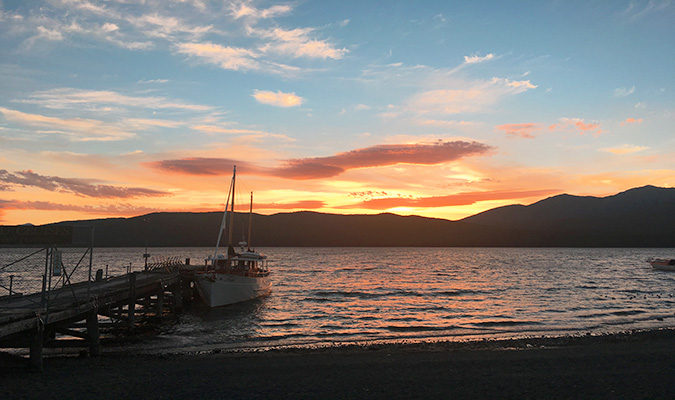
A sunset in New Zealand

As I watched the sky turn a pink as the sun rose, I was glad that, unlike my last visit, I didn’t skip this area. Here in this little town on the edge of New Zealand, where tourists outnumbered locals, there was little else to do but enjoy nature. The region stripped away the distractions so common in other parts of the country.

And I also hoped that when I come back, I’ll show Jim I’ve overcome my fear of heights.

P.S.NEW UPDATED GUIDES! As a reminder, we’ve updated 5 of our guides: Paris, Stockholm, Amsterdam, New York City, and Kristin’s solo female travel guide, Conquering Mountains: How to Solo Travel the World Fearlessly. We added maps and language sections to our guides and tons of new tips to Kristin’s book. If you’re going to any of these cities, grab a guide so you can plan your trip, learn how to save money, get off the tourist travel, and find your way around easier!

The post Flying High in New Zealand’s Fiordland appeared first on Nomadic Matt's Travel Site.


from Nomadic Matt's Travel Site https://www.nomadicmatt.com/travel-blogs/new-zealand-fiordland/

Tuesday, 3 April 2018

AK Monthly Recap: March 2018

If my travel life can be cleaved neatly in half, this is the month where it should be done. Before Antarctica. After Antarctica. The most important, moving, and beautiful trip of my life.

Half the month was spent on board the Ocean Diamond, with seven days of exploring Antarctica and two days crossing the Drake Passage each way. I added a full extra day in Ushuaia and once getting back to New York, spent time exploring the other towns where I once lived.

Where I’ve Been

Ushuaia, Argentina

Stonington Island, Crystal Sound, Yalour Islands, Port Charcot, Lemaire Channel, Cuverville Island, Paradise Harbour, Danco Island, Wilhelmina Bay, Graham Passage, Cierva Cove, and Deception Island, Antarctica

New York, New York, USA

Fairfield, CT, USA

Reading and Melrose, Massachusetts, USA

Favorite Place

Antarctica, all of it, every minute of it.

Highlights

Being humbled by Antarctica. This place was nothing short of life-changing. I went into it in-depth in this post and it remains one of my favorite pieces of writing I’ve ever done.

Not just kayaking, but being a kayaker in Antarctica. Kayaking was amazing — beautiful, peaceful, and it felt like you were alone in the world. But beyond that, the kayakers were a separate group on the boat in Antarctica — it really felt like we were the coolest people on board.

Doing the Polar Plunge! I jumped into 32F/0C water, south of the Antarctic Circle at Stonington Island. I was terrified at first but it was exhilarating! And yes, the jump is on film and there’s an iceberg in the background to prove it!

Meeting so many interesting people in Antarctica. There really was an interesting collection of people on board, of all ages, across the world. I hope to see them again in the future.

Lucking out on the Drake Passage. The most common question I’ve gotten from Antarctica vets is, “How was the Drake?” And honestly, we really lucked out. The Drake Passage is home to some of the roughest seas in the world and some of my blogger friends spent their crossings throwing up. It was choppy on the way down but not nearly as bad as it could have been; on the way back, the captain decided to leave half a day early to avoid storms and it was only a little bit worse.

Landing in Ushuaia. Probably the most beautiful landing I’ve ever had — such incredible jagged mountains. If you’re flying to Ushuaia, try to get a seat on the right!

A beautiful day in Tierra del Fuego. I arrived in Ushuaia a day early, lucked out with the weather and got to explore a stunning Tierra del Fuego National Park in sunshine. I capped it off perfectly with an interesting Patagonian tasting menu at Kalma Resto.

Lots of fun activities in NYC. Hanging out in a salt cave, a Japanese jazz bar, walks through Central Park, seeing all my friends, even my first-ever cupping session as part of my therapy for an injury. Oh, and the Stormy Daniels on 60 Minutes viewing party at my local bar was fun. (Stormy: “I viewed it as a transaction.” Loud Southern gay dude: “As it SHOULD be!”)

Marching for sensible gun laws in the March for Our Lives in New York. I was honored to take part in this protest, nearly 20 years after I first marched for gun control one year after Columbine. And I remain deeply hopeful that this time momentum is on the side of sanity. Whoever controls the narrative controls everything, and we’ve never controlled the narrative like this before.

An impromptu trip to Connecticut for pizza. Turns out Frank Pepe’s is worth the hype — and somehow I went to college nearby for four years without ever going there.

A trip home — and a baby shower! A dear friend from home was showered with love as she prepares to welcome her baby girl later this spring.

Keeping one of my big resolutions for 2018: no more buses home to Boston. The bus is the cheapest and most convenient way to get from New York to Boston, but it’s miserable and uncomfortable, especially if there’s traffic, and my back hurts for days after. (Getting old is fun.) After last Christmas, I decided to prioritize my comfort and start taking the train instead. It costs around 3-5 times as much as the bus, but you can get lower rates in advance and it’s a million times more pleasant.

Finally, this month I joined the Society of American Travel Writers. One of the toughest dilemmas in the travel blogging industry is how to quantify which bloggers have the most value. Many organizations have tried; nobody has succeeded. The SATW is a prestigious organization and it’s hard for most bloggers to meet their requirements, so many elite bloggers are joining this year. Also, they’re having a conference in Barbados in September…

Challenges

I had a bad reaction to the scopolamine patch in Antarctica. After several days on the seasickness patch, my vision blurred so badly that I couldn’t read anything unless it was held far from my face. This was the worst — it was not only scary but I couldn’t see what my camera was focused on.

I met with the ship’s doctor and she told me it was a common side effect of the patch and to take it off. The worst part was that I chose to sit out a kayaking session…and it was THE ONE DAY THE SUN CAME OUT. And it turned out to be the final day of kayaking too, sadly. That’s Antarctica for you! Say yes to everything, even when you can’t see straight, or you’ll regret it.

I was reminded how much I dislike Argentine food. If you take away steak and tasting menus or exceptional fare, the majority of what remains is BREAD and PIZZA and PASTA and DULCE DE LECHE. If you’re not spending a lot of money, you’re going to eat a lot of crappy sandwiches and/or sugary desserts when all you want is a decent salad or a piece of fruit.

Oh, and I got stuck in my building’s elevator. It only lasted ten minutes, but those ten minutes were SUPER FUN!

Most Popular Post

Antarctica and the Traveler’s Ego — How Antarctica wiped my ego clean.

Other Posts

What to Wear in Antarctica: Packing List for Women — The most comprehensive Antarctica packing list you’ll ever need.

Splurging on the Right Things in Tokyo — My second trip to Tokyo cemented it as one of my favorite cities in the world.

Most Popular Photo on Instagram

When I saw there were stamps for El Fin del Mundo in Tierra del Fuego National Park, I figured I could get one. I have a souvenir stamp from Liechtenstein and it looks like a normal stamp. Well, this stamp turned out to be HUGE, taking up the whole page! Whoops! Good thing it’s time to renew! For more updates from my travels, follow me on Instagram at @adventurouskate.

What I Listened To This Month

One of my favorite albums of the century is Maxwell’s BLACKsummersnight from 2009. At the time he said that his next albums would be titled blackSUMMERSnight and blacksummersNIGHT. I worked in search engine marketing at the time and I remember thinking, “Those are going to be the hardest albums to differentiate in Google since the Prince symbol.” I assumed he would change his mind, but blackSUMMERSnight came out in 2016 and I finally started listening to it, and despite the hard-to-convince-Alexa-to-play-it title, it’s AWESOME.

The song “1990x” is my current obsession. Well worth a listen if you ever grinded to Maxwell from the 90s through today.

What I Watched This Month

Netflix has been so good this month! Ugly Delicious is a new favorite. It’s a show about food starring David Chang, the chef behind the Momofuku empire and one of the most buzzworthy young chefs of recent years. This is very much a show of the times — it feels local and familiar and a bit Instagrammy, but not gimmicky. It’s a reminder of how food-focused consumers have become in the last decade. Watching this, I feel like I would be friends with David Chang and all his chef friends. Give it a watch if you haven’t seen it yet.

What I Read This Month

I’m continuing with my effort to read authors from different countries — I think instead of my original goal of 12 for 2018 I’ll aim for 25 or so. This month I added authors from North Korea and Myanmar.

Best of the month: The Heart’s Invisible Furies by John Boyne (2017) — I LOVE when you fall for characters when you read books, and Cyril Avery is one of my favorite characters of the past few years. This novel tells his life story, from a child growing up adopted to distant, eccentric parents; hiding his sexuality in conservative Dublin as an adolescent and young adult; escaping and building a fulfilling life abroad; and finally, his return home. Book of the Month members rated this book the #1 read of 2017 and I can see why.

At 592 pages, this was the biggest unread book on my shelf, so I decided it would be my one real book I’d bring to Antarctica. I started it on the flight to Buenos Aires and finished before I even got on the ship. No joke. It was that good.

When you think of countries that are hostile to LGBT people, you don’t think of Ireland — but in a country so embedded with Catholicism, the slightest hint that you were gay was enough to be excommunicated by everyone you knew. It would make anyone crazy. Cyril had a lot of highs and lows over the course of his life, and I loved standing with him every step of the way as he righted his wrongs and became the man he never thought would be possible. Great ending, too.

The Woman in Cabin 10 by Ruth Ware (2016) — This book has been a major hit, and I knew I wanted to read it on a boat, so it became my Antarctica read. Lo Blacklock is a travel writer on her very first press trip aboard a luxury vessel off the coast of Norway. Then a woman on board goes missing and she suspects she’s been murdered. It’s a fast-paced thriller as Lo tries to figure out who did it before it’s too late.

I didn’t like this as much as I thought I would, but I see why it was a hit. One of the curses of frequent travel is that you notice mistakes in books and movies. This vessel is supposedly hardcore Scandinavian, from its look and style to the names of the staterooms — but if that were the case, the chandelier would not be made of ornate crystal (Scandinavian design is very clean) and there wouldn’t have been rooms named after Finns (Finland is Nordic but not Scandinavian).

Beyond that, I wasn’t crazy about Lo as a character and it irritated me to no end that she was on her first press trip ever and so nervous to do it right — yet she spent the whole time drinking, wandering, and taking zero notes whatsoever. Way to give us a good name, Lo.

Under the Same Sky by Joseph Kim (2015) — Joseph Kim grew up in North Korea during the Great Famine of the 1990s. This memoir shares how he survived near-starvation for several years, outlived his father, saw his sister sold into bride-slavery, was abandoned by his mother, begged and stole for survival, was held capture in a prison for children, and ultimately made the escape into China and, eventually, America.

I knew North Korea had a famine, but I had no idea just how long it lasted. This book illustrates what it’s like to starve for years on end. To work so hard for every single meal — it seems unsurvivable. And yet so many people did survive it. I’ve read a few books about North Korea before, but never by a North Korean who escaped. It’s a devastating book on so many levels and I highly recommend it, along with Suki Kim’s fascinating Without You, There Is No Us, for understanding North Korea today.

The Feast Nearby by Robin Mather (2011)  — After losing her job and marriage in the same week, food journalist Robin Mather needed to find a way to survive on little money as she put her life back together. She moved to a cottage on a lake in rural Michigan and decided to focus on eating local food — and while she initially did for financial regions (eating very well on $40 per week), she realized how much joy this lifestyle brought her.

Two of my guilty pleasures are memoirs about city women who move to the country and memoirs about eating locally, so this was a great choice! She went into great detail about how to source local food, the ambiguities of eating ethically, and the variations within the seasons. The book is filled with lots of recipes as well. My one complaint is one lots of other readers had: she didn’t talk whatsoever about how it felt to lose her marriage and her job, and it seemed odd to completely omit those things from a memoir. Otherwise, I very much enjoyed reading about the food. Oh, and if what she writes here is accurate, her parrot is creepily intelligent. If you’re into books about local eating, one of my all-time favorite memoirs is Barbara Kingsolver’s Animal, Vegetable, Miracle.

Smile As They Bow by Nu Nu Yi (2008) — It’s the time of the Taungbyon Festival in northern Myanmar, not far from Mandalay. Daisy Bond is a ladyboy in his fifties (I’m using male pronouns because the book does) who performs as a natkadaw — the wife of a nat, or spirit. The natkadaw is possessed by the spirit and performs at the festival for money. Daisy has a boyfriend, a twenty-something boy, Min Min, whom he essentially purchased from his mother when he was a teenager. But after years together, Min Min falls in love with a girl and decides to leave Daisy.

What I most loved about this book is how you feel immersed in the festival. Yi paints so many colorful details around — the natkadaws evoking the spirits, people young and old diving for money, the backstage antics and rivalries. And the discussion of the gay scene in Myanmar was fascinating. My only complaint would be that the translation leaves a lot to be desired. It’s choppy and uneven. And while song lyrics often fill the pages, I think they would have had more power if the translator hadn’t tried to make them rhyme. Even so, this gave me my first look into Burmese literature and I really enjoyed it.

Strangers In Their Own Land: Anger and Mourning on the American Right by Arlie Russell Hochschild (2016) — In the last years of Obama’s presidency, before Trump was elected, Hochschild wanted to profile the white working class people who made up the Tea Party. A liberal journalist from Berkeley, California, she focused on the area around Lake Charles in southwest Louisiana. This part of Louisiana is being destroyed by the petrochemical industry, and Louisiana is often in the bottom five states for education and healthcare, yet so many of the residents vote against their interests again and again. Why is this happening? This book tries to explain.

I started this book years ago and I abandoned it because it made me so angry. Residents would be heartbroken seeing their family’s homes become unlivable, land strewn with sinkholes, lakes filled with poisonous fish, bridges on the verge of collapse, and they had the power to stop it, yet they would vote based on a single criterion: does this candidate hate abortion as much as I do? I’m glad I picked it up again, though, working through an hour at a time at my nail appointments. The last part of the book is most interesting, profiling several individuals in-depth.

I read this book to understand the mindset behind people voting far-right. This book didn’t just show me what people believe, but it went into all the factors that influenced those beliefs. Additionally, it made me realize yet another privileged position I hold: by living in a blue state, I get to enjoy all the products made by the American petrochemical industry but don’t have to deal with the resulting damage to my local environment, like the people of southwest Louisiana do.

Maya Angelou: The Complete Poetry (2015) — This is the single most comprehensive collection of Maya Angelou’s poetry. Everything is here, from Still I Rise, which gained a recent resurgence with the women’s marches, to On the Pulse of Morning, written for Bill Clinton’s inauguration, to her complete collections about growing up black in Arkansas like Just Give Me a Cool Drink of Water ’fore I Diiie. Her poetry is about femininity, spirituality, vulnerability, social justice. Her earlier poems are jaunty with a sense of humor; her later, more serious poems have a more disjointed and somber sound. If you’re a poetry fan in the least, you should have this one in your collection.

My favorite new lines, from her poem On Working White Liberals:

This rocky road is not paved for us,
So, I’ll believe in Liberals’ aid for us
When I see a white man load a Black man’s gun.

Eleanor Oliphant is Completely Fine by Gail Honeyman (2017) — Eleanor Oliphant is thirty years old, socially awkward, and somewhat reclusive, living in Glasgow, Scotland. She has no friends and only barely speaks to coworkers. She spends her weekends drinking vodka. And she has a mysterious past trauma that necessitates a social worker’s visits. But when she and a coworker come across an elderly man in medical distress, it sets off a series of events opening her up to possibilities she’s never entertained. A life of isolation slowly gives way to social interaction, friendship, humor, pleasure, even the prospect of love.

At first I assumed Eleanor was neurodivergent, possibly on the autism spectrum, and that’s why this book reminded me of the excellent The Pleasure of My Company by Steve Martin. But it seems that she’s not — she’s just a person recovering from trauma in her own unique way. This book is sweet, heartfelt, and while I consider it an easy read, it felt like it was a “literary” easy read — my favorite kind! I also liked that the relationship at the center of the book is friendship — something that is too often overlooked in literature. I rooted for Eleanor throughout the book and wanted to cheer at the end.

Coming Up in April 2018

It’s a bit hard to say at this moment! Currently I’m spending the first week of April visiting my family in Massachusetts, then on Saturday I have another dear friend’s baby shower followed by a 75-minute flight to New York followed by my sister’s 30th birthday party in Manhattan! I feel like a secret agent with that schedule!

There are some possibilities for April, but nothing is 100% set yet, so stay tuned for more. Nothing international, though — if anything, it will be a short trip or two within the US. After two big international trips, it’s nice to plan much shorter, closer getaways!

Where are you going this April? Share away!

The post AK Monthly Recap: March 2018 appeared first on Adventurous Kate.


from Adventurous Kate http://www.adventurouskate.com/ak-monthly-recap-march-2018/

Monday, 2 April 2018

19 Things I Learned From 10 Years Blogging

Matt speaking at a conference
Back in January 2008, I’d just returned from my trip around the world. I was broke and got a temp job at a hospital. My job was to sit there, answer phones, open the mail, and just generally not break anything while the full-time assistant was on maternity leave. Within a few days, I said to myself “This is not for me.” Being back in a cubicle felt like I was back to the same spot I left. Like the last 18 months on the road hadn’t happened. It was dispiriting. I wanted to be “out there” — that mythical place that was anywhere but home.

Sitting in that cubicle, I wondered, “What could I do to keep me traveling?”

“Travel writer” seemed like a good idea.

So I started a blog to showcase my work, get freelance writing gigs, maybe write some guidebooks, and hopefully make a living from this all. I imagined myself a cross between Bill Bryson and Indiana Jones.

I bugged my design friends for help, learned HTML, wrote blog post after blog post, connected with other bloggers, pitched stories to online publications, and figured out SEO and social media.

Today is the anniversary my first post. I can’t believe I am still at it ten years later. What started as an online resume has morphed into a business that includes this website, a charity, hostel, conference, blogging course, community meet-ups, tours, ebooks, and a NYT best selling book.

So, on today’s ten-year anniversary, I want to share some of the business/blogging lessons I learned (often the hard way) in the past decade:

1. Being first helps, but it’s not a prerequisite for success.

When I started, travel blogging was in its infancy. Starting before it became mainstream certainly helped contribute to the success that I have today. It would be foolish to deny that.

But it’s not the most important thing. After all, Netscape was first — but how many of you still use that today?

And I can name dozens and dozens of blogs that went under despite having started early.

But more importantly, I can name dozens and dozens of blogs that have started in the last few years that have done extremely well.

What matters more than being first is being persistent and innovative, creating quality content, offering something that solves your readers’ problems, networking, and many other things. “Being first” would be low on my list of “things you need for success.”

2. You’re going to change — and so will your blog. That’s OK.

Your life is going to change — and so is your blog. At first, I wanted to travel a lot and just blog. Now, I want to stay in place more. Build a routine. Go to the gym. Write more books. Maybe start a podcast. Mentor more. Do more community events.

Basically, not be nomadic anymore.

For a long time, I resisted that change. I tried to still be the person I was when I started this whole thing. What would I be if not Nomadic Matt? How would this website continue?

Then I said, “Who cares? So long as this website is helping people travel, it’s not really important if I am always on the road. The content matters more than anything else.”

People will either love it…or they won’t, being on (or off) the road won’t change that.

Moreover, the lives of your readers will also change. They will get older too. They will have new desires. Maybe people stop reading your blog because they find it boring. Or they grow out your advice, Or they simply stop traveling. It doesn’t matter. That’s just how it is.

Life changes for you and your readers.

Don’t fear change.

3. Don’t do this for you. Do it for your readers.

Matt's readers
Do you know who the most successful people are? The ones who wake up and think about how they make someone’s life better. The people who do whatever it is they do for a reason beyond themselves. If your goal is to get free travel and how to do cool stuff for yourself, the Internet will quickly tire of you. No one wants to read the story of someone doing things they can never do. “Inspiration porn” only goes so far. We all want people – and businesses – that solve a problem we have a problem in our life. That can be anything from the mundane “I need to know how to dress better” to the esoteric “what do I do with my life?”

No matter what you do, do it for your readers. Think about how to solve their problems.

Do something that makes your audience go, “Because I came here, my life is better.”

For me, that’s helping people travel cheaper. Figure out what it is for you. Your mission should never be “How can I make my life better?” People will see through that. Being a personality on the Internet only lasts so long as your schtick is in vogue.

If your mission is reader centric, you’ll stand the test of time.

4. Because your readers want you to succeed.

Your audience wants to support you. They read you for a reason. Give them a way to support you. Don’t think, “Oh, people just like free stuff. I’m gonna need to throw up ads and do brand deals or I’ll be broke.” People want to support artists and creative people they love. Don’t be afraid to sell them a product you created. Or start a Patreon page. Or do tours. Or create a subscription service for added content. Mark Manson does that for $5 a month. You know what? I bet a lot of people pay that.

Give people a way to support you and they will surprise you. Because when you create something that helps people and improves their lives, they want to support you. They will go out of their way to do so. Because everyone wants to help those that help them.

5. Ways to monetize will change greatly.

There have always been easy ways to make money online. First, it was Google’s ad network, AdSense. You’d slap up a few ads that looked like normal links and people would click away. Then it was banner ads. (Those both still exist, but how many of us click on banner ads?) Then it was selling text links to companies trying to game SEO. Then sponsored posts that did the same thing but were supposedly harder for Google to detect.

Each was a fad that people said would last forever. (Now, it’s “influencer” marketing, where everyone with a following gets free stuff, and people are still saying the same thing about that.)

But everything changes.

If you’re only doing the most popular thing to make money online, you are going to fail. When the tides shift, you’ll be left holding the bag and having to start over again.

Never rely on a fad for your income. EVER.

For example, you used to be able to sell e-books for like $50. Now, thanks to Amazon and people used to $1.99 Kindle books, that’s changed. No one buys expensive ebooks anymore. Ebooks are a cheap product. We sell a lot of ebooks and had to adapt our model…but it also forced us to figure out other ways to monetize. We used to rely on one page for a lot of our affiliate income but then it dropped in Google and we had to scramble to figure out what to do.

Always assume whatever it is your doing is not going to last. It will keep you innovating.

6. Create your own products.

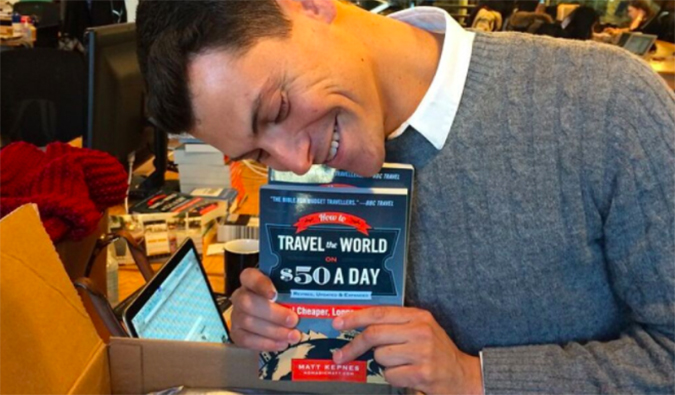
Matt with his book
Continuing on that idea, own your income stream as much as possible: e-books, tours, T-shirts, whatever.

When I started out, I sold a lot of text links (see #6). Then one day it all went to zero after Google changed its algorithm. It didn’t bother me, though, because by then I had already moved on. I had e-books. Then tours. Then courses. A hostel. A conference. I had diversified my income and created my own products.

Having your own thing — no matter what it is — means you don’t rely on others for your income because you never know what could happen. Amazon could kick you out of its program or cut its payout in half (we got kicked out for a few months and lost thousands. Luckily, we’re back in but that money is gone), influencer marketing could change, brands might not want to work with you, or someone could cut their affiliate rate or stop offering their program altogether.

When 100% of your income is from other people, you are 100% at the mercy of other people. Creating your own products allows you to be independent.

Always own your income.

7. Your first stuff will suck.

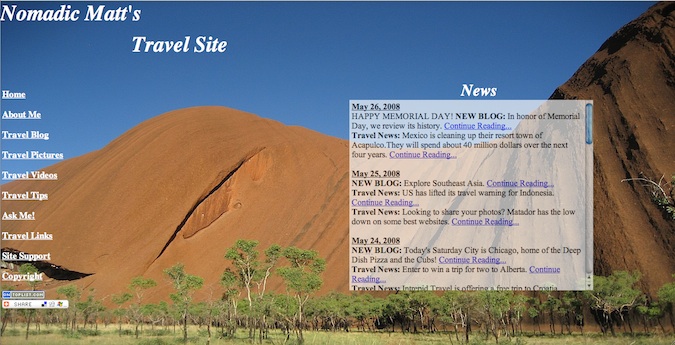
Early homepage of Nomadic Matt's travel site
Years from now, you’ll look back at your first articles and go, “Who the hell wanted to read this? This is horrible!” Or you’ll look at the first version of your website (see above) and go “What the F was I thinking!!!” It’s only natural. It means you’ve grown as a writer (and a blogger). It’s about progress, not perfection. In the beginning, don’t obsess about your work (whether writing or design). Just put it out there and go back later and fix it.

Why? You only get better by doing. Never wait for perfection. And if you wait for perfection you’ll never start your blog. There’s no cost to putting up a website. Just get it up there and fix the problems later!

8. SEO is not a dirty word.

A lot of bloggers think SEO is this dirty thing, that optimizing for Google takes away from the “humanness” of their website. But every day, billions of people search for answers to their questions. Optimizing your website for search engines means that your website can be the one that answers their question. It’s a source of unlimited free traffic!

Over the last decade, focusing on SEO has given me a huge advantage and has helped me reach millions of people, earn a living, and get media mentions (I once got a big feature on CNN because the journalist found me on Google).

9. Write for humans.

But still, write for humans. Don’t put in overly optimized content, because, at the end of the day, you want people to connect with your website. No one is loyal to WikiHow or another generic information website. People read blogs because they connect with the voice behind it. Optimize for Google, but write for humans.

10. There will always be setbacks.

Six years after I started this blog, I lived on credit cards for three months. I had put all my money into a Kickstarter project, and until that ended, I was broke. I hit my fundraising goal, paid off my bills, and launched the app. But it turned out I didn’t know how much work apps were, and, by the time I stopped updating the app, I was down $10,000.

I’ve run sales that didn’t go anywhere. Launched books no one bought. Hosted webinars no one showed up to. Made shirts no one wanted. Redesigned parts of my website that caused conversions to crash. Hired consultants that didn’t do anything but sap my bank balance. Tried video that went nowhere.

I’ve failed constantly.

The trick is to remember that failure is a teacher. Sure, it sucked wasting time and money on all these projects that didn’t work out but we took the lessons from these projects and improved the site and reader experience other ways. If you believe in your mission, just pick yourself up, dust yourself off, learn, and move forward. You’ll find another way to get your message across.

As Edison said, he didn’t fail, he just found 10,000 ways that didn’t work.

11. People will be really mean. I mean REALLY mean.

The Internet brings out the best — and the worst — in people. They will get really mean. I mean so mean that you’ll want to curl up into a ball and cry. You might actually do so. I have a whole folder of all the mean emails I get.

You have to learn to develop a thick skin. Because it is only going to get worse the bigger you get.

It takes time to learn to do this, but don’t take it personally. It’s never about you. It’s about their problems and their lives. People like to troll to make themselves feel better. You’re just their current target.

Just ignore the haters and move on. It’s easier to say than do, but you must!

Because for every troll, there are a thousand people who value what you do.

And, when you get a troll, send this video:

12. Start an email list.

From the day you start your blog, start an email list. Tweets, Facebook, social media — people miss those updates all the time.

Social media changes all the time. Facebook says “pay me or never your readers will never see your content,” Vine goes out of business, and Instagram does some funky stuff — and suddenly you can’t reach people anymore.

But no one misses an email. Everyone checks their inbox all the time! Email is still king. My greatest mistake was not starting an email list right at the beginning. Forget about the likes. Get emails and you’ll always own control of your audience. No algorithm can take that away from you.

13. Never call yourself an influencer.

Stephen King has influenced a generation of writers, George Lucas a generation of sci-fi fans, Gloria Steinem a generation of women. Ditto to folks like Gene Roddenberry, Ernest Hemingway, Tim Ferriss, Carrie Fisher, Gal Gadot, Levar Burton, Mr. Rogers, Steve Jobs, and countless others.

They got people to do something. To better themselves, read more, follow their dreams, and strive to be better.

They influenced.

Do they go around calling themselves influencers?

No.

Why?

Because being an influencer is a fake profession created by millennials and social media “stars.”

You have influence when people listen to you. When I find myself thinking “What would Bryson do?” — that’s Bryson’s influence. My friends have influence over my life when I follow their recommendations. In some ways, I have influence when I suggest something travel related and someone does it.

You have influence when you provide value and make someone’s life better.

You do NOT have influence because 20,000 people “liked” a photo on their way home from work.

True influence comes not from calling yourself an influencer but from what you actually do and the example you set.

Don’t set out to be an influencer. Because that is YOU centric. Not READER centric. (See #3 again.)

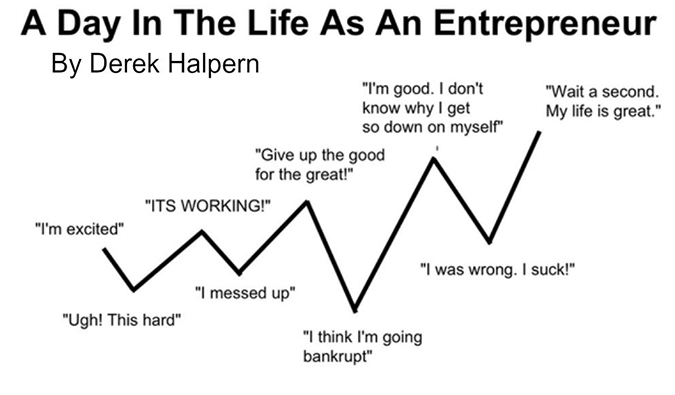
14. Success takes time.

Success takes time
(Photo from Derek Halpern)

A lot of people try to become insta-famous these days. They want to be rich and successful NOW and don’t care how they get there. But where are those Vine stars now?

I can’t fault people who want quick cash, but remember, real success takes years to achieve. It’s work. Anthony Bourdain didn’t get famous overnight. Stephen King was rejected countless times. Morgan Freeman didn’t get famous until he was 40. It took me years to turn this into a living.

This is a marathon, not a sprint.

If you don’t have the patience for the long haul, you should find something else to do.

15. There will always be someone better.

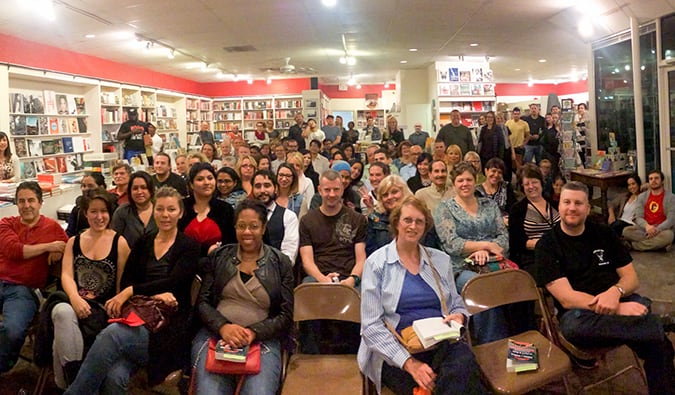
Matt at a conference
Be humble. Remember that as good as you think you are, there is someone better. I can name ten people who do what we do better. All that does it make me try harder. Don’t say, “that person is making it and I’m not.” Say, “That person is way better than me. What can I learn from them?”

Only fools think they are wise. People who don’t learn or find mentors are the ones that fade away. Most of the bloggers I know who stagnated or failed were also the ones that never read books, never found mentors, or never attended conferences. They never improved themselves. My success is in part because I always sought out new knowledge, books, and especially teachers. I wouldn’t be here without my mentors.

If you aren’t learning, you aren’t growing.

16. If you’re going to be a business, treat this like a business.

It’s easy to view everything as having a cost, but investing in your business is the surest way to grow it.

When I started, I didn’t have much money and I hated spending money on things. I found the cheapest designers, hosting, virtual assistants, and tech support. I went cheap — and I also did a lot by myself. I regret that. Now I wish I had paid a little more for quality.

I know what it is like to start your blog with not a lot of money, but the day you decide to make this a business, put more money into it. Buy a nicer theme, get a better hosting platform, get a better email service, hire someone to help. This will help you grow quicker. And the quicker you’ll grow, the sooner you’ll start making up the costs of your investments.

The scariest thing I did was hiring a full-time employee, but it allowed me to do so much more. It allowed me to make a much better website.

I once paid $5,000 to go to a high-level conference. Why? I knew the people there were going to help me go the next level. It was a lot of money and I couldn’t really afford it, but I knew if I was going to grow my business, I needed the people in that room to help me out. If the right people are in the room, no amount of money is too much.

17. Don’t be afraid to take a second job.

When I started, I was working as an English teacher. Daymon John from FUBU waited tables while he built his business. Don’t be afraid to get a second job while you develop this venture. It may take longer to get off the ground, but it’s a lot better than being a starving artist!

18. It’s OK to walk away.

via GIPHY
If you don’t want to do this, walk away. If you start a project and don’t love it, walk away. We get so invested in projects that our pride keeps us from giving up on them. But sometimes you just need to walk away. Successful entrepreneurs don’t double down. They know when to walk away and shift their energies to something else.

19. Remember timing is everything.

Timing and luck are everywhere. Being at the right place at the right time is a big percentage of success. I got lucky by starting when there wasn’t a lot of competition. I got lucky by having good teachers, seeing that Tweet that got me a New York Times interview, and that Facebook ad that got me an invite to a conference attended by the best businesses minds in the world. I got lucky when someone found my website and featured me on CNN, sending a ton of traffic and more interview requests. A lot of success is just being at the right place at the right time.

I never think, “I am a success because I am great at everything.” No, I am a success because I’m better than average at a lot of things (and outsource the things I suck at) but also because I’ve been in the right place at the right time.

Remember that. No one is a success because they are great at everything. People are a success because of a combination of skill and luck.

***

As Mary Schmich said, “Advice is a form of nostalgia; dispensing it is a way of fishing the past from the disposal, wiping it off, painting over the ugly parts, and recycling it for more than it’s worth.”

But I hope you found something of worth here as you start your own ten-year journey.

P.S.- If you’d like to learn how to start a blog the right way, avoid my early mistakes, and get a peek at all the processes and methods I use to continue to grow this website (without scammy ads), check out my blogging course. It gives you all my secrets as well as direct feedback on your website from me and tech support from my tech team.

P.P.S. – If you’re in NYC, we’re hosting a meet-up Wednesday night at 7pm at Solas. Come join us! You can find out more and RSVP on our event page!

(Photo credits: 5)

The post 19 Things I Learned From 10 Years Blogging appeared first on Nomadic Matt's Travel Site.


from Nomadic Matt's Travel Site https://www.nomadicmatt.com/travel-blogs/10-years-blogging/