Thursday, 23 February 2017

How to Visit Malta on a Budget

beautiful harbor in malta, photo by Daniel Sjöström (flickr: @damienz)
For centuries, the Maltese archipelago passed between North African Moors and European Crusaders in an epic struggle for control of this important hub. This constant back and forth created a culture that blended architectural, culinary, and cultural styles (in fact, the Maltese language is a mix of Arabic and Italian) unique to nowhere but maybe Southern Spain.

Now, the country draws people less with the whole conquering-empires-thing and more with its warm summer temperatures, pristine beaches, clear Mediterranean water, striking hiking, friendly locals, and cheap prices.

Though I didn’t spend as much time as I wanted in Malta, I spent enough (literally and figuratively) to get a sense of how to travel the country on a budget. Luckily, the country is already very budget friendly (it’s one of the cheapest Eurozone countries out there) so you don’t need a lot to begin with. Even though I was on a holiday and not being as budget friendly as I wanted, I still never spent a lot of money. My most expensive day cost me 70 EUR, and that’s because I rented a car! Even when I was watching my wallet, at no point did I ever feel as if I was missing out.

Though Malta will never break your budget, I always am one to look for a deal as I’m a firm believer that every destination has a way to be cheaper.

So here is your in-depth guide to visiting Malta on a budget:

Getting There

While most European carriers operate seasonal flights, there aren’t many airlines that fly to Malta year round. Ryanair, Air Malta, easyJet, and Lufthansa are the biggest carriers that service the island year-round. One-way flights from the mainland cost 50-100 EUR ($53-106 USD), especially if you book in advance. You can also take the ferry to/from Sicily; it’s 2.5 hours and costs 61-127 EUR ($65-135 USD) each way (depending on the season).

Typical Costs

cars on a colorful street in malta, photo by Tobias Scheck (flickr: @uncloned)
Malta is cheap. While I went in the middle of winter — without the seasonal increase in prices for accommodation, car rentals, and flights — many friends told me that most prices for food, activities, and public transportation stay the same throughout the year. Here is a list of typical costs in the country:

  • Bottle of water: 1 EUR ($1 USD)
  • Ferry to Valletta from Sliema: – Single: 1.50 EUR ($1.60 USD), Return: 2.80 EUR ($2.95 USD)
  • Pastizzi (cheap snack): 1-2 EUR ($1-2.10 USD)
  • McDonald’s value meal: 5-6 EUR ($5.25-6.50 USD)
  • Sandwich: 6 EUR ($6.50 USD)
  • Bottle of wine: 8-10 EUR ($8.50-10.50 USD)
  • Ferry from Malta to Gozo: Pedestrian: 4.65 EUR ($5 USD), Car and Driver: 15 EUR ($16 USD)
  • Car rental:  38-48 EUR ($40-50 USD)
  • Nice dinner at a sit-down restaurant with wine: 25 EUR ($27 USD)
  • Main meals: 10-14 EUR ($11-15 USD)
  • Pizza: 6-9 EUR ($6.50-9.50 USD)
  • Lunch at a cafe: 8-10 EUR ($8.50-10.50 USD)
  • Beer: 3 EUR ($3.15 USD)
  • Public bus ticket: 2 EUR ($2.10 USD)
  • Taxi prices: 10-20 EUR ($10.50-21 USD)
  • Museum entrance: 6 EUR ($6.50 USD)
  • Breakfast sandwich: 3-4 EUR ($3.15-4.25 USD)
  • Full breakfast: 8-9 EUR ($8.50-9.50 USD)

On average, you’ll be able to visit Malta 30-45 EUR ($32-48 USD) per day, though in the summer I would say you need to budget closer to 50 Eur. At that price, you’re looking at staying in a hostel dorm or splitting an Airbnb with a friend, taking public transportation, mostly sticking to the free activities, cooking your breakfast, and eating to the cheap(er) cafes.

How to Save Money in Malta

Accommodation
beautiful building facade and bright red shutters in malta
There are a couple of hostels on the islands, with dorm prices beginning at 9 EUR ($9.50 USD) per night (though prices double in the peak summer time). Airbnb is ridiculously cheap — I found a whole house for 35 EUR ($37 USD) a night. Most budget hotels cost 40 EUR ($42.50 USD) so I would stick to Airbnb or hostels for accommodation. However, like hostels, the prices for places more than double to around 80 EUR ($84 USD) per night. Budget hotels cost around 40-60 EUR ($42-63 USD) in the summer.

To save money on accommodation, travel off-season and stay in dorms or split Airbnb units with friends. You can use the website eurocheapo.com to find good B&Bs, as they have a robust listing.

Food and Drink
good mediterranean food in Malta, photo by: (flickr: @)
Food prices are relatively inexpensive, though you’ll find higher prices in tourist areas such as Valletta, St. Julian’s, Sliema’s boardwalk, and Marsaxlokk.

To save money on food, stick to the pastizzi (savory filled pastry) for about 1-2 EUR ($1-2.10 USD), eat at the plethora of vegan and vegetarian restaurants throughout the country (see the list below), avoid snacking, and cook as many meals as possible (breakfast will see the biggest wins).

Transportation
ferry from valletta to sliema in malta, photo by Charlie Dave (flickr: @charliedave)
There are three ways to get around the island: buses, taxis, and car rentals. Buses cost 1.50-2 EUR ($1.60-2.10 USD) for a two-hour ticket or 21 EUR ($22 USD) for a weekly pass, while car rentals cost 39 EUR ($41 USD) per day (in the summer they start closer to 50 EUR or $53 USD per day. There are a number of local rental companies, but I used Hertz since it was close to my Airbnb. Many of the local car companies don’t take credit cards and want deposits in cash. Going with bigger companies adds another layer of security.

Taxis cost 10-20 EUR ($11-21 USD); while not ideal, they can be ordered ahead of time via Whatsapp and are a good last-minute option if you get stuck because the bus doesn’t turn up.

One thing to note about the buses is that they are infrequent so they fill up fast. We got on one bus, only to have him pull over, kick everyone off, and put us all in another bus, that then waited for 20 minutes to move. It’s a crazy system and, during the summer months when the crowds peak, expect long waits. Don’t be in a rush if you’re using the bus!

Activities
azure window at a beach in malta, photo by Berit Watkin (flickr: @ben124)
When the weather is nice, there are a bunch of free activities to do, such as enjoying the beach, hiking, swimming, and just walking around. Additionally, all the churches are free. You’ll find a lot of companies that will take you around the island in a boat for 25 EUR ($27 USD). Most museums and attractions cost 5 EUR ($5.25 USD) but you can get a Malta tourism card (there’s one for Mdina and a separate one for Valletta) that will save you about 10-20 EUR ($10.50-21 USD) depending on how many attractions you squeeze in.

On a side note, I found the main tourism center in Valletta unhelpful. The staff couldn’t answer a lot of my questions. The smaller, unofficial locations that littered Sliema’s boardwalk had more information on car rentals, things to do, and prices.

Recommended Bars and Restaurants

Restaurants: Rising Sun (Mdina), Loli (Vegetarian), The Grassy Hopper (Vegan/Vegetarian), the Marsaxlokk fish market, Suruchi, Ta Doni, Cuba, Rocksalt, Ta’ Rikardu (Gozo), Electro Lobster Project.

Bars: Hole in the Wall (Sliema), Native (and any bar on that street as it’s the main hub for nightlife), Dubliner, Legligin, The Thirsty Barber

****
It’s easy to visit Malta on a budget. I was shocked at how cheap this place. Even with summertime increases in accommodation and tour prices, Malta remains an affordable country. I’ve been to all the Eurozone countries now and I have to say Malta is one of the best — if not the best — value. When you combine it with warm weather, amazing landscape, historic cities, and incredible beaches, Malta because one of the best destinations to visit in Europe if you’re looking to save money.

Looks like all those British retirees were on to something after all!

P.S. – BIG NEWS! This year I’m relaunching the Nomadic Matt group tours. You can come travel around with me and other community members! I’ll be doing four over the course of the summer. You can find out more about them and sign up by clicking here

Photo Credits: 1, 3, 67, 8

The post How to Visit Malta on a Budget appeared first on Nomadic Matt's Travel Site.


from Nomadic Matt's Travel Site http://www.nomadicmatt.com/travel-blogs/malta-budget/

Where to Stay in Barcelona — Best Neighborhoods and Accommodation

Where’s the best place to stay in Barcelona? I called in the experts! After writing my Where to Stay in Paris post, I was inundated with requests to do one for Barcelona, too. At the time, I grumbled, “I’m only one woman — I’m not an expert on every city in the world!”

But you know what? You really want to know. And while I’ve been to Barcelona several times, I don’t know it like I know Paris (and I can’t stand when travel bloggers write ultimate guides to places they barely know). So I hired two Barcelona experts to write the best, most detailed Barcelona accommodation guide possible: Ashley and Alex from the blog In Pursuit of Adventure.

And for the record — my personal favorite Barcelona neighborhood to stay in is Gràcia!

Take it away, guys!

Kate

The enchanting city of Barcelona is our favorite city in Europe to explore, and we love indulging in its unique culture. We’re not alone — tourists around the globe flock to this coastal Mediterranean city year-round, seeking out beautiful beaches, a vibrant culinary scene, and lively nightlife.

Barcelona is part of the region of Catalonia in northeast Spain, and the independence flag hanging off balconies reminds us that they are Catalan, not Spanish. The Catalan residents are proud of their city, their culture, their heritage, and of course their fútbol team, FC Barcelona! Their spirit of independence is contagious and gives the city so much character.

But choosing where to stay in Barcelona can be overwhelming, as it’s a large city broken into many different neighborhoods. Each neighborhood has its own distinct feel, charm, and loyal locals. So what do you do? That’s where we come in!

We know each of these Barcelona neighborhoods like we know the stamps in our passports. So here are our favorite neighborhoods to make your trip memorable. Just remember, no matter where you end up staying in Barcelona, be sure to venture out and sample the charms of each neighborhood from the touristy yet hipster neighborhood of El Born to the gritty and diverse El Raval.

Best Neighborhood Overall: El Born

El Born is the neighborhood to stay in if you are looking to be in the heart of the old city with fantastic artisan shops and hip restaurants. While it can be touristy, El Born is one of our favorite neighborhoods.

El Born is also perfect for anyone looking to be in the heart of Barcelona, as it’s walking distance to Barceloneta, the beach, the Gothic Quarter, and several metro stops that can connect you to all the different major sites in the city.

This neighborhood is perfect for exploring little local shops full of amazing products from handmade ceramics to custom leather aprons (which every trendy restaurant seems to have their waiters wear!) to art galleries. The alleyways are filled with street art, especially la bomba (the bomb), which represents Barcelona’s anarchist spirit, and flags and buntings for the perfect photo opportunities.

Be sure to pop into the Picasso Museum, which showcases the artist’s work from an early age to some of his most famous paintings. Try to visit on the first Sunday of the month when it’s free! Then grab a coffee or a vermouth at one of the many outdoor patios and soak in the relaxed lifestyle here.

Lower El Born is the more touristy side of the neighborhood with the church of Santa Maria Del Mar dominating the area and a large pedestrian area lined with hip restaurants, cocktails bars that go all night and boutique shops.

Upper El Born is quieter, filled with more residential apartments, local bar, and the famous Mercat Santa Caterina where you can go for the best local menú del día, or lunch special, at Bar Joan, which we think is the best lunch deal in town.

Check out hotels in El Born here.

Best Neighborhood for Beach Lovers: Barceloneta

Barceloneta is probably the proudest Catalan neighborhood in Barcelona and you’re never further than five minutes from the beach. The independence flag of Catalonia flies proudly from almost every balcony here.

Barceloneta is also the neighborhood where you will see the most backlash on tourism. Residents want to keep the neighborhood local and have fought ardently to keep it that way.

That doesn’t mean you should stay away, though. Thoughtful tourists who respect the locals are welcome. That means that when you leave the beach, put on some clothes before you pop into a shop or grab a bite to eat. If you are out until the early hours of the morning (which happens easily here), keep your voices down to avoid disturbing people who are asleep.

Also, make an effort to support local businesses here. Head to small, family-run restaurants like La Cova Fumada, where la bomba (not the street art — in this case, a glorious ball of fried mashed potatoes stuffed with minced meat and topped with aioli and bravas sauce) was first invented back during the Civil War. Or head to Vaso del Oro, where they have been brewing their own beer and serving it up in flautas, or beer flutes, for over fifty years.

Take a stroll along the sand and notice all the locals out walking, rollerblading, biking, and soaking up the Mediterranean sun. Barceloneta will treat you well if you treat it well.

Check out hotels in Barceloneta here.

Best Neighborhood for a Cultural Mix: El Raval

El Raval is the infamous neighborhood once known for drinking establishments, cabaret shows, prostitution, crime and Hemingway — and that’s exactly why you should stay there.  This neighborhood embraces its gritty past while looking to a modern future. Centrally located near the main port in the historical district of Barcelona commonly known as Ciutat Vella, today El Raval is far more charming than seedy.

The neighborhood is known for its diversity and often referred to as Barri Xinès, or Chinatown, by the locals. Today Chinese, Pakistanis, Filipinos, South Americans, Eastern Europeans and Middle Easterners inhabit the neighborhood, creating a unique melting pot of cultures.

Here you will also find one of Gaudi’s earlier works, the Palau Güell, and the Barcelona Museum of Contemporary Art, more affectionately called MACBA. Here you will find locals of El Raval on the steps drinking wine and watching the skateboarders do tricks in the streets.

Today El Raval has become a treat for young foodies and boozehounds. The neighborhood is filled with restaurants and bars like Bar Marsella (pictured above), an old absinthe bar stuck in the time of Hemingway (the writer himself used to drink here quite often), or Bar Cañete, a modern player in the Barcelona culinary scene using classic Catalan ingredients to make innovative, modern dishes. 

Check out hotels in El Raval here.

Best Neighborhood for Foodies: Poble Sec

Poble Sec is the perfect neighborhood to stay in if you are looking for a some peace and quiet but also want to eat like a local. The neighborhood is quiet during the day but really comes to life at night when all the tiny tapas bars along the pedestrian-only Carrer de Blai open up shop and fill with hungry locals. This is the neighborhood to drink vermouth, grab some cheap eats, and revel in being Catalan if only for the duration of your stay.

While there are no major tourist sites in Poble Sec, this neighborhood is well connected by metro and it’s just a hike up the hill to see the castle of Montjuic, the gardens, and to take the funicular down to the beach.

This is also the neighborhood to visit Quimet & Quimet, one of the most famous tapas bars in the city. Here they focus on high quality conservas, or canned food, and montaditos, small open-faced sandwiches.

Squeeze in here, order some cava, a couple montaditos and throw your napkins on the floor like a local — that’s what you do in Poble Sec!

Check out hotels in Poble Sec here.

Best Neighborhood for a Small Town Feel: Gràcia

Gràcia is the neighborhood to stay in if you are looking for that small town charm while still in the big city. One of the more unique neighborhoods, Gràcia was its own village until Barcelona’s expansion absorbed it into the city itself. The locals, however, still very much consider themselves separate to Barcelona and it’s noticeable as soon as you exit the metro. It feels like you’ve stepped into another world here in Gràcia.

We personally love Gràcia as it is lesser-known to tourists but has a wonderful bar and restaurant scene, especially for classic Catalan dishes. Cal Boter is one of those restaurants that features traditional dishes like snails and pig trotter. If that’s a little too old-fashioned for your taste, head over to Bar Bodega Quimet for tapas in their small, bustling, and decidedly local bodega. Don’t forget to grab a drink at La Festival, a modern wine shop focusing exclusively on organic and biodynamic wines.

During the late afternoon, head to Plaça del Sol, the main square, where everyone in Gràcia congregates to gossip, people-watch, and just enjoy their daily life. Grab a beer and join in!

Gràcia exemplifies what Barcelona is all about: individuality and independence against larger outside forces.  It’s quiet and quaint with traditional shops but leaves room for modern roots to be established. Gràcia comes as a highly recommended neighborhood to stay in especially if you enjoy that local vibe and you are visiting Barcelona for the second or third time, as it is not located in the old city.

That said, Gràcia is located just beneath Gaudi’s famous park, Parc Güell, and is close to lesser-known Gaudi architecture and Tibidabo, an amusement park from the early 1900s that is still operational.

Check out hotels in Gràcia here.

Best Neighborhood for Hipsters: Sant Antoni

Sant Antoni is the hipster neighborhood and is the perfect place to stay for those looking for a modern vibe in the old city. While still very residential, it is quickly becoming host to a number of hip establishments like Cafe Cometa and La Donutería (yes, you can even find fancy donuts in Barcelona!). You will also find locals of Sant Antoni congregating around the Carrer del Parlament which is host to several very chic restaurants, bodegas and bars.

Sant Antoni hasn’t totally abandoned its roots, however, and here you will also find the much loved old school La Bodega d’en Rafel. They’re also renovating the heart of the neighborhood, Mercat Sant Antoni, which has been around since 1882.

Sant Antoni is a neighborhood that is focused on residential life, making it a great neighborhood to live like a local. However, it is not as well-connected to the city for first time visitors and does not have any tourist attractions. It also doesn’t have any major hotels, so apartment rentals may be the way to go here.

However, with the expansion of restaurants and nightlife, this may change in the future; Sant Antoni is, after all, the chic neighborhood. 

Check out hotels in Sant Antoni here.

Best Barcelona Hotels

You can compare rates on hotels throughout Barcelona here. Here are some of our top recommendations:

Best Luxury Hotel: W Barcelona

The W is an icon and the place to stay for luxury in Barcelona. Located on the beach in Barceloneta, across the street from the Desigual headquarters, the W Hotel invites sunbathers with its glass sail-like facade, reflecting the city and the beach below. 

There is a pool with a bar located on the 26th floor, so you can soak in views of both the city and the Mediterranean. Plus, during the summer they host a series of parties with local and international DJs on their pool deck. The W is the epitome of Barcelona cool.

Rates from 230 EUR ($242) per night.

Best Mid-Range Hotel: Barceló Raval

Dominating the skyline at Rambla del Raval is the Barceló Raval. This imposing circular hotel offers the perfect place to stay in the heart of the city with 180-degree views. Prices are very reasonable for the quality you receive. Plus, there is a swimming pool and a 360-degree rooftop bar that is the perfect place to catch every gorgeous Barcelona sunset. (That photo above is from the roof!)

Rates from 90 EUR ($95) per night.

Best Hostel: Generator Barcelona

Located in Gràcia, Generator Barcelona is a fantastic hostel to stay in while visiting the city, especially if you’re not a hostel person. The design of this hostel alone makes it less like a hostel and more like a boutique hotel. They also have a range of rooms starting from dorm shares to privates with twin beds to even a penthouse with a terrace!

This hostel has it all — free wifi, a lounge, even a bar, and is the perfect place to decompress after a day of sightseeing or a wild night out. You can meet lots of fellow travelers if you wish or just relax and enjoy your solitude.

Dorm beds from 11 EUR ($12) per night, private rooms from 45 EUR ($47) per night.

Barcelona Travel Tips

Barcelona can be overwhelming at times, so here are some travel tips to ensure you have the best trip possible:

Don’t stay too far outside the city. Barcelona has a very large metropolitan area, which is more than just the downtown and tourist sites, and the easiest way to ruin your trip is to stay too far outside.

Instead, stay within the old city limits of Barcelona, or right outside like in Gràcia, because when you are out in the boonies it can be difficult to find transportation back and forth to downtown. Keep in mind that the metro closes around midnight — you don’t want to take expensive taxis or tear yourself away like Cinderella!

Avoid La Rambla. La Rambla, or Las Ramblas as it is more often called, is the most famous street in Barcelona and at one time would have been a wonderful place to stay. Over the years, however, its popularity has become its downfall with overpriced souvenir shops and tourist traps.

We suggest taking a walk down to see La Rambla for yourself, but avoid spending too much of your precious time there. Barcelona has a lot of amazing things to offer you, but La Rambla is not one of them. Go see it and then hightail it to El Raval or El Born.

Learn a little Catalan. Barcelona’s official language is Catalan, not Spanish. Locals will not expect you to know Catalan, but they will appreciate it. Say bon dia for hello, adéu for goodbye, and mercès for thank you. Learn these three simple phrases and the Catalans will be so appreciative of your respect of their language!

Barcelona is best seen on foot. Despite its large size, Barcelona is a walking city at heart. Most of Barcelona’s tourist sites are clustered around Ciutat Vella, the old city. The little windy streets are like treasures — and you’ll miss them when underground on the metro!

Soak up all the wonderful vibrant energy this city has by taking daily strolls in different neighborhoods. You never know what you may encounter. As a bonus, you will work off all that wonderful food you’ve been eating. Speaking of which…

Eat when the locals eat (yes, they eat late). To truly understand the Barcelona lifestyle, you have to eat when the locals eat, otherwise you’ll be sitting in empty restaurants that are only for tourists. Get up in the morning but not too early, as the Catalans are not early risers, and have a cafe con leche (coffee with milk) with some pan con tomate (bread rubbed with tomato and garlic).

And then between 12:30 and 3:00 PM, enjoy the menú del dia, daily cheap lunch specials that often get you three courses with wine for around 10-15 EUR ($11-16). Locals love the menú del dia!

Drinking and eating is crucial to Catalan life, so grab drinks and tapas between 6:00 and 9:00 PM. Hop from one tapas bar to the next while enjoy a drink and just grab a few tapas at each place. Stand up at the bar or outside as you enjoy the bustling atmosphere.

Next, head to dinner around 10:00 PM and take your time eating. There is no rush in Catalonia, especially when you stay centrally and don’t have to worry about the metro closing! This is what the locals do, so you might as well enjoy it while you’re there.

Don’t Visit Barcelona Without Travel Insurance

A lot of people think travel insurance is an unnecessary expense — that’s far from the truth. Travel insurance is vital. It’s saved Kate hundreds of dollars and for one of her friends, who slipped and broke his back while traveling, his travel insurance saved him literally hundreds of thousands of dollars.

If you get pickpocketed on Barcelona’s metro, travel insurance will refund you what you lost.

If you slip on the stairs at the Parc Güell and break your ankle, travel insurance will refund your medical costs and get you home for free.

If you get appendicitis while in Barcelona, travel insurance will cover your medical costs.

If an immediate family member dies while you’re in Spain, travel insurance will help you get home immediately.

These are unpleasant things to think about, but it’s so important to be prepared for the worst.

AdventurousKate.com uses and recommends World Nomads Travel Insurance. They’re a great fit for almost every traveler. Take a look at their policies before you buy to make sure they’re right for you.

Barcelona is waiting for you!

So there you have it — everything you need to know in order to set yourself up for the best trip to Barcelona.  Once you are settled in a neighborhood, just let the infectious energy of the city carry you away and we promise you will love Barcelona as much as we do!

Meet the Barcelona Experts

Ashley and Alex are two travelers from California who are addicted to living local. They run the travel blog In Pursuit of Adventure and focus on eating, drinking, and living locally across the globe. They are currently exploring the cuisine and drinks of Cuba before turning their sights to Peru. They also are the authors of Eat Local in Barcelona: A Guide to Catalan Cuisine, which will be published in March.  

Have you been to Barcelona? Where’s you favorite place to stay? Share away!


from Adventurous Kate http://www.adventurouskate.com/where-to-stay-in-barcelona-best-neighborhoods-and-accommodation/

Wednesday, 22 February 2017

A Study in Light, Directionality and Mood

In the first of a series of follow-up articles to The Quality of Light, I have posted this article to share a series of photographs (along with the thought processes behind them) that I hope will accentuate the interplay of light, directionality, shadows, and mood in landscape photography. As previously discussed, the directionality of light is a powerful factor in defining the quality of shadows, the contrast, textures, and three-dimensionality of a scene, as well as the mood and emotion that the photograph will convey. In particular, unidirectional light qualities (e.g., side lighting and backlighting) serve this purpose well in landscape photography.

142 - 1200 - USM35 - Copy

Unidirectional side lighting sweeping across the landscape, creating long shadows, revealing textures, and imparting depth
Nikon D800, Nikkor 28-70mm f/3.5 – 4.5 D

73260002-2 - 1200 - Copy

Unidirectional side lighting sweeping across the landscape, creating long shadows, revealing textures, and imparting depth
Mamiya 7II, 43mm f/4.5 L, Fujichrome Velvia 50, Hoya HMC 81A

Moreover, with both unidirectional and non-unidirectional lighting the prevailing cloud cover can potentially be an equally powerful factor in modifying the quality of light. In landscape photography, clouds serve two instrumental purposes. The most obvious is that they can potentially represent a strong compositional element in the scene.

4279_07 - 1500 - Copy

Mamiya 7II, 150mm f/4.5 L, Kodak T-Max 100, Hoya O (G) HMC (Wratten #16), Hoya HMC polarizer

75650002 - 1400 - Copy

Mamiya 7II, 80mm f/4 L, Ilford Pan F Plus 50, Hoya Y (K2) HMC (Wratten #8), Hoya HMC polarizer

Secondly, clouds can be effective substrates in modifying the quality of shadows, and thus, the contrast, textures, and depth of the scene. As previously discussed in The Quality of Light, in the context of even lighting overcast skies represent one extreme of cloud cover that causes the incident sunlight to illuminate the scene from all angles, resulting in less well-defined shadows, relatively lower contrast, and potentially a flat appearance of the landscape. In essence, the cloud cover of overcast skies serves as a giant “soft box” that increases the effective area from which light emanates, creating a diffuse light source that fills in shadows, resulting in low contrast. Depending on the photographer’s visualization for the photograph, this quality of light may or may not be desirable. On the other extreme, in the relative absence of clouds (i.e., clear blue skies) the sun serves as a “point” light source that depending on other factors (the directionality of the light, time of the day, season of the year, geographical latitude/longitude) results in more well-defined shadows and potentially excessive contrast that may or may not be desired.

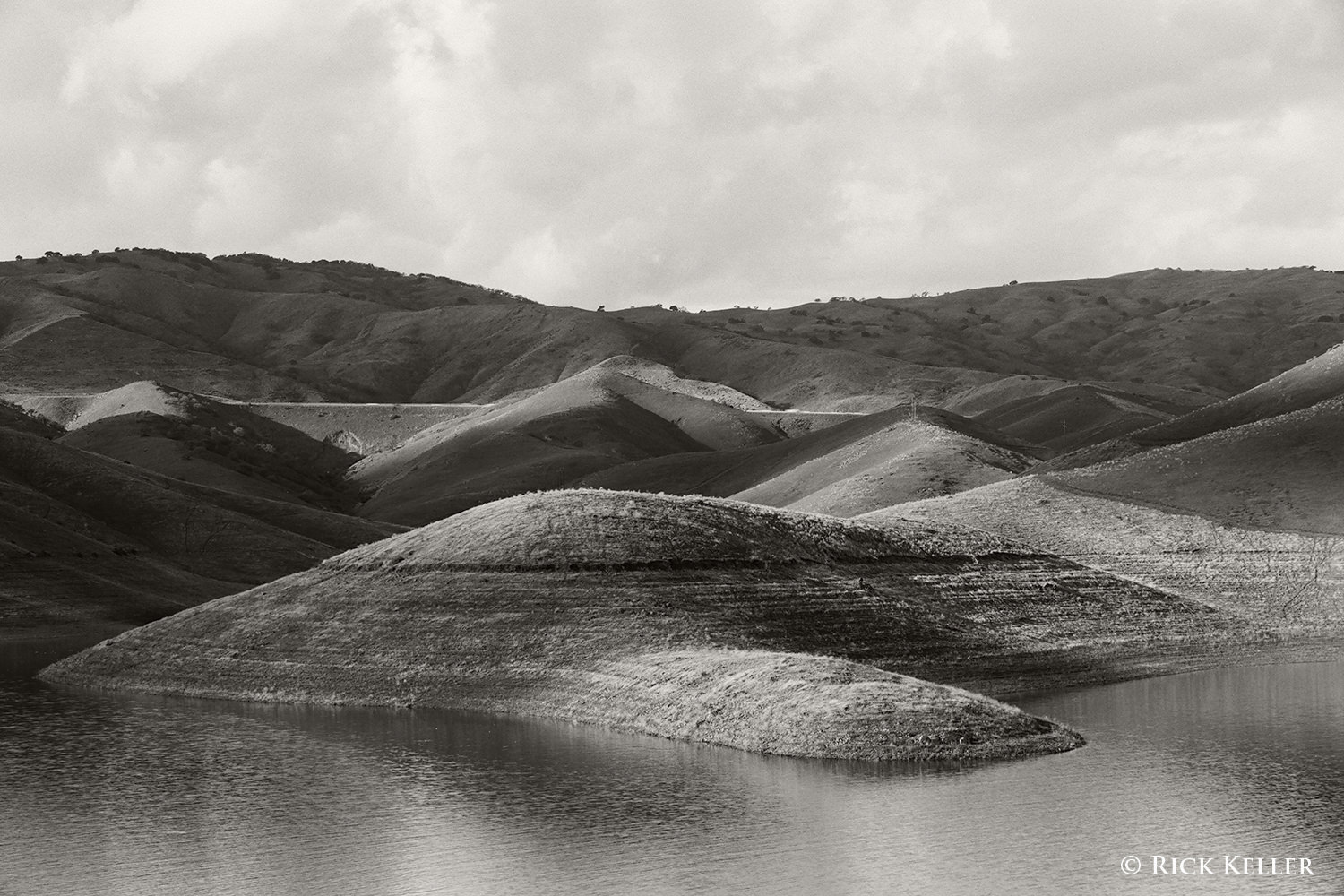
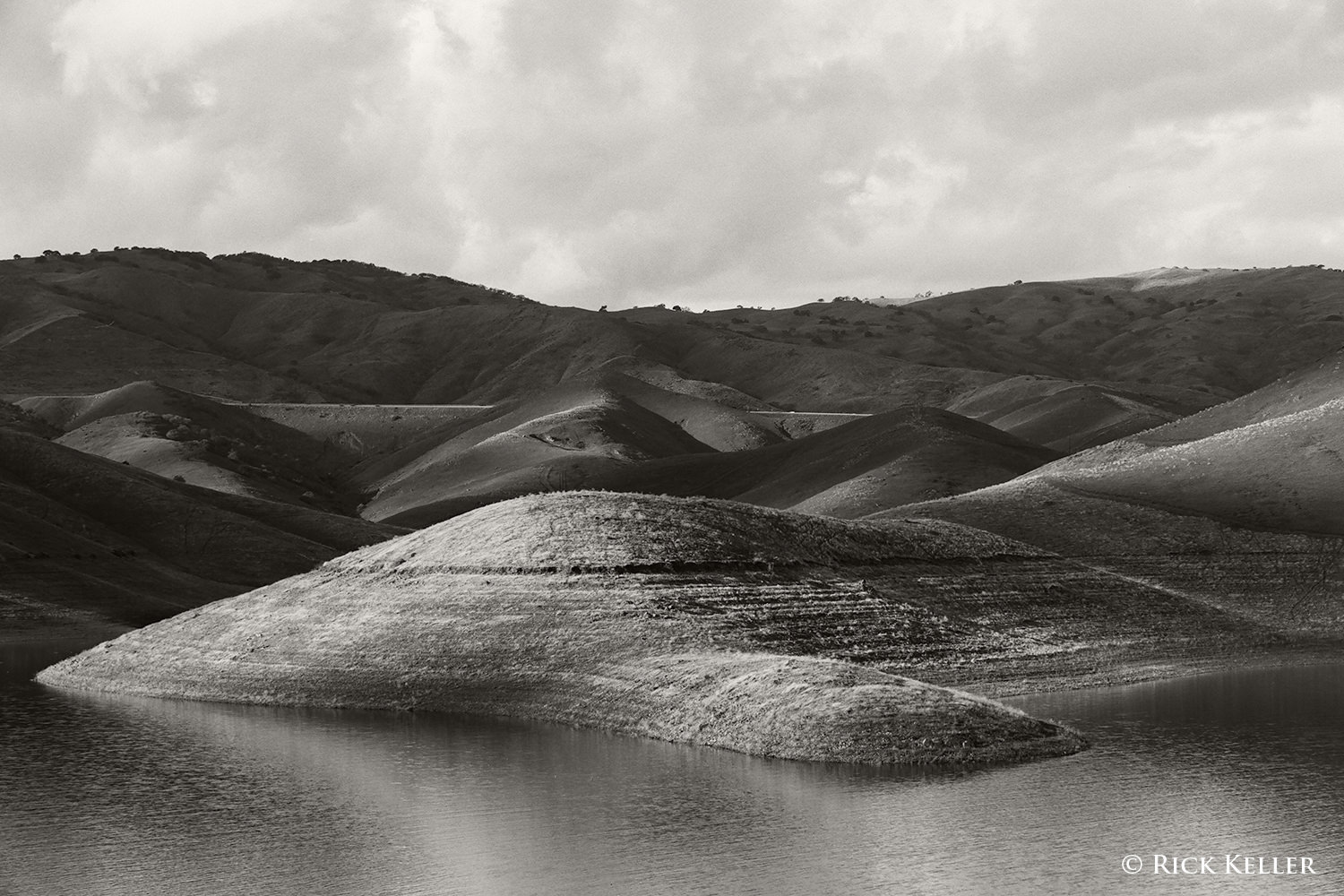
With these considerations in mind, let’s examine how cloud cover and its potentially dynamic nature can alter the quality of light and the mood of a landscape scene. Consider the following series of four photographs, all made in a single photo shoot in the late afternoon on a winter day in the U.S. with the sun at a relatively low angle in the sky. (Technical notes: Nikon F6, Nikkor 70-200mm f/4 G ED VR, Rollei Ortho 25, Hoya HMC polarizer)

69400013 - 1500 - Copy

69400014 - 1500 - Copy

694000150 - 1500 - Copy

69400017 - 1500 - Copy

First, please note the directionality of the light. From which direction is the incident light illuminating the landscape? What direction are the shadows being cast? Perpendicular to the lens? Toward the lens? Or away from the lens? Here, I chose one of my preferred qualities of light: unidirectional light from the side and slightly behind the landscape (oblique angle relative to the lens), which lends itself well to revealing textures, shape, and dimensionality. Secondly, please note the dense cloud cover. I had been scouting this site for the previous two weekends at the same time of the day. At that time the paucity of cloud cover yielded unfettered unidirectional light that was too intense and contrasty for what I visualized for my photograph; there were not enough shadows to impart the mood and dimensionality that I desired. So, as any determined landscape photographer would do, I patiently waited for the weather to change to obtain the desired cloud cover and quality of light. And I waited … and waited … until Mother Nature kindly provided a few rainy days. In my humble opinion, when bad weather arrives the time is now for the landscape photographer. I plan to have more thoughts on this special quality of light in a dedicated article soon, but an approaching and/or clearing storm can potentially create a special quality of light that can provide the landscape photographer with his most cherished tool and inspiration to capture the moment. It is a quality that you cannot adequately describe in words; you just have to be there to witness it and photograph with it. For this particular series of photographs, I waited until the storm front began to clear and the cloud cover to gently lift. Ultimately, I was blessed to have had cloud cover that was physically dynamic – changing form moment to moment, providing a beautiful quality of light with moderated intensity and dynamic shadows to paint the landscape. It was gorgeous!

Please, carefully study the above series by clicking on the first photo and using the toggle arrow at the right hand corner to scroll back and forth. Starting with the first photo, you can discern that the dense cloud cover had pockets that allowed some sunlight to bathe the landscape, creating a lovely series of alternating highlights and shadows that nicely revealed the textures of the grassy hills and imparted shape, dimension, and mood to the scene. As the clouds starting moving eastward and the pockets of light changed, the landscape evolved before the human eyes: a new set of shadows declared itself, revealing a new set textures, new shapes, and a different mood as the seconds elapsed. Every photograph in this series is different because the light and shadows are different. Herein lies the take home point of this article: it really is all about the light. My personal favorite photograph of this series is the third one, but that is a matter of taste and again highly dependent on the visualization process and what the photographer was feeling and seeing at the time of opening the shutter. This is what I love about landscape photography!

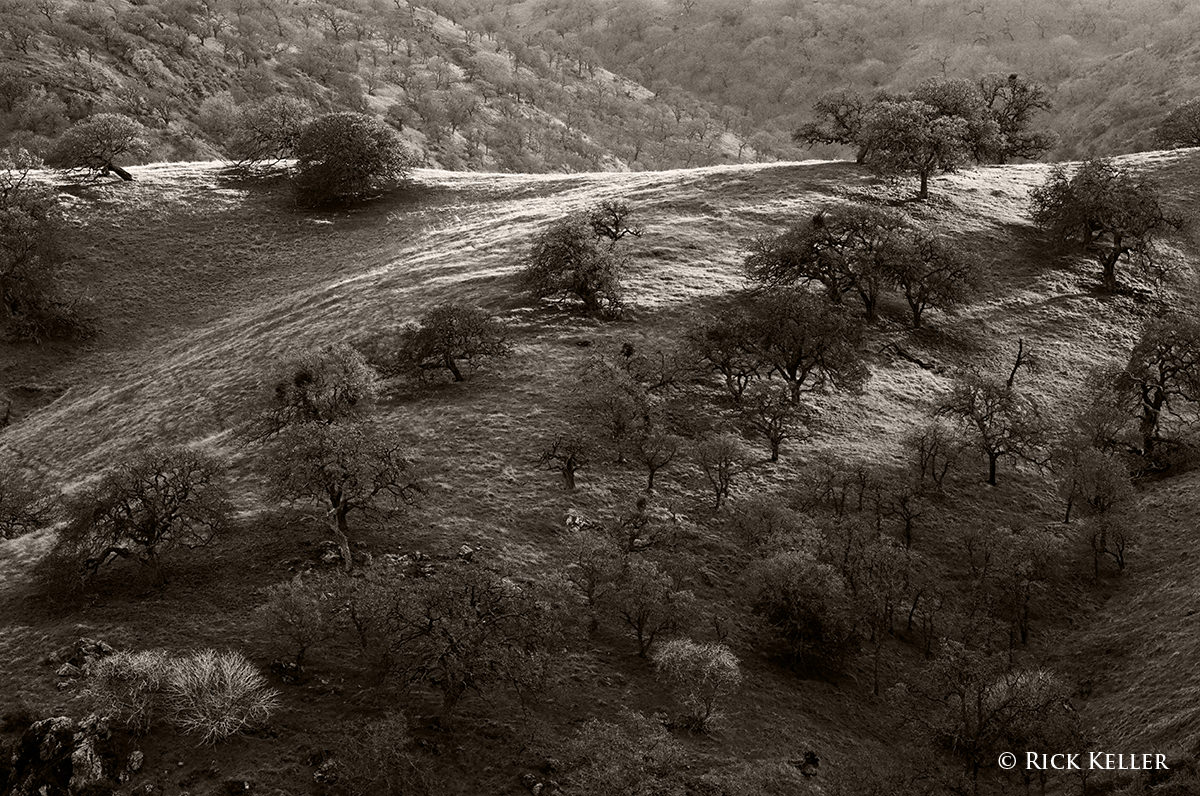
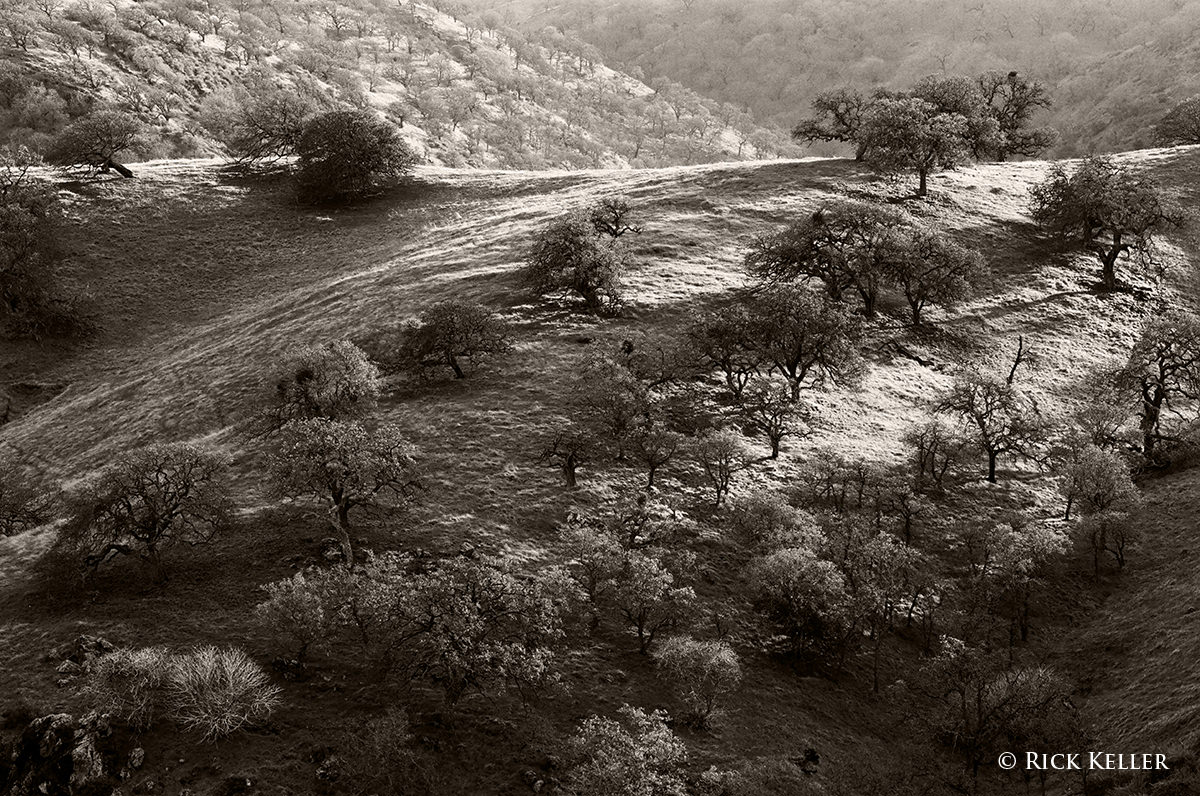
Next, let’s consider the following series of photographs made under similar circumstances: unidirectional light from both the side and back under rapidly changing cloud cover. As you scroll through these images, please note the change in the quality of the shadows, the textures, and the mood. The same subject . . . three different qualities of light . . . three different photographs. In my humble opinion, one of the great challenges of landscape photography is capturing the moment during rapidly changing light; yet this challenge also represents of its most enjoyable aspects. In this scenario, the photographer may potentially visualize a different composition, feel a different emotion and interpretation, and thus come away with a completely different photograph in a span of seconds to minutes, which I think is a beautiful experience. (Technical notes: Nikon F6, Nikkor 70-200mm f/4 G ED VR, Rollei Ortho 25, B+W MRC UV filter)

69400022 - 1200 - Copy

69400023 - 1200 - Copy

69400026 - 1200 - Copy

Next, I chose the following landscape photograph to share to reinforce the observations and principles of light already discussed as well as to share some of my personal reflections on Nature. The difference here is that I chose a subject with more simplicity and emotion.

75670001-1400 - Copy

Nikon F6, Nikkor 70-200mm f/4 G ED VR, Fujichrome Velvia 50, Hoya HMC 81C, Hoya HMC polarizer

A week before I made this photograph, I had scouted this scene under dense overcast skies. At the time, the scene had artistic potential in terms of the composition, but the light was uninspiring: even, diffuse, and devoid of patterns of highlights and shadows. Emotionally, the scene was cold, flat, and lifeless. Nonetheless, my imagination was captivated by the seemingly dead tree in the foreground with a backdrop of rolling hills and fog/mist. As I surveyed the scene, I felt that if the light were to be vibrant and inspiring then perhaps the tree and the mood of the scene may become also vibrant and lay the framework for an enticing image. Then came the most critical part of making this image: as I do with every single photo I make, I invoked the process of visualization. I studied the scene with my composing card. I made note of the desired perspective within the frame as well as the modifiers of light to the far right (bigger hills that would potentially obscure low angle incident sunlight). For the light, there was only option to fulfill the visualization: warm, unidirectional light from the side. I visualized a scene in color with the warm glow of light during the Golden Hour bathing the landscape (in particular the dead tree in the foreground) to impart life to a cold and lifeless scene. With these aesthetic considerations in mind, the choice of tools was manifest: color slide film and a long lens to frame the perspective. All I needed was for Mother Nature to deliver the goods. As the days and weather reports passed, I did not lose faith in this process. In my heart and mind, I needed to follow visualization and this inspiration to the very end. When the moment finally arrived, Nature did not disappoint. The beautiful glow of the Golden Hour light invigorated the landscape; the hills were revitalized; and an otherwise lifeless tree was once again born. Perhaps, a second chance, a fresh start, in life . . . Please, note the directionality of the light, the shadows, and the contrast. With light cloud cover in the vicinity of the sun, the light swept in low and at a right angle to the axis of the lens and unveiled lovely textures on the grassy hills, accentuated their contours, and imparted an illusion of depth. As the textures burgeoned, I felt as I could run my fingers through the blades of grass and feel the damp and soft textures of the grass on my bare feet … Minutes later, as the light ceased to bathe the landscape, the scene became lifeless and cold – devoid of texture, dimension, emotion, or intrigue. Mother Nature raised the curtains then lowered them on a scene visualized in the heart and mind of the artist. It was but one act of many in a series of light performances that are there for the taking. Yes … it is all about the light.

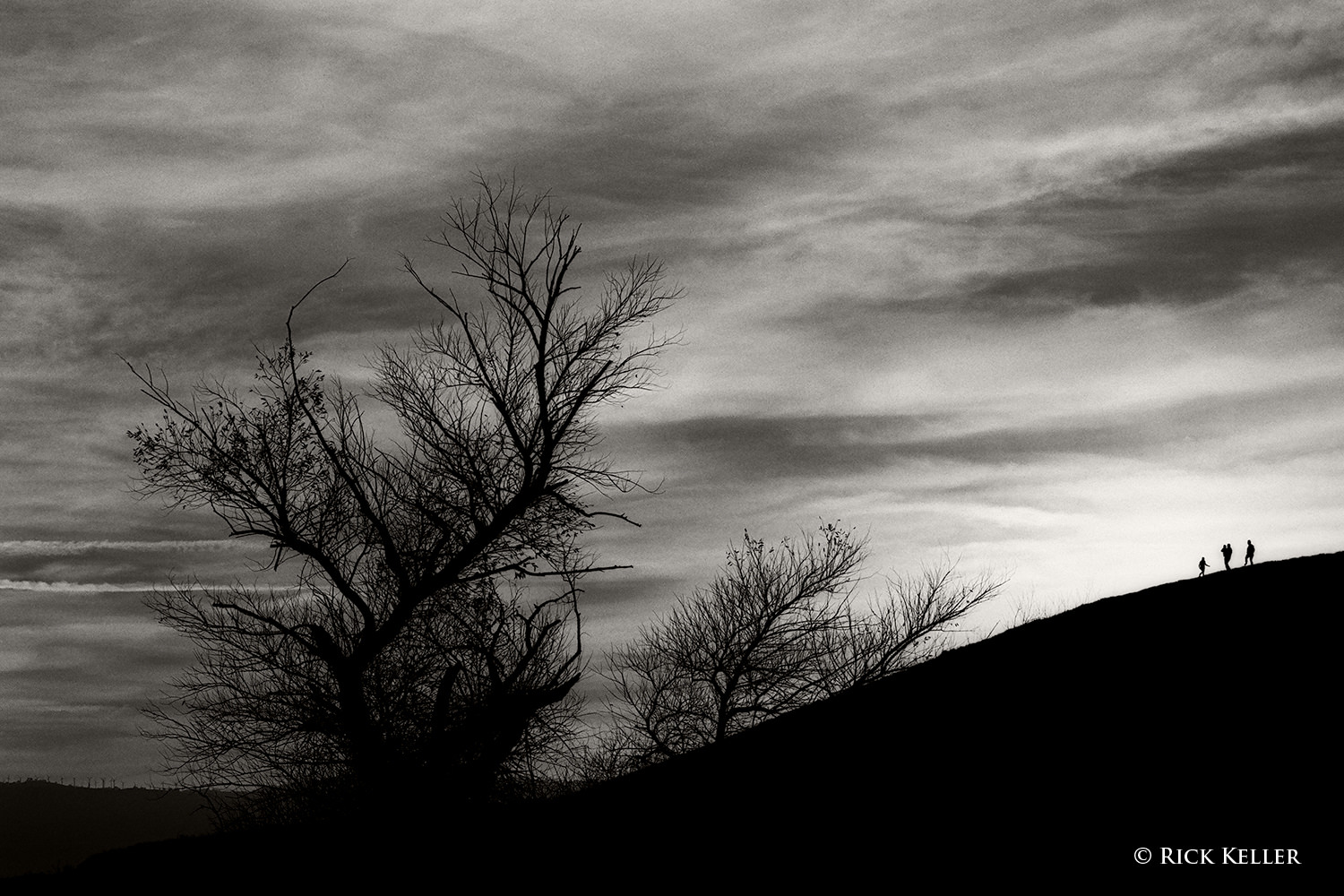
Next, let us explore once again the special mood conferred from backlighting and the silhouette effect. The choices of subjects (mountains, hills, trees, people, buildings) and compositions that the landscape photographer can visualize and craft with this quality of light are endless, which is why I gravitate to backlighting as one my most preferred tools. Consider the following photograph, which I made near the end of a delightful hike and photo shoot in the rolling hills of Central California. Interestingly, I neither scouted this subject, nor did I have time to visualize the photograph in advance. It was a serendipitous opportunity that presented itself when the light and the emotion just happened to be in harmony.

86600015 - 1500 - 2 - Copy

Nikon F6, Nikkor 70-200mm f/4G ED VR, Rollei Ortho 25, B+W MRC UV filter

As I have previously written, whenever I set forth on a landscape photo shoot, I do so with either one (or both) of two approaches in mind. Either I have a pre-determined subject that I have scouted and all that I require is for the desired light to materialize, or inspiring light has already declared itself but I do not yet have a well-defined subject in mind. Neither approach is mutually exclusive; yet every photograph I construct has one of these approaches as its foundation. As Galen Rowell often wrote and spoke about in his books, teachings, and interviews, once ‘magical’ light has materialized for the landscape photographer the artistic imperative becomes one of finding a subject to place within that light. Returning to the photograph, as my mind explored the trees, hills, contours, and directionality of the light, I was not yet inspired by a subject to make an exposure. With the retiring sun beaming through diffuse but thin cloud cover, a chilly breeze numbed my face and ears, and the mist of my breath billowed in all directions. Suddenly, among the distant hills I was stunned to see to a delightful family of four (adults, children) hiking in the distance. With the soft and warm light glowing on my face, I felt as if I could reach out with my hand and feel the light bathe my palm and collect the silhouetted human figurines in my hand. With the brooding silhouetted appearance of the foreground trees contrasting with the uplifting mood of the human element in the distance, at that moment I saw and felt my photograph and opened the shutter. It was a beautiful experience.

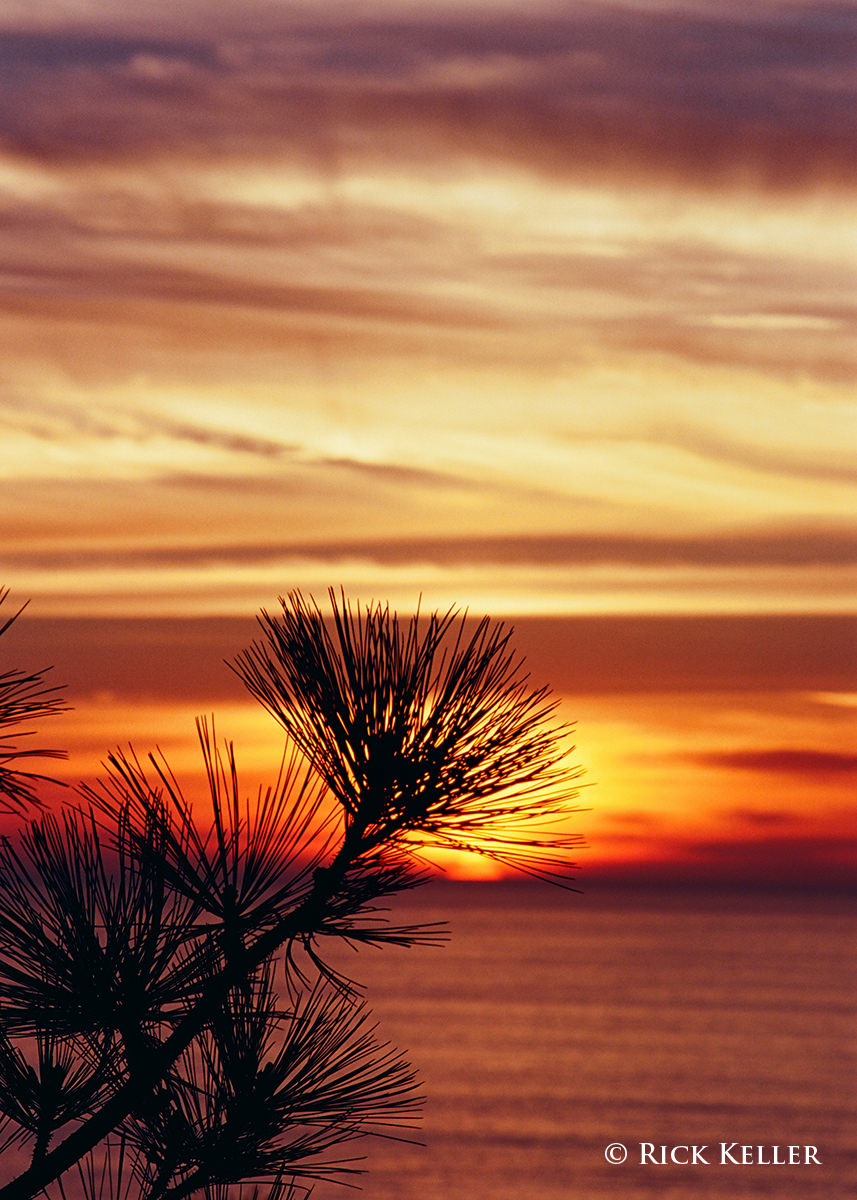
Finally, I chose this next photograph to once again illustrate my personal vision and interpretation of the intersection of light, directionality, color temperature, and emotion. Days before I made this exposure of a Torrey Pine, I had scouted this subject. I felt that if the light, cloud cover, and the mood were aligned, the potential was there to make a pleasing image that accentuates simplicity and harmony. I saw my image through my composing card (exactly as composed in the photograph below), but the light and the mood were uninspiring. So I waited . . . and contemplated … and dreamed … To fulfill the visualization, I chose the tail end of the Golden Hour to take advantage of the strong backlighting, silhouetting, and warmth of the sun melting into the ocean.

25810007 - 1200 - Copy

Nikon F6, Nikkor 70-200mm f/4G ED VR, Kodak Ektar 100, Hoya HMC 85C

To accentuate the radiance of the light that I had visualized, I used a strong warming filter to lower the color temperature. Please, note the textures of the clouds and on the surface of the water provided by the light sweeping across and toward the lens. Technically, to frame the scene as I had visualized it though my composing card, I used a long lens to isolate the subject. I selected the appropriate aperture for sufficient depth field (but not too much) to reveal enough creamy and soothing textures in the clouds and water; if I had chosen to pursue more depth of field, then too much detail would have been revealed in the water and clouds, potentially distracting the viewer’s eyes from the primary subject. There is no right or wrong in visualization, yet these considerations are one of the many joys of the ‘artist’s choice’ at the decisive moment. As I opened the shutter, the mood was uplifting, as I felt an emotion of peace and harmony at the conclusion of a glorious day. Seconds after I closed the shutter, the sun dipped below the horizon, and in an instant all textures on the water surface and the contrast between the silhouetted pine and the water disappeared. Another curtain raised and lowered on a magnificent performance by Nature. As Galen Rowell once said, we only get to witness only so many of these acts in our lifetime … Following the light to the edge was symbolic and exhilarating. The edge of a light performance, the edge of creativity, the edge of another glorious day of our short life on Earth. It was yet another beautiful experience.

Conclusions

Short and to the point: one tool, one imperative, the quintessence of the photographic and artistic process: it really is all about the light. In landscape photography, the prevailing cloud cover (especially if it is dynamic) can potentially modify the shadows and contrast to provide the photographer with the inspiration to visualize the photograph and the physical means to make the decisive exposure. A landscape photographer need not always have clouds to enjoy landscape photography or make a compelling photograph, but their presence can certainly make a positive impact on the aesthetic quality of the composition and potentially on the quality of the light; of course, it all depends on the photographer’s visualization process. Whether you are a landscape photographer or have an interest in other genres in photography, an important philosophy to bear in mind is that light, artistic vision, and the skill of the photographer are paramount to visualizing the photograph and making it a reality. As always, my best recommendations for my fellow beginning photographers are to study the light, allow yourself to be inspired by it, learn to manipulate the light, and use it creatively to translate your expressions and interpretations of the world as you feel and see it. More importantly, seize the day and have fun!

Special thanks to Northcoast Photographic Services for the film development services for these photos. Great job, Bonnie & Scott! Please, stay tuned for an upcoming article, “The Second Sunset”, where I will discuss and illustrate how this special phenomenon of light can capture the imagination of the artist and lend itself well to making spectacular scenic photographs.

All of these photographs are copyright protected. All rights reserved, Rick Keller © 2017. You may not copy, download, save, or reproduce these images without the expressed written consent of Rick Keller.

Suggested Reading

  1. Light For Visual Artists, Richard Yot.
  2. Mountain Light, Galen Rowell.
  3. Galen Rowell’s Inner Game of Outdoor Photography, Galen Rowell.
  4. The Quality of Light
  5. A Study In Light, Vision, and Shadows
  6. Construction of a Photograph: The Process of Visualization
  7. Visualization: The Hunt For The Light

The post A Study in Light, Directionality and Mood appeared first on Photography Life.


from Photography Life https://photographylife.com/a-study-in-light-directionality-and-mood

Tuesday, 21 February 2017

How to Properly Use and Care for Memory Cards

As photographers, we heavily rely on memory cards, because they store images captured by our cameras and we use them to transfer images to our computers / main storage. In some cases, photographers even rely on memory cards to be their secondary or tertiary backups when shooting in the field. The role of memory cards […]

The post How to Properly Use and Care for Memory Cards appeared first on Photography Life.


from Photography Life https://photographylife.com/how-to-properly-use-and-care-for-memory-cards

Sigma Does It Again – 4 New Lenses Announced!

Ever since Sigma decided to revamp its line of lenses with its “Art”, “Contemporary” and “Sport” editions, we have seen a number of innovative lenses from the company, some of which claimed the “world’s first” title. Sigma has been working hard on producing fast, high-performance and durable lenses for Nikon, Canon and Sigma mounts at […]

The post Sigma Does It Again – 4 New Lenses Announced! appeared first on Photography Life.


from Photography Life https://photographylife.com/sigma-does-it-again-4-new-lenses-announced

Monday, 20 February 2017

Hand-held Close-Up Photography

Many photographers enjoy exploring the world around them with macro and close-up photography. The basic difference between these similar genres of photography is the amount of magnification achieved, with a 1:1 magnification generally accepted as an example of macro photography. Images at this level of magnification also have more details than are achieved with close-up […]

The post Hand-held Close-Up Photography appeared first on Photography Life.


from Photography Life https://photographylife.com/hand-held-close-up-photography