Nighttime photography is something that a lot of photographers enjoy; I certainly do, along with countless others. Modern cameras can capture more detail at night than we can see with our naked eyes, revealing entire worlds that couldn’t exist otherwise. However, more than almost any other genre, night photography also challenges your camera equipment to its most extreme. In this article, I will go through some of the top lenses for Nikon cameras if you want to take pictures at night, including information about their low-light performance and depth of field. I cover 20 lenses in this article, so it’s pretty extensive — hopefully, you’ll learn something new about the equipment you need in order to capture good star and nighttime landscape photos.
This list doesn’t cover every lens made, and there certainly are some gaps in the lineup below. (For example, I don’t cover any lenses longer than 35mm, but some people like using longer focal lengths to stitch nighttime panoramas.) On balance, though, this does cover most of today’s common nighttime photography lenses.
These lenses are described assuming that you want sharp stars, without any star trails. That means that wide-angle lenses (which let you use longer shutter speeds without visible star movement) have priority. The ISO score for each lens takes into account both its maximum aperture and the longest shutter speed you can use without getting significant star trails.
Note: Before reading this article, in order to understand the “ISO score” and “full-frame equivalent ISO score” rankings, you’ll want to read my earlier article, which provides an explanation of what makes a good night photography lens. That article explains exactly how I find the ISO and depth of field values listed in the sections below, and it’s also useful if you aren’t familiar with topics like coma or crop-sensor ISO performance.
1) FX Cameras
Nikon’s FX cameras — and the full-frame cameras of other brands — are arguably the best tools on the market for nighttime landscape photography. Their sensors perform very well at high ISO values, and, more importantly, they offer a huge lineup of lenses that work well at night.
The lenses below are measured in terms of the ISO that they will allow you to use and still capture sharp star photos. Just like on your camera, a lower ISO value in this ranking system is better, since you’ll end up with less noise/grain in your images. Again, more information is available in our other nighttime photography lens article.
The lenses below aren’t ranked in any particular order. In fact, it isn’t possible to rank nighttime photography lenses at all, since all photographers will have different needs for their own work. With that in mind, let’s begin:
1.1) Nikon 14-24mm f/2.8
This lens is well-known for its nighttime performance. Shoot at f/2.8 and 14mm, and you’ll be able to get some very interesting shots.
There is no perfect nighttime photography lens, and the 14-24mm is a case in point. For example, f/2.8 is not the ideal aperture for nighttime photography. Something like f/2.0 allows in twice as much light, letting you use an ISO that is significantly lower.
On the other hand, 14mm and f/2.8 is just about the ideal intersection of ISO performance and depth of field. Sure, other lenses have a wider aperture, but this one can render a sharp image from 1.16 meters (3.8 feet) to the stars in a single photo. At night, that’s incredibly useful. With other lenses, if you want a large depth of field, you’ll need to focus stack — not something that is easy, or sometimes even possible, when it’s dark.
It doesn’t hurt that Nikon’s 14-24mm f/2.8 is also good for normal landscapes. It is quite sharp, even at f/2.8 in the corners, and is almost entirely free from coma.
However, it’s not perfect. This lens has very high levels of flare, appearing prominently when the moon is in your frame. Plus, the 14-24mm f/2.8 is heavy and expensive (though decent on the used market), deterring many potential buyers.
If you’re willing to spring for it, though, this is one of the most balanced nighttime photography lenses you can buy.
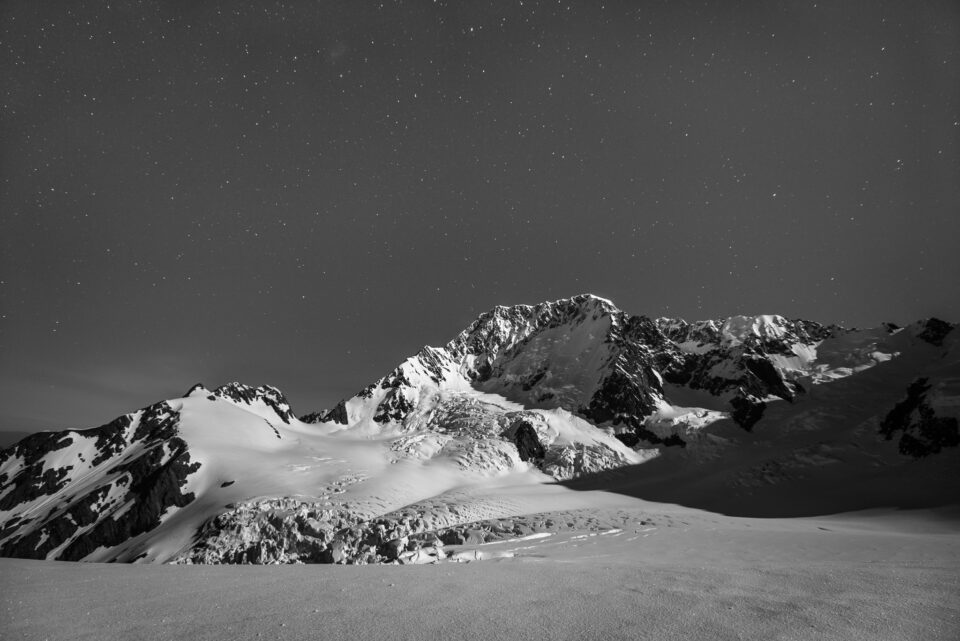
NIKON D800E + 14-24mm f/2.8 @ 14mm, ISO 200, 25/1, f/2.8
1.2) Tamron 15-30mm f/2.8
By most accounts (including our own review) the Tamron 15-30mm f/2.8 lens is on par with the Nikon 14-24mm f/2.8 in optical quality, if not slightly better. Specifically, the Tamron has less flare than the Nikon, while being even a bit sharper in the corners at wide aperture values — something that is particularly useful for nighttime photography.
Because their specifications are nearly the same, the Tamron and the Nikon require essentially identical ISO values for a proper exposure at night. Although the Nikon has a bit more depth of field, the two are so close that you’ll barely notice a difference.
The main negative of the Tamron is its weight. At 1100 grams, it’s even heavier than the Nikon, making it the heaviest ultra-wide lens for Nikon cameras on the market. It’s also not quite as wide as the Nikon; 14mm gives you noticeably more coverage than 15mm. Of course, in exchange, you’ll get the additional range from 25mm to 30mm, which the Nikon does not offer.
The Tamron’s retail price is $800 cheaper than the Nikon 14-24mm. For most photographers (unless you already own the Nikon), it’s the better choice.
1.3) Tokina 16-28mm f/2.8
Another similar lens is the Tokina 16-28mm f/2.8. It doesn’t have as long of a zoom range as the Tamron, but it makes up for that by costing less than half the price. At $580, this lens is a wonderful value.
As our review shows, the Tokina 16-28mm is a hidden gem. While not as sharp as the 14-24mm f/2.8 or 15-30mm f/2.8 at their widest apertures, this lens is a good choice if you want a nighttime photography zoom lens on a budget.
1.4) Nikon 24-70mm f/2.8E VR (as well as the older version and all third-party variants)
If nighttime photography is your primary goal, this lens shouldn’t be your top choice. At 24mm and f/2.8, it’s two stops darker than other lenses that cost far less money (such as the Samyang 24mm f/1.4 or the Sigma 20mm f/1.4).
However, a lot of people already own a 24-70mm f/2.8 lens, opening it up as a potential option. If you do have one of these lenses, should you purchase something different solely for nighttime photography?
Here’s the good news: with a 24-70mm f/2.8, you can take some very good nighttime photos as-is. This combination lets in enough light to capture stars that are still bright and clear, and most 24-70mm f/2.8 lenses have low levels of coma.
At the same time, if you keep taking nighttime photos, you’ll eventually want something more. Other nighttime lenses either have a greater depth of field (as is true for the ultra-wide f/2.8 zooms) or a brighter aperture (true for most of the prime lenses covered next).
There are enough 24-70mm f/2.8 lenses that I won’t go into detail on all of them here. Here are our reviews for the original Nikon 24-70mm f/2.8 and the newer Nikon 24-70mm f/2.8. We also reviewed the Tamron 24-70mm f/2.8 VC. Other options exist from Sigma and Tokina as well.
These lenses aren’t ideal for nighttime photography, but, if this is your widest f/2.8 lens, don’t shy away from using it at night; it is still a solid choice that can result in some fantastic photos.
1.5) Samyang 14mm f/2.8
- ISO score (widest aperture): ISO 3576
- Depth of field (widest aperture): 1.16 meters to infinity
- Weight: 552 grams, or 1.2 pounds
- Price: $330
- Purchase the Samyang 14mm f/2.8
This Samyang lens (identically sold under the brand names Rokinon, Vivitar, Bower, and many others) is a compelling option.
For starters, it has the same ISO score and depth of field as the Nikon 14-24mm f/2.8, since it’s also 14mm at f/2.8. Everything I said about the 14-24mm f/2.8 rings true here — it’s one of the best compromises between depth of field and necessary ISO that you can buy.
The Samyang is also $1570 less than the Nikon 14-24mm f/2.8’s retail price, as well as around half the weight. Not bad.
The downside, as with all Samyang lenses, is that you’ll have to focus manually. This isn’t an issue for most photos at night, since you’ll have to focus manually regardless of the lens you use. However, it could be a problem if you want to use this lens for general-purpose landscape photography during the day. Although I personally like using manual focus for some landscapes (magnified 100% in live view), autofocus is certainly convenient. For some photographers, in fact, it’s a necessity.
Like the Nikon, this Samyang has noticeable levels of flare but essentially no coma. It’s a sharp lens, and it works very well for photographers who don’t mind a lack of zoom or autofocus capabilities.
On balance, as a budget prime lens — and even compared to much more expensive options — this Samyang is one of the best options for nighttime photography available today.
1.6) Laowa 12mm f/2.8
- ISO score (widest aperture): ISO 3072
- Depth of field (widest aperture): 0.85 meters to infinity
- Weight: 609 grams, or 1.34 pounds
- Price: $950
- Purchase the Laowa 12mm f/2.8
This lens is very new to the market, but, at least on paper, it has the right specifications for nighttime photography.
At 12mm, it has a huge depth of field, even at the widest aperture of f/2.8. If you want to capture a landscape’s foreground at night, this is one of the best options available.
Unfortunately, there are some issues. For one, this lens has noticeable coma — more than the Nikon 14mm-24mm f/2.8 or the Samyang 14mm f/2.8. At $950, it’s also not a cheap lens, especially considering that it is manual-focus only. I think that most photographers will see the prices of this and the Samyang 14mm f/2.8 and pick the Samyang instead. I certainly would.
Of course, some photographers will find the 12mm focal length to be invaluable. That’s significantly wider than 14mm, meaning that you can capture more of the Milky Way in a single shot, as well as get a somewhat larger depth of field. For certain images, that could be the deciding factor.
Although the price and coma make this lens somewhat hard to recommend — especially given the cheap price and high quality of the Samyang 14mm f/2.8 — I can see some nighttime photographers buying it simply because of the incredibly wide angle.
1.7) Nikon 20mm f/1.8
The Nikon 20mm f/1.8 is another solid nighttime lens — in fact, by the light it allows, this one is almost a stop better than the 14-24mm f/2.8 or 15-30mm f/2.8 options (though it doesn’t have the same depth of field).
I’ve used the Nikon 20mm f/1.8 for nighttime photography for about a year, and I’ve found it to be an excellent performer. It’s sharp and has very low levels of flare, making for clean images at night, even when the moon is in your frame.
From what I’ve seen, though, this lens has noticeable coma in the corners at f/1.8. I end up stopping down to f/2.2 for some nightscapes, which sharpens things up a bit (at the cost of a higher ISO, of course). I don’t do this for every photo, though; it’s all a balancing act.
What makes this lens so appealing is its relatively low price and light weight. At $800, it isn’t exactly cheap, but it’s priced better than almost any other autofocus FX lens in this article. It’s also light enough to carry along without a problem, which is not something you can say of the f/2.8 zooms. If you have a medium-range budget, the 20mm f/1.8 should be near the top of your list.
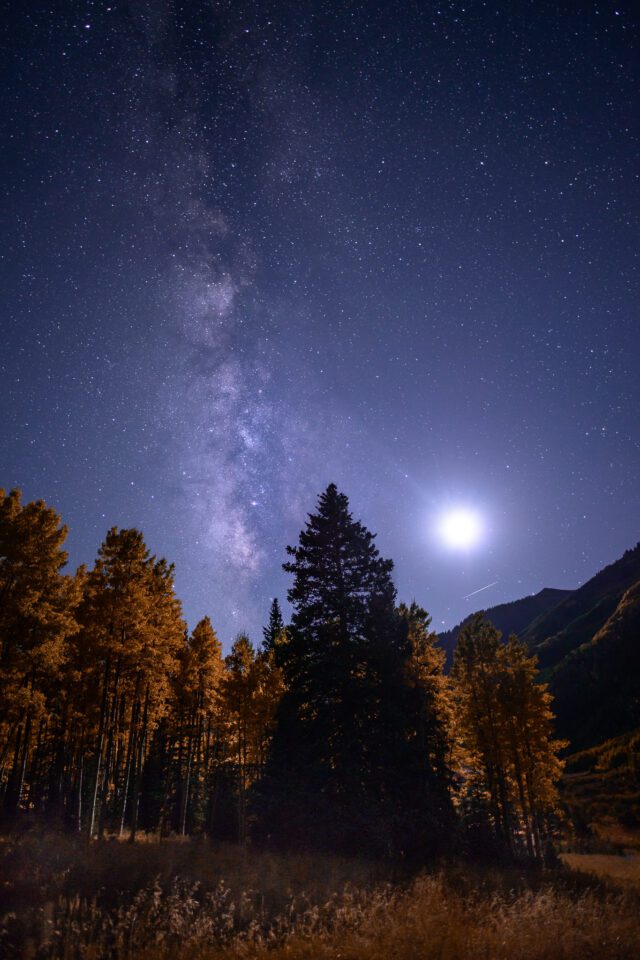
NIKON D800E + 20mm f/1.8 @ 20mm, ISO 1600, 15/1, f/1.8
1.8) Sigma 20mm f/1.4
- ISO score (widest aperture): ISO 1282
- Depth of field (widest aperture): 4.72 meters to infinity
- Weight: 950 grams, or 2.09 pounds
- Price: $900
- Purchase the Sigma 20mm f/1.4
This is a relatively new lens, as well as the one with the best ISO score on this list (which, as mentioned in our earlier article, is a measure of the noise you’ll get in a nighttime photo without blurry stars). In other words, you’ll be able to use a lower ISO with this lens than any other in this article, assuming that you shoot at its widest aperture setting on an FX camera.
Since it is the widest f/1.4 lens available for Nikon cameras, this was likely a huge challenge for Sigma to design (which normally would suggest a lower optical quality). Despite that, it’s a very good lens. There is some noticeable coma in the corners at f/1.4, though, so you may want to stop down to f/1.8 or f/2. It’s similar to the Nikon 20mm f/1.8 in this department.
The main issues with the Sigma are its weight and lack of a filter thread. This lens weighs almost a kilogram (more than two pounds), which is about three times as heavy as the Nikon 20mm f/1.8. And, if you want to use filters, you’ll have to purchase a large and expensive holder, as well as bigger filters than normal, since the front element of this lens is pretty large.
For many people, the Nikon 20mm f/1.8 will be a more practical choice. However, if nighttime photography is your main focus, the Sigma’s large f/1.4 aperture still holds a clear advantage. For photographers who care more about light transmission than depth of field, this is perhaps the best lens available today for nighttime photography.
1.9) Any 24mm f/1.4
- ISO score (widest aperture): ISO 1534
- Depth of field (widest aperture): 6.8 meters to infinity
There used to be just one option if you wanted a 24mm f/1.4 lens — Nikon’s own version. Now, there are two others: the Sigma 24mm f/1.4 and the manual-focus Samyang 24mm f/1.4.
Of the three, the Samyang has the least coma, which means that you will get the sharpest stars in the corner of your frame. However, the differences aren’t as favorable to the Samyang as you might think; in fact, the Nikon and Sigma lenses are clearly sharper than the Samyang if you aren’t photographing stars (even at f/1.4).
The Nikon 24mm f/1.4 lens is one of Nikon’s sharpest wide-angles, as our review covers. The Sigma, though, doesn’t just hold its own — it’s actually a bit sharper than the Nikon version. Although both of these lenses have clear coma at f/1.4, either is still a good choice for nighttime photography simply due to the large aperture. If the coma is objectionable in a particular shot, you can always stop down by 1/3 or 2/3 of a stop.
The three lenses are roughly the same weight: 620 grams for the Nikon, 665 grams for the Sigma, and 680 grams for the Samyang. This isn’t enough difference here to worry.
In terms of price, though, things are more interesting. The Samyang is $500, the Sigma is $850, and the Nikon is $2000 (though significantly less on the used market).
Don’t forget that the Samyang lens is manual focus. That’s fine for nighttime photography, where you’ll be focusing manually most of the time, but it’s not ideal for work during the day.
If your only goal is nighttime photography, and price is a factor, the Samyang is a wonderful value. It’s the least expensive lens on this list, as well as the one with the lowest coma. However, if you want to take pictures during the day or with autofocus, the Sigma should be your choice instead (and, other than the coma issue, is a better lens optically).
Although the Nikon is a wonderful lens, you don’t need to pay $2000 to get a good 24mm f/1.4, so it is hard to recommend unless you already own it.
1.10) Nikon 24mm f/1.8
This lens doesn’t have quite as wide an aperture as a 24mm f/1.4, but that doesn’t mean you should overlook it.
In fact, Nikon’s 24mm f/1.8 is one of their all-around best prime lenses for landscape photography, given its light weight and great performance. We covered all this in our review, but there are very few wide-angle primes that match the Nikon 24mm f/1.8’s image quality.
For nighttime photography, this lens does have some coma — slightly better than the performance of the 20mm f/1.8, but still not great. However, this is true of every lens in this article at f/1.8. The other problem is depth of field. Although it’s not horrible, a depth of field from 5.4 meters (17.7 feet) to infinity is noticeably worse than other lenses in this article. If you have any nearby objects in your foreground, they’ll be blurry.
If you are interested in the 24mm focal length rather than something like 14mm (perhaps for general photography as well as nighttime photography), it is hard not to recommend this lens. Although it doesn’t let in as much light as one of the 24mm f/1.4 lenses, it still lets you use very low ISOs at night. Its light weight and high optical quality should not be overlooked.
1.11) Sigma 35mm f/1.4 Art (and other brands’ variants)
At this point, the Sigma 35mm f/1.4 has acquired a reputation as one of the best 35mm lenses available today. Although others can potentially challenge this reputation (such as Nikon’s 35mm f/1.8, discussed below), it certainly shows that the Sigma is a great piece of equipment.
However, for nighttime photography, it would be far from my top choice. The problem here isn’t the ISO that you can use; in fact, the Sigma’s wide aperture means that you can use a relatively low ISO and still capture a bright image. Instead, the problem is depth of field. At its largest aperture of f/1.4, the Sigma is only sharp in the range from 14.5 meters (48 feet) to infinity (using a very generous depth of field measure, as explained in section four of my earlier nighttime photography article).
If you’re trying to capture a distant mountain, this won’t be a problem — both the mountain and the stars can be sharp in a single image. However, if you try to include anything in your foreground, it will simply be out of focus. As mentioned earlier, you can always try focus stacking, but, at night, that can be incredibly difficult.
You may already own the Sigma 35mm f/1.4, or a 35mm f/1.4 of a different brand. If so, don’t be discouraged from using it for nighttime photos. However, if you’re looking to buy a lens specifically for star photography, there are better options on the market.
1.12) Nikon 35mm f/1.8 ED (and other brands’ variants)
This is a great lens, but, like the 35mm f/1.4, it’s not really intended for nighttime photography.
On one hand, nothing in the photo will be sharp unless it’s 11.5 meters away from the lens (38 feet) or farther. That doesn’t give you much of a foreground. And, since it requires an ISO of 3701, it’s one of the lower-ranked prime lenses in this article.
Again, though, if you already own this lens, you certainly can use it for nighttime photography. You’ll actually get relatively clean images; the main problem, as with the 35mm f/1.4 lenses, is depth of field. Unless all of your subjects are far away, this lens won’t let you take particularly sharp nighttime photos. Other options are better if nighttime photography is your primary goal.
2) DX Cameras
Crop-sensor cameras — including Nikon’s DX lineup — are not necessarily known for their nighttime photography prowess. They’re about a stop noisier than Nikon’s FX cameras, and they don’t have the same extensive lens lineup for star photography. Nevertheless, you still can capture nighttime photos successfully with a DX camera.
The FX lenses listed above, for example, still tend to be good lenses for DX cameras. Something like the Nikon 20mm f/1.8 or Sigma 20mm f/1.4 remains a very good choice. However, some DX-specific lenses have the potential to work just as well, or potentially better.
Note: The “full-frame equivalent ISO score” does not represent the actual ISO you should set while taking pictures. Instead, it’s a way to compare the amount of noise to that of a full-frame camera. In other words, you may be shooting at ISO 1600 with your DX camera, but the noise levels will be equivalent to ISO 3200 on an FX sensor. That’s why some of the values below are so high. Again, for more information, read the earlier article on nighttime photography.
2.1) Samyang 16mm f/2.0
- Full-frame equivalent ISO score (widest aperture): ISO 6163
- Depth of field (widest aperture): 3.41 meters to infinity
- Weight: 571 grams, or 1.26 pounds
- Price: $420
- Purchase the Samyang 16mm f/2.0
As a brand, Samyang does a good job creating nighttime photography lenses, both for full-frame and crop-sensor cameras. Their 16mm f/2.0 lens, for example, is one of the most popular nighttime photography lenses available for DX cameras.
Equivalent to a 24mm f/2.8 lens on a full-frame camera (in terms of depth of field and the noise in your photo), this lens is a great way to test the waters of nighttime photography. Although it doesn’t quite match the noise performance of a full-frame camera, you’ll be able to capture fairly clean images of the night sky, which is all that really matters.
This lens is manual-focus only, which can be problematic for daytime shots, but that isn’t an issue at night (since you’ll be focusing manually regardless). On top of that, the 16mm f/2.0 is a solid value at $420.
Combined with an entry-level DSLR like the Nikon D3400, this is one of the most affordable ways to get good nighttime photos.
2.2) Tokina 11-20mm f/2.8
- Full-frame equivalent ISO score (widest angle, widest aperture): ISO 8160
- Depth of field (widest angle, widest aperture): 1.07 meters to infinity
- Weight: 560 grams, or 1.23 pounds
- Price: $600
- Purchase the Tokina 11-20mm f/2.8
One of the most popular choices for nighttime photography with a DX camera is the Tokina 11-20mm f/2.8, as well as its variants (the 11-16mm f/2.8 lenses). At 11mm and f/2.8, this lens will allow you to take nighttime photos with a large depth of field — something that isn’t easy with most other options.
However, in terms of the light you can capture at night, this 11-20mm f/2.8 is equivalent to a 16-30mm f/4.0 lens on a full-frame camera. There’s a reason I excluded Nikon’s 16-35mm f/4.0 from the prior section: it simply doesn’t let in much light.
With DX cameras, though, you have to relax your standards somewhat. Compared to most of the other options available, this lens actually works quite well for nighttime photography. You won’t get full-frame image quality, but you’ll be able to capture the stars and Milky Way better than with most other crop-sensor equipment on the market.
2.3) Tokina 14-20mm f/2.0
- Full-frame equivalent ISO score (widest angle, widest aperture): ISO 5128
- Depth of field (widest angle, widest aperture): 2.37 meters to infinity
- Weight: 725 grams, or 1.60 pounds
- Price: $600
- Purchase the Tokina 14-24mm f/2.0
This is a very interesting lens, and not one that is particularly well-known. For nighttime photography with a DX camera, though, it ranks near the top.
What makes the 14-20mm f/2.0 so odd is its limited zoom range. This lens is only for crop sensors, making it a 21-30mm full-frame equivalent. That’s not much. It feels like Tokina simply could have created a 14mm f/2.0 prime lens instead (saving additional weight and cost), although some people certainly will find the slight zoom to be useful.
For general landscape photography, there is very little reason to purchase this lens rather than the 11-20mm f/2.8. With the 11-20mm, you’ll get a longer zoom range at exactly the same price, and both lenses perform well optically.
However, if you are interested in a dedicated astrophotography lens, this 14-20mm is a better choice. Its wide aperture lets you use a relatively low ISO, but it still offers a very good depth of field and a high image quality standard. Not a bad lens by any means.
2.4) Sigma 18-35mm f/1.8
As the widest-aperture zoom lens available for DX cameras, it’s no surprise that the Sigma 18-35mm f/1.8 made this list. It is well-known for its optical quality, even at f/1.8, which makes it one of the better nighttime options for a crop-sensor Nikon body.
However, if stars are the only thing you want to photograph, you might consider simply getting the Nikon 20mm f/1.8 instead. It’s the same aperture and almost the same focal length, yet costs and weighs significantly less (not to mention that it can be used on FX cameras as well).
If you are more interested in a zoom, though, this is a great option. The 18-35mm zoom range is not particularly large, but it’s certainly welcome if you plan to do daytime photography as well.
2.5) Any 17-55mm f/2.8
- Full-frame equivalent ISO score (widest angle, widest aperture): ISO 14,303
- Depth of field (widest angle, widest aperture): 2.56 meters to infinity
A lot of manufacturers make 17-55mm f/2.8 lenses for Nikon (or 16-50mm, 17-50mm, 18-50mm, and so on). There are worse lenses for astrophotography, but there are far better ones as well.
I used Nikon’s own 17-55mm f/2.8 lens for about a year, and I had moderate success shooting some star photos with it. However, you’ll be left wanting more.
The problem with these lenses is simply a lack of light. You’re shooting a full-frame equivalent of a 28mm f/4 lens, which doesn’t really compete against other options out there. You’ll either need to use a high ISO or brighten things significantly in post-production. However, it can still be done, as the image below demonstrates:
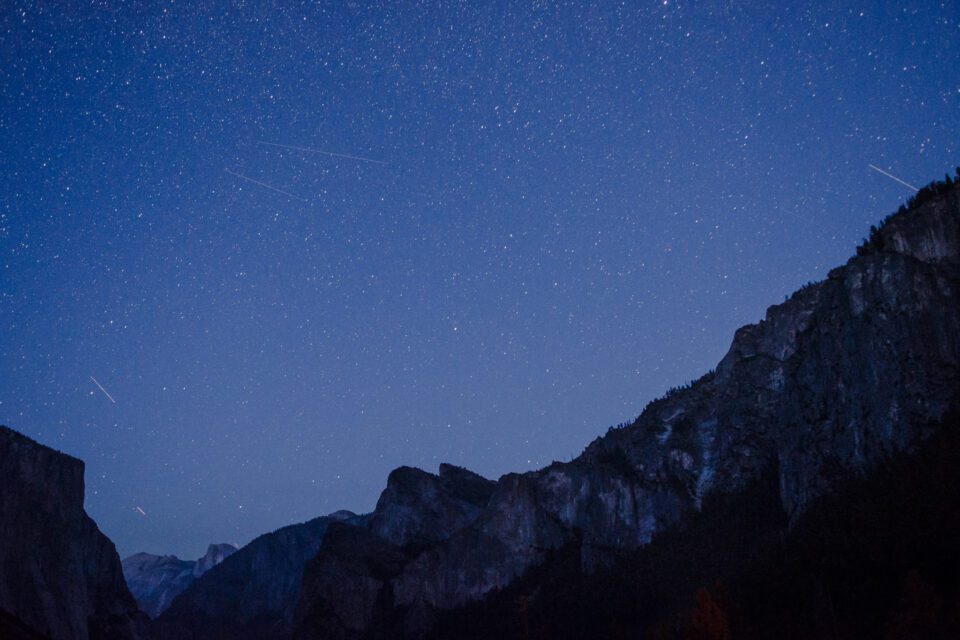
NIKON D7000 + 17-55mm f/2.8 @ 18mm, ISO 1250, 20/1, f/2.8
2.6) Any 18-55mm f/3.5-5.6
- Full-frame equivalent ISO score (widest angle, widest aperture): ISO 18,482
- Depth of field (widest angle, widest aperture): 2.28 meters to infinity
For astrophotography, 18-55mm f/3.5-5.6 lenses are noticeably worse than the 17-55mm f/2.8 lenses, which weren’t great in the first place.
You’ll be pushing your ISO very high (in the ISO 8000 to 10,000 range), equivalent in noise performance to roughly ISO 18,000 on a full-frame camera. Not great.
However, if you own an 18-55mm f/3.5-5.6, you can still get star photos — they’ll just be grainier than you may want. Don’t let that discourage you from taking pictures at night. The 18-55mm f/3.5-5.6 lenses will give you a taste of astrophotography, which makes it easy to tell if this is something you want to continue doing.
3) Conclusion
There is no one “best” lens for nighttime photography. Each one has its pros and cons, and different photographers will find some lenses better than others for the work they do.
If you want a large depth of field at night, as well as a general-purpose landscape photography zoom lens, the Nikon 14-24mm f/2.8 and Tamron 15-30mm f/2.8 are among the best options available today. Or, if you’re on a tighter budget, the Tokina 16-28mm f/2.8 should be high on your radar.
Other photographers — those who want a lens solely for nighttime photography — will find a lot of value in the Samyang 14mm f/2.8 lens. It focuses manually, but it’s a sharp lens that only costs $330, making it perhaps the best value in this entire article.
At the same time, some photographers will prefer a lens that prioritizes a large aperture rather than offering a large depth of field. If that sounds like you, take a look at something like the Sigma 20mm f/1.4; at its widest aperture, it allows you to take star photos at lower ISO values than anything else on the market. Or, if you want to save weight and use filters, Nikon’s 20mm f/1.8 is another good option.
Finally, if you have a DX camera, lenses like the Samyang 16mm f/2.0 or Tokina 14-20mm f/2.0 also can help lead to some spectacular images at night. This article isn’t a complete list (so feel free to mention other possibilities in the comments section), and it already covers twenty lenses!
As you can see, there’s no shortage of options for nighttime photography. Even if you don’t have one of these lenses yourself, you should still go out and experiment. It’s fun to take pictures of stars, and you’ll come back understanding which options fit your personal needs the best.
The post The Best Night Photography Lenses for Nikon Cameras appeared first on Photography Life.
from Photography Life https://photographylife.com/the-best-night-photography-lenses-for-nikon-cameras